


Log management is an important component of DevOps practices, allowing programmers and project managers to gain insights, troubleshoot issues, and create reliable software.
This tutorial will provide DevOps developers with a foundational understanding of log management principles, processes, and tools commonly used in software development environments. By using log management practices, developers can collect, analyze, and utilize logs to improve application performance, find errors, and enhance overall software monitoring.
Jump to:
- Overview of log management
- Benefits of log management for DevOps developers
- Log management concepts
- Log management tools for DevOps developers
- Best practices for log management in DevOps
Overview of log management
As a process, log management is the collection, storage, analysis, and use of logs generated by software systems and tools. Logs capture important events, errors, and performance metrics, giving developers valuable insights. In a DevOps environment, the focus of log management is on centralizing and standardizing log data to create efficient monitoring, troubleshooting, and performance optimization.
Benefits of Log Management for DevOps Developers
There are several noteworthy benefits to implementing log management for DevOps developers, including:
- Troubleshooting and debugging: Logs help identify the root causes of issues, helping developers find and fix errors more quickly.
- Performance optimization: Analyzing logs can highlight performance bottlenecks and opportunities to optimize code, leading to enhanced application performance.
- Proactive monitoring: Log analysis enables proactive monitoring, allowing developers to identify anomalies and take preemptive actions.
- Security: Logs contain valuable data for security monitoring, conducting audit trails, and ensuring compliance.
- Application insights: Logs provide insights into important metrics such as user behavior, application usage patterns, and trends, all of which support solid, data-driven decision-making practices.
Log management concepts and principles
Below are some basic log management concepts and principles you will need to understand to effectively manage logs.
Log types
Logs can be categorized into several types, including application logs, system logs, security logs, and network logs. As their names suggest, they are generated from different sources, such as servers, applications, databases, and network devices.
Log aggregation
Log aggregation is the process of collecting logs from various sources into one centralized repository for management and analysis. Log aggregation lets developers and PMs search logs, filter results, and correlate data against performance. For instance, if server load increases during certain periods of the day and a web application slows down during this same time, DevOps engineers can surmise that more resources are needed.
Log parsing and filtering
Log parsing is the extraction of relevant data from logs by interpreting log formats and retrieving structured data. Log filtering lets developers focus on specific log entries based on predefined criteria, such as severity, keywords, or custom-defined metrics.
Log storage
Log storage involves figuring out appropriate storage mechanisms, taking into consideration factors like scalability, performance, and cost. Log retention policies define how long logs need to be stored based on regulatory requirements, compliance, and historical analysis needs.
Log analysis
Log analysis revolves around examining log data to identify patterns, anomalies, and performance issues. Visualization tools and techniques, like charts, graphs, and dashboards, help developers and team leads understand log data from a visual perspective.
Log management tools for DevOps developers
Below are a few of the best log management tools for DevOps developers, including ELK Stack, Splunk, Graylog, and Fluentd.
- ELK Stack (Elastic search, Logstash, and Kibana) is a popular open-source log management solution for DevOps. Elasticsearch is a distributed search and analytics engine that stores and indexes logs. Logstash is a logging and processing tool that collects, filters, and transforms logs before sending them to Elasticsearch. Kibana, meanwhile, is a web-based visualization tool that provides a user-friendly interface for log analysis and data visualization.
- Splunk is a solid choice for a commercial log management platform. It features powerful search, analysis, and visualization capabilities. It also offers real-time monitoring, alerting, and AI/machine learning insights. Splunk supports multiple data sources, including logs, metrics, and events, and offers a nice set of features for log management and analysis.
- Graylog is another open-source log management and analysis tool that provides centralized log collection, processing, and storage. It supports multiple log sources, and its web interface is excellent for searching, filtering, and visualizing log data. Graylog also features alerting, custom dashboards, and plenty of plugins for added functionality.
- Fluentd is an open-source log collection and forwarding tool. Its primary focus is on log aggregation and log routing from different sources to multiple destinations, including storage systems, databases, and log analysis tools. Fluentd offers support for many log formats and provides flexibility in log processing and integration with other log management software.
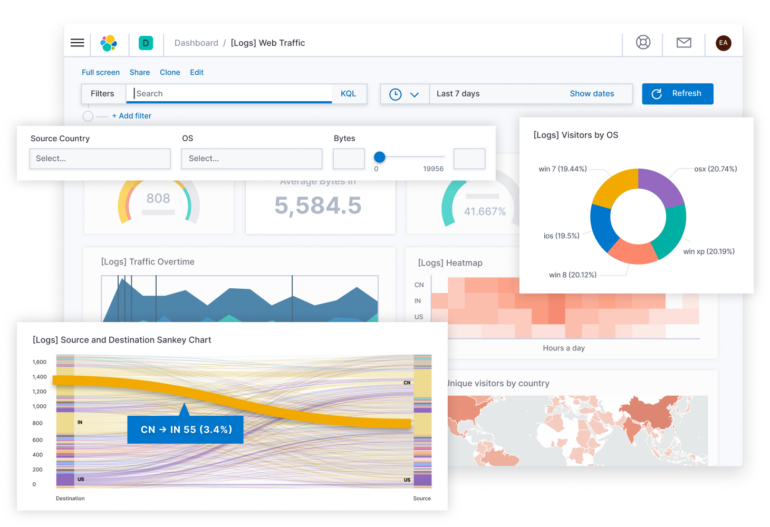
Example of ELK Stack Log Management
More DevOps coverage
- Best DevSecOps Tools
- Top DevOps Certifications
- Hiring kit: DevOps engineer
- Agentic AI’s Role in the Future of AppSec
Best practices for log management in DevOps
In order to facilitate effective log management measures in a DevOps environment, consider the following log management best practices:
- Define logging standards: Create clear guidelines for log formats, severity levels, and structured data logging for better consistency and ease of analysis.
- Centralized log collections: Create a centralized log collection mechanism to gather and aggregate logs from various sources. This facilitates easy access and analysis.
- Utilize log rotation and retention policies: Create log rotation schedules and retention periods based on the needs of the project, compliance, analysis, and available storage.
- Log enrichment: Enhance logs by adding contextual information, including timestamps, hostnames, user IDs, and transaction IDs to aid in log analysis and troubleshooting.
- Log parsing and filtering: Log parsing and filtering techniques help developers retrieve relevant information, reduce noise, and focus on important log entries for better analysis.
- Monitor log anomalies: Create alerting triggers to detect and notify of any anomalies in log patterns, error rates, or security-related events.
- Use log data visualization tools: Use log visualization tools to create dashboards, charts, and graphs that show real-time insights into log data and trends.
- Monitoring and alerting integrations: Be sure to integrate log management tools with monitoring and alerting systems to correlate and corroborate log events with performance metrics and set up triggers for proactive actions to mitigate risks.
- Regularly review and analyze logs: Schedule regular, frequent log reviews to identify patterns, trends, and performance issues, and use the insights gathered to optimize application performance.
Final thoughts on log management
Log management is an important element of DevOps practices, enabling developers, engineers, operations, and project managers to effectively collect, analyze, and utilize logs for troubleshooting, performance optimization, and monitoring.
By understanding key logging concepts, leveraging log management tools, and following best practices, DevOps developers can gain valuable insights from log data, enhance application reliability, and improve overall application performance. Implementing strong log management practices contributes to better problem-solving, proactive monitoring, and informed decision-making in the DevOps lifecycle.