


Alibaba has launched Qwen3, a family of large language models (LLMs) that the company describes as a significant milestone in the journey toward artificial general intelligence (AGI) and artificial superintelligence (ASI). The models introduce hybrid reasoning and support more than 100 languages, marking a significant step forward in multilingual AI.
The lineup features eight models, all available globally as open source. With dynamic switching between “thinking” and “non-thinking” modes, Qwen3 is positioned to rival today’s top-performing AI systems.
A closer look at Qwen3
The Qwen3 models are designed to advance hybrid reasoning, multilingual support, and agentic abilities. The series includes six dense models and two Mixture-of-Experts (MoE), ranging from 0.6 billion to 235 billion parameters. But beyond the impressive scale, what are Qwen3’s core features?
Hybrid reasoning and mode switching
Qwen3 uses a dual-mode system that lets users toggle between “thinking mode” for complex reasoning and code tasks, and “non-thinking mode” for fast responses and general conversations. This flexibility allows users to optimize for depth or speed depending on the task, ensuring efficient use of computational resources.
Advanced agent abilities
The AI models exhibit advanced agentic capabilities, integrating seamlessly with external tools in thinking and non-thinking modes. Qwen3 can execute complex, tool-augmented tasks with precision, establishing it as one of the most capable open-source models in agent-based applications.
Extensive multilingual support
Qwen3 supports 119 languages and dialects and is built for global accessibility. Its robust multilingual capabilities enable high-quality instruction following and translation across various linguistic contexts.
Top-tier benchmark performance
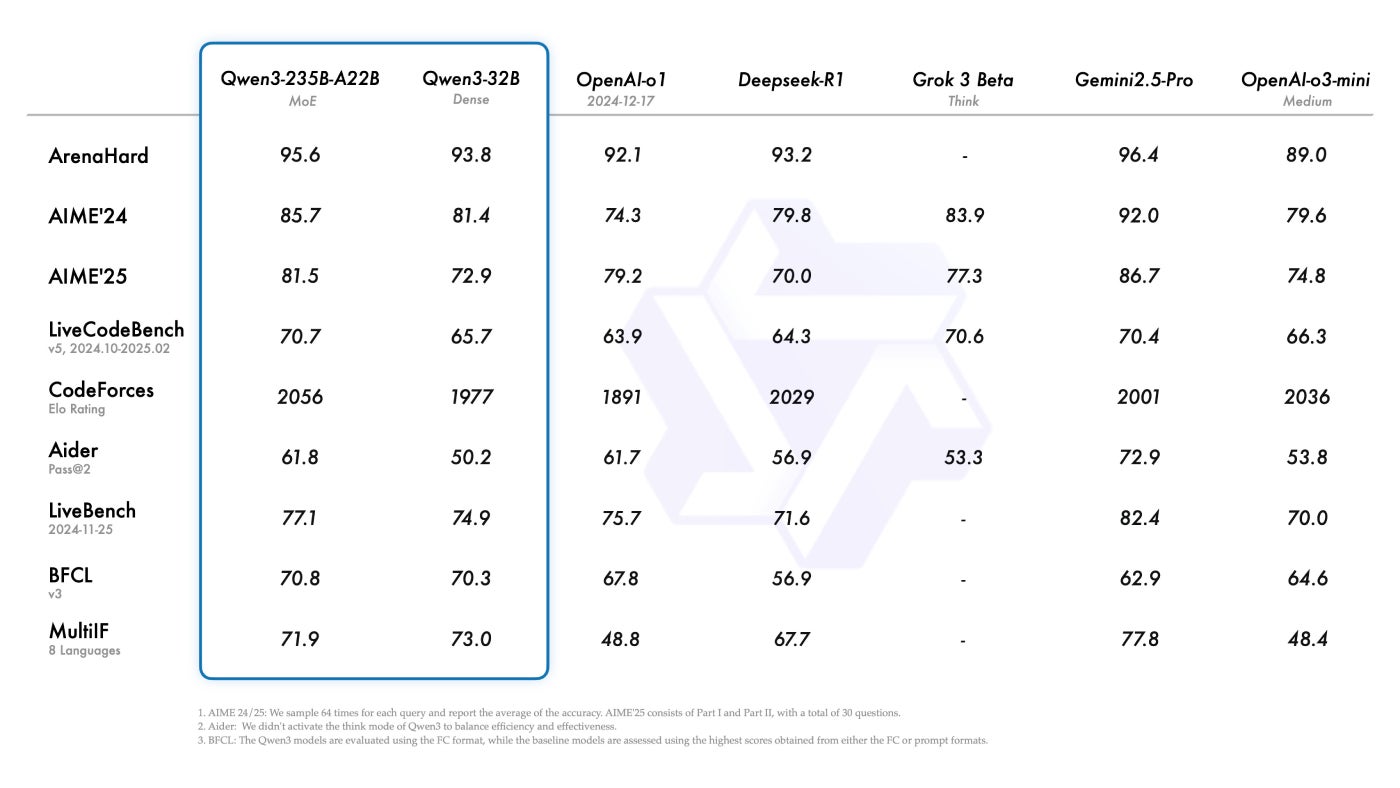
The flagship Qwen3-235B-A22B has posted strong results in industry benchmarks, outperforming OpenAI’s o1 and DeepSeek’s-R1 in coding, mathematics, and general reasoning. It also surpasses OpenAI’s o3-mini and Google’s Gemini 2.5 Pro on platforms like Codeforces.
More must-read AI coverage
- SS&C Intralinks DealCentre AI vs. Datasite: Which platform is built for the future of dealmaking?
- SS&C Intralinks FundCentre AI vs. Juniper Square: Which platform better supports modern private markets fund managers?
- Why Data, Not Models, Determines AI Success
- The Rise of the AI-Native Factory: How Physical AI Is Transforming Manufacturing
Massive and diverse training data
Trained on over 36 trillion tokens — including textbooks, Q&A pairs, code, and synthetic data — Qwen3’s vast training set underpins its strong reasoning and instruction-following performance
Open-source accessibility
All Qwen3 models are released under the Apache 2.0 license, making them freely available for use and integration on Hugging Face, ModelScope, Kaggle, and GitHub. This encourages broad adoption and community-driven development.
Extended context handling
Qwen3-8B, one of the series’ models, has 8.2 billion parameters spread across 36 layers. It can handle up to 32,768 tokens of input at once, allowing it to manage tasks requiring extensive context, such as document summarization or multi-step conversations.
Qwen3 ushers in a new era of accessible AI innovation
Qwen3’s advanced features, like hybrid reasoning, MoE architecture, and broad multilingual support, combined with its cost-efficient scalability, deliver new possibilities for both users and businesses. Companies can now deploy powerful AI models tailored to their needs and budgets, while users can benefit from smarter, more context-aware tools and services.
As Alibaba pursues AGI as its core mission, Qwen3 is compelling proof of that ambition. It represents a new standard for accessible, high-performance AI that can transform industries.