


TypeScript kept GitHub’s crown. Rust supplied the growth spurt.
GitHub’s 2026 Octoverse report puts TypeScript ahead of Python and JavaScript, while Rust recorded the fastest percentage growth among the languages compared. Published Oct. 28 and updated Nov. 6, the annual report tracks development activity across GitHub through September.
For development managers, the findings offer context for training and tooling decisions. Growing use of AI coding agents also makes review capacity an important part of that planning.
Top three hold steady as contributor numbers climb
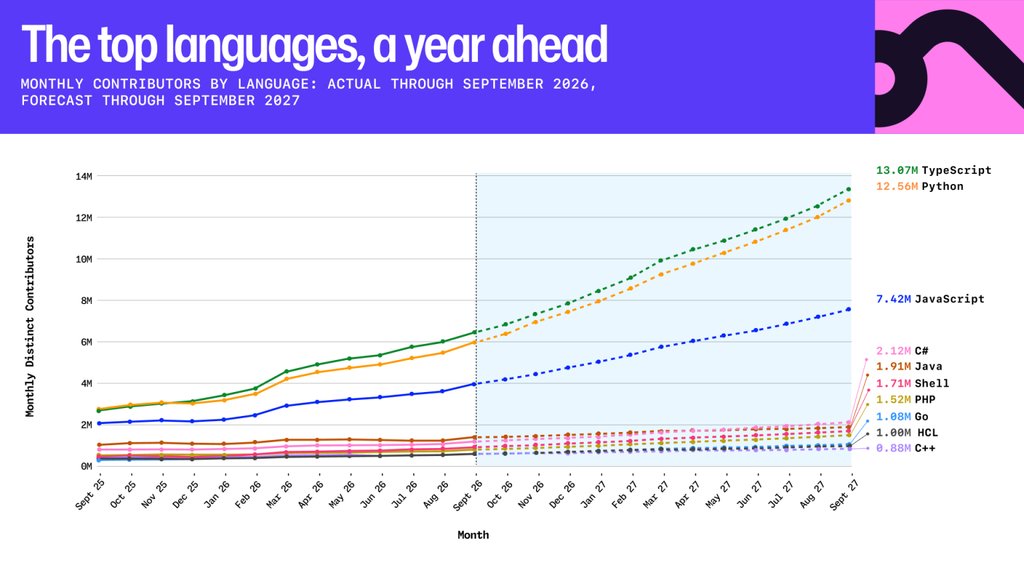
TypeScript retained first place in GitHub’s 2026 Octoverse rankings, with Python second and JavaScript third. Their positions have remained unchanged since 2025, when the Microsoft-developed language overtook both rivals.
Between September 2025 and September 2026, TypeScript’s monthly contributor count increased by 3.62 million, compared with 3.23 million for Python and 1.82 million for JavaScript. These were the largest numerical increases among GitHub’s top 10 languages.
GitHub counts participation through code pushes, pull requests, issues, reviews and comments, assigning activity to each repository’s primary language. The figures measure participation in language communities, rather than only people writing code.
Each remains important to everyday software development. Python is widely used in AI and data science, while JavaScript powers interactive websites. TypeScript builds on JavaScript with additional checks that can help catch coding mistakes before software runs.
Looking ahead, GitHub projects that the two leading languages could approach 13 million monthly contributors each by September 2027. Both forecasts depend on recent growth trends continuing.
A 162% jump outpaces the established leaders
Rust posted the fastest percentage growth among the programming languages compared in GitHub’s chart, with its monthly contributor community expanding 162% year over year. TypeScript followed at 134%, while Python grew 118%.
Even after such a large jump, the community remains considerably smaller than either leader. Its rapid expansion reflects a higher growth rate, not a larger overall contributor base.
Memory safety is one reason developers consider the language for performance-sensitive projects. Its design helps prevent certain errors that can create security vulnerabilities, and US cybersecurity agencies have urged software manufacturers to adopt memory-safe programming languages. The guidance provides context for its appeal, although GitHub’s figures do not establish what caused the growth.
AI coding agents take on more development work
By September 2026, AI agents produced the first drafts of more than 40% of GitHub pull requests, up from 17% in March. A pull request is a proposed code change that developers can review before adding it to a project.
GitHub Copilot provides another example of that adoption. Some 55% of its monthly active users now use agentic features, compared with 35% a year earlier. Tools such as Copilot’s coding agent can take an assigned task, including fixing a bug, and prepare the changes for review.
AI activity was especially visible in the fastest-growing language communities. GitHub detected agent involvement in roughly 40% to 44% of merged pull requests involving TypeScript, Python and Rust, compared with about 21% for Java.
Among repositories created in 2026, TypeScript was the primary language in 35% of those with detected agent activity, compared with 24% of those without a detected signal.
GitHub suggested that developers using agents may favor languages where generated code is easier to check.
What development teams should check before 2027
The rankings offer context for workforce and tooling plans, but they cannot determine which language best suits an application. GitHub can count the same contributor in several language communities, so growth does not necessarily mean developers are abandoning one language for another.
For IT leaders, the useful comparison is between these platform trends and their own applications, available skills and delivery results.
| Planning area | What to check |
|---|---|
| Training | Compare the languages used in maintained applications and planned projects with gaps in the team’s skills. |
| Language adoption | Assess compatibility, library support, security requirements and long-term maintenance costs before introducing another language. |
| Agent performance | Track accepted changes, rework and defects alongside the volume of generated code. |
| Review capacity | Monitor review waiting times and open pull requests to identify whether proposed changes are arriving faster than maintainers can assess them. |
Research provides another reason to examine outcomes closely. A 2026 ACM conference study comparing 40,214 pull requests across 2,807 GitHub repositories found that agent-authored submissions were integrated faster when accepted, but had lower overall merge rates than human-authored submissions. That finding describes the study’s sample, rather than every development team.
Teams expanding agent use should establish who owns each proposed change, which tests and security checks it must pass, and who approves it for release. Those responsibilities remain necessary when an agent prepares the first draft.
Before expanding a pilot, compare its results with the team’s existing workflow. Useful measures include time from submission to deployment, reviewer effort, changes requested during review and defects discovered after release.
The practical question for 2027 is whether new tools help teams deliver maintainable software within their staffing and budget constraints. More proposed changes are useful only when teams can assess, integrate and support them.
More on programming languages: Which programming languages gained or lost ground this month? Our latest TIOBE report covers the biggest ranking changes.