


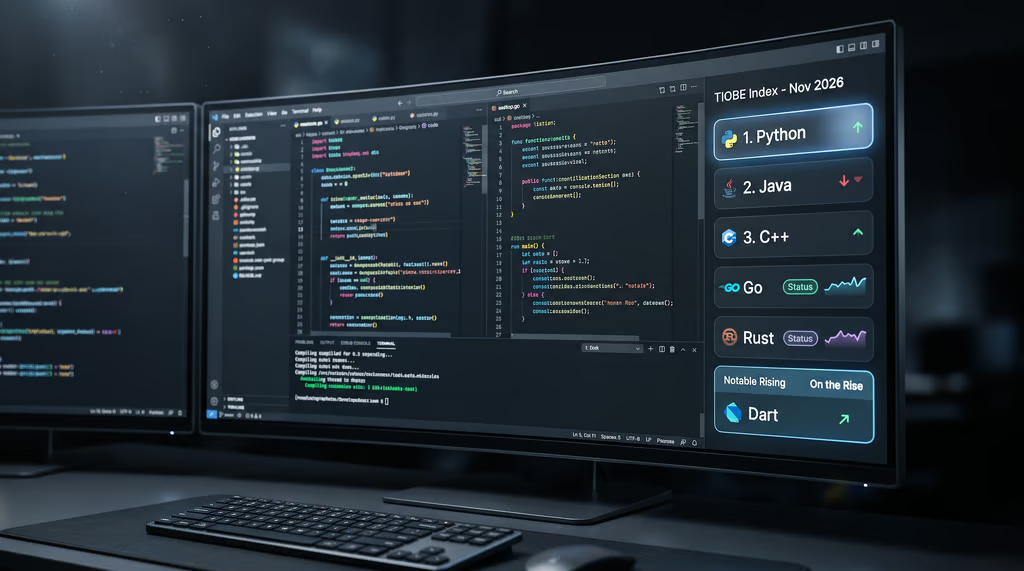
November brings another reshuffle to the TIOBE Index, with established programming languages trading places and recent gains proving difficult to sustain.
Several rankings remain separated by slim margins, allowing even modest rating changes to rearrange the leaderboard. With 2026 nearing its end, some of the year’s closest contests remain unresolved.
The TIOBE Programming Community Index measures programming language popularity using search engine results related to skilled engineers, courses, and third-party vendors. Its ratings reflect search-based visibility rather than the number of developers using each language or the amount of code written in it.
Python maintains its lead as C strengthens
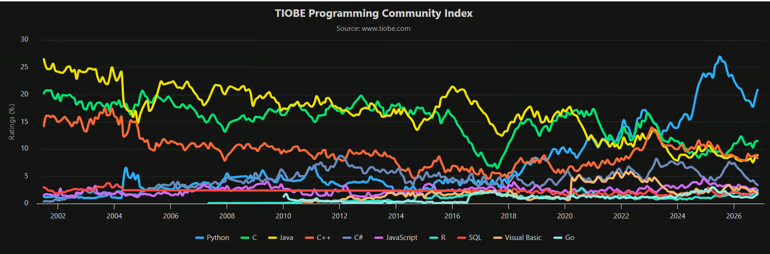
Python remains first at 20.86%, extending its recovery after several months of weaker ratings. Despite the recent gains, the language has yet to return to its level from a year ago.
C holds second at 11.48%, following a different trajectory with a 1.80-point year-over-year increase. TIOBE CEO Paul Jansen previously attributed C’s enduring strength to its importance in embedded systems, where speed and low-level control remain valuable.
Python continues to hold a substantial advantage, leaving the more immediate competition among the languages ranked beneath it.
Java takes third place from C++
Java climbs from 8.41% to 8.89%, reclaiming third place for the first time since May. C++ moves in the opposite direction, falling from 8.87% to 8.35% and dropping to fourth.
October left just 0.46 percentage points between the pair in C++’s favor. November reverses the order and gives Java a 0.54-point advantage, continuing their frequent ranking exchanges throughout 2026.
C# remains fifth despite declining from 3.79% to 3.39%. JavaScript also loses rating share, falling to 2.42% from 2.77%, but retains sixth place.
R rises to seventh as Go displaces Rust
R continues its climb, reaching seventh at 2.27% after overtaking SQL last month. SQL advances to eighth at 1.91%, while Visual Basic falls from seventh to ninth as its rating declines from 2.20% to 1.88%.
The final position also changes hands. Go returns to the top 10 at 1.69%, overtaking Rust, which drops to No. 11 despite increasing its rating from 1.44% to 1.63%.
Rust first entered the top 10 in July and remained there through October. Its departure ends that four-month run, but the difference between Rust and Go is just 0.06 percentage points, leaving another reversal possible.
Dart enters the top 20 for the first time
Dart reaches No. 20 at 0.74%, climbing from 27th in October and entering the top 20 for the first time. Its arrival follows Julia’s return last month, which proved brief as Julia has already fallen back out.
According to Jansen, Google’s Flutter framework is the main reason behind Dart’s growing popularity. Flutter allows developers to build applications for multiple platforms using a single codebase, giving Dart an established development ecosystem.
Jansen notes that Dart includes modern programming features but credits its success primarily to Flutter’s adoption in cross-platform mobile development.
Dart’s arrival and Rust’s departure illustrate how quickly positions can shift near the boundaries of TIOBE’s top 10 and top 20. With several languages separated by narrow rating margins, December could bring another reshuffle.
For developers and IT teams, however, these monthly movements are better viewed as indicators of changing interest than definitive measures of a language’s long-term relevance. Factors such as ecosystem support, available talent, and project requirements remain more important when choosing which technologies to adopt.
Related reading: Cursor is automating parts of full-stack development, including PostgreSQL database setup, application hosting, and user sign-in.