


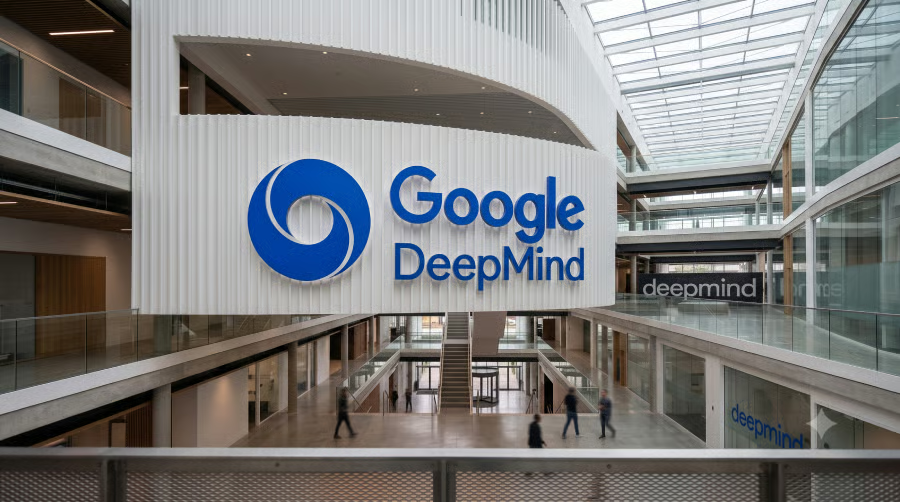
Google is reorganizing its AI command structure at a moment when execution matters as much as research prestige.
Demis Hassabis is stepping away from day-to-day leadership of Google DeepMind to become Alphabet’s chief scientist and DeepMind chair, while Koray Kavukcuoglu takes operational control. Jeff Dean and several other senior engineers are also leaving to launch Discovery Loop.
For enterprise customers, the reshuffle puts the focus on whether Google can deliver Gemini updates faster, strengthen Google Cloud integration, and turn its research advantage into products businesses can deploy with confidence.
Who will run Google DeepMind?
Kavukcuoglu will lead the unit as a senior vice president and continue serving as Alphabet’s chief AI architect, Reuters reported. He will report to Google CEO Sundar Pichai and assume the operational responsibilities previously handled by Hassabis.
Hassabis will focus on long-term AI research, strategy, and the potential development of artificial general intelligence. He said he wanted more time to work on the “big picture” rather than the management duties attached to running DeepMind.
Business Insider said that the change gives Hassabis more room to pursue research while Kavukcuoglu concentrates on running the organization and moving its work toward commercial products.
According to The Guardian, Hassabis will also remain CEO of Isomorphic Labs, the DeepMind spinout focused on AI-assisted drug discovery.
Jeff Dean’s departure deepens the talent shift
Dean is leaving Google with Sanjay Ghemawat, Oriol Vinyals, and Quoc Le to establish Discovery Loop, a public benefit corporation focused on machine learning, science, and engineering.
The group includes researchers and engineers who played major roles in Google’s AI models and the infrastructure behind its products. Google will invest in Discovery Loop and provide cloud computing capacity through a partnership with the new company, Reuters reported.
Their departure follows other recent losses from Google’s AI organization, including researchers who moved to OpenAI and Anthropic. Reuters also noted that Alphabet shares closed 4% lower after the leadership changes were announced.
More Google coverage
- New Google Search AI Mode is ‘Total Reimagining,’ Says CEO Sundar Pichai
- In Major Ruling, Judge Finds Google ‘Willfully Acquired and Maintained Monopoly Power’ Over Digital Ad Market
- Google’s Big Bet on Nuclear Energy: ‘The Race to Power AI-Driven Data Centers is Accelerating’
- Computer History Museum Releases Original AlexNet Code: Why It Matters
What the overhaul means for enterprise AI
Google is making the changes while facing pressure to deliver its next major Gemini model and compete with systems from OpenAI, Anthropic, and lower-cost Chinese providers. Reuters said that a planned Gemini release had been delayed, while Business Insider argued that Google has struggled to keep pace in areas such as AI coding.
Kavukcuoglu’s closer involvement with Google Cloud could give enterprise customers a clearer line between DeepMind research and commercial services. Reuters reported that some Google Cloud leaders viewed his appointment as a positive step for commercialization.
The leadership reset does not guarantee faster Gemini releases or better integration with Cloud products. It does, however, place operational responsibility with an executive already involved in connecting DeepMind’s research to Google’s enterprise business.
IT leaders should watch Google’s next Gemini release, changes to its Cloud AI roadmap, and whether the departure of senior researchers affects model development. The success of the overhaul will depend less on the new job titles than on whether Google can turn its deep research bench into products customers can deploy on schedule.
See how Google’s biggest 2026 announcements across Gemini, Search, Android, Workspace, Pixel, Chrome, and Cloud could shape business technology decisions.