
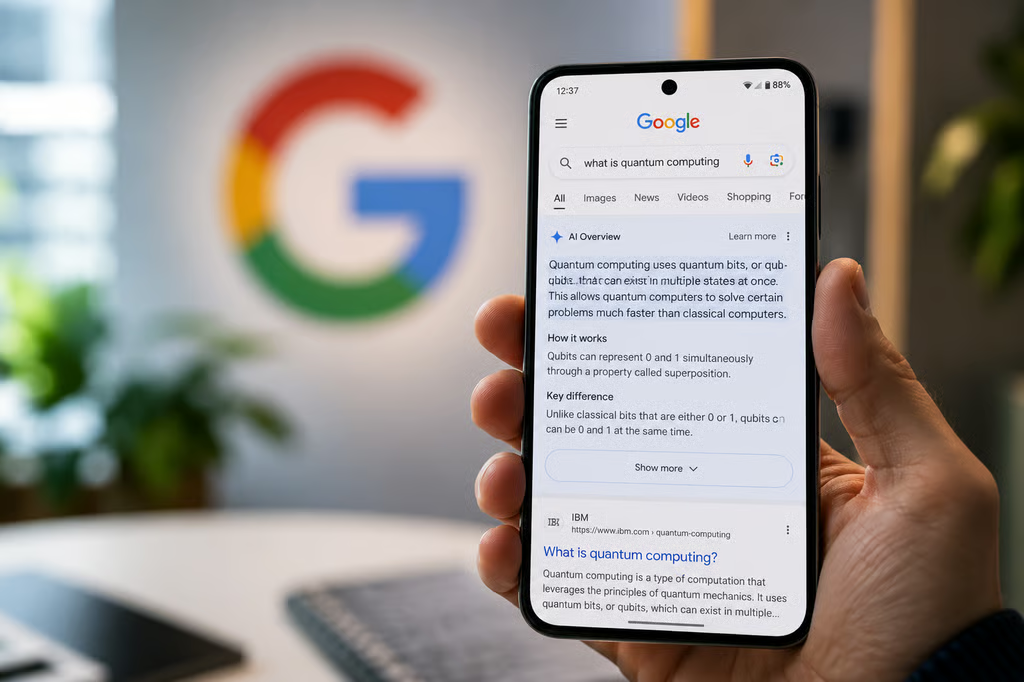


Google’s AI Overviews can now put a generated answer where search links used to be, and courts are starting to test who pays when that answer is wrong.
Teams may already use AI search for security context, procurement, compliance checks, or legal background before anyone has decided how those answers should be verified. That puts AI Overviews in the same risk category as chatbots, copilots, and internal AI search tools.
AI Overviews face their first legal stress tests
Google says AI Overviews help users get the gist of complicated topics. Its Search Central guidance says site owners do not need special optimization to appear in the feature or AI Mode, though they can use controls such as nosnippet, data-nosnippet, max-snippet, and noindex to limit what appears.
Unlike traditional search results, AI Overviews synthesize source material into new language that may not appear in any single linked page.
On May 28, 2026, the Munich Regional Court issued an injunction against Google after an AI Overview allegedly linked two Munich-based publishers to scams and questionable business practices. Reporting on the decision said the court treated the summary as Google’s responsibility because the company controls the system that produced it.
The ruling does not settle US law, but it pushes AI search risk toward output governance.
Canadian musician Ashley MacIsaac sued Google in Ontario Superior Court in May 2026, alleging that an AI Overview falsely identified him as a sex offender and contributed to the cancellation of a Dec. 19, 2025, concert. The claim remains unproven.
Publishers are pressing traffic and compensation claims, too. Penske Media sued Google in Washington, D.C., in September 2025, alleging that AI Overviews use its journalism to produce summaries that reduce visits to sites including Rolling Stone, Billboard, and The Hollywood Reporter. On June 3, the UK Competition and Markets Authority ordered Google to give publishers opt-out tools for AI Overviews, AI Mode, and related AI services.
Pew Research Center found that US Google users clicked a traditional result in 8% of visits with an AI summary, compared with 15% without one. A May 2026 arXiv study found that 11% of 98,020 AI Overview claims were unsupported by the cited pages.
How companies should govern AI search at work
Public AI search tools belong in AI governance policies. Employees may use AI Overviews for vendor research, compliance checks, legal background, or financial analysis, just as they may use stricter AI settings for sensitive ChatGPT work.
Set a verification rule for consequential work: AI Overviews can orient employees, but health, safety, legal, compliance, financial, security, and reputational claims should be checked against primary sources before anyone acts.
Training should separate citations from verification. An AI answer can cite credible-looking sources while still making unsupported claims, and recent compliance testing of major AI models reinforces the need for legal review.
Internal AI search tools need the same controls. Logs should capture the prompt, retrieved sources, generated answer, citations, and downstream action as oversight expands from models to devices, data flows, and trusted-source controls.
AI Overviews can speed up research, but any claim used for compliance, security, legal, or financial decisions still needs a primary source behind it.
Also read: EU regulators are testing how much control major platforms can keep over AI access, including Meta’s handling of rival AI assistants on WhatsApp.