
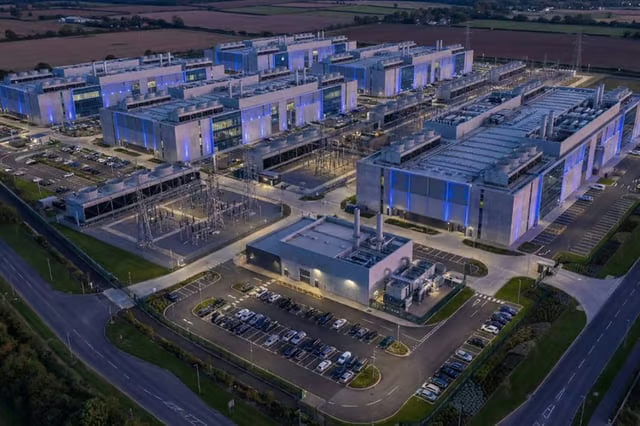


As AI data centers face mounting criticism over their water use, Google has pledged to replenish more freshwater than its offices and data centers consume by 2030, positioning water stewardship as a key part of its AI infrastructure strategy.
The announcement comes as governments and local communities increasingly scrutinize the environmental impact of AI infrastructure, particularly the vast amounts of water and electricity required to cool modern data centers. Google’s plan includes more than $500 million for the various projects inside its water commitments.
The company is also expanding its use of alternative water sources while increasing transparency around water consumption. This development comes as the rapid buildout of AI data centers increasingly draws criticism from communities, with regulators now paying closer attention to their effects.
Google wants to give back more than it uses
According to Google, the tech giant wants to replenish more freshwater than its offices and data centers consume by 2030 as part of five commitments the company made regarding water use.
In 2025, Google reported that its water stewardship projects replenished over 7 billion gallons of water. The company expects its broader portfolio of 165 projects across 97 watersheds to restore more than 19 billion gallons annually by the end of the decade.
Google said those projects include restoring wetlands, replenishing groundwater, improving irrigation systems, and fixing and upgrading water infrastructure.
Rather than simply cutting consumption, the company says the goal is to return water to the communities where its data centers are located.
Alternative cooling systems
Google’s pledges also extend beyond water-based cooling, particularly in locations where water resources are limited. The company said cooling systems will increasingly be selected based on local environmental conditions rather than following a standard design across all facilities.
Although Google maintains that water-based cooling can lower energy consumption — another factor that has also caused data center criticisms — it said the method is not always the best choice.
Where freshwater availability is a concern, the company said it might rely on air cooling or other lower-water alternatives.
Google apparently isn’t alone here. Nvidia has explored unconventional concepts such as space-based data centers to reduce the environmental constraints faced by terrestrial facilities, although the idea remains highly conceptual.
Transparency forms another core of Google’s commitment
Google’s initiatives are not limited to reducing its environmental impact; they also include showing more of it. The company said it will continue publishing transparent data on how its data centers consume water.
Such greater transparency is intended to build trust with the communities hosting the company’s data centers. It will also allow the public to measure the company’s progress toward its 2030 water stewardship targets.
More Google coverage
- New Google Search AI Mode is ‘Total Reimagining,’ Says CEO Sundar Pichai
- In Major Ruling, Judge Finds Google ‘Willfully Acquired and Maintained Monopoly Power’ Over Digital Ad Market
- Google’s Big Bet on Nuclear Energy: ‘The Race to Power AI-Driven Data Centers is Accelerating’
- Computer History Museum Releases Original AlexNet Code: Why It Matters
Where does this leave everyone?
The commitments come at a time when communities have become increasingly uncomfortable with the presence of these massive infrastructure projects near their residences.
That discomfort could lead to delays in data center construction and, in some cases, might result in temporary suspensions on data center construction. New York, for example, recently became the first U.S. state to impose a one-year moratorium on new hyperscale data centers, pausing environmental permits for projects consuming 50 megawatts or more while regulators assess their impact on the state’s power grid, water resources, and local communities.
Delays to new data center projects could slow the expansion of cloud infrastructure needed to support increasingly demanding AI workloads, potentially affecting businesses that rely on scalable computing resources.
That is exactly the kind of problem that Google is aiming to solve: not by directly removing the issues critics are pointing out, but by using a workaround it believes will satisfy everyone while being environmentally friendly.
Whether Google’s strategy succeeds remains to be seen. But it gives the groups involved something they have long sought.
Communities gain greater insight into how local water resources are managed, environmental advocates can track measurable strategy, and policymakers have more data to assess the impact of rapidly expanding AI infrastructure.
The approach could also prove valuable for businesses that depend on AI. If environmental concerns become less of a barrier to new data center construction, cloud providers can continue expanding capacity, helping enterprises access the computing resources required for increasingly demanding AI workloads.
As AI infrastructure expands, companies will face growing pressure to demonstrate that increased computing capacity does not come at the expense of local communities or natural resources. Google’s latest commitments suggest environmental stewardship is becoming a competitive consideration alongside computing performance and cost.
Other News: San Francisco is pressuring Apple and Google to remove AI “nudify” apps, escalating the debate over whether app stores should be held accountable for distributing harmful deepfake tools.