

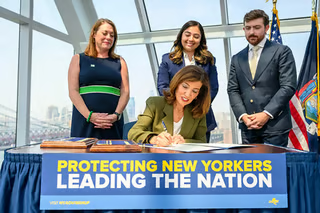
New York has become the first US state to impose a one-year moratorium on new hyperscale data center development by temporarily pausing environmental permits for the largest projects.
Under the terms of an executive order signed by Gov. Kathy Hochul, New York is establishing what she characterized as “the strongest standards for data center development and creating a blueprint to support localities.”
The temporary pause of state environmental permits aims to “build a nation-leading regulatory framework that protects ratepayers, the environment, the energy grid and communities across the state,” the governor’s office said.
The threat of rising utility bills and concerns about the depletion of natural resources “create uncertainty for New Yorkers,” she said.
Details of Hochul’s executive order
Hochul is also pursuing legislation to repeal sales tax exemptions for massive data centers statewide to reduce the burden on taxpayers.
The construction ban will apply to data centers that use 50 megawatts or more of power, officials in the governor’s office said.
The state’s Department of Environmental Conservation will not issue any discretionary permits not already deemed complete while the moratorium is in effect.
Hochul also directed state officials to develop a Generic Environmental Impact Statement (GEIS) to ensure new data centers are held to consistent standards.
The governor said she wants the GEIS to assess the potential environmental impacts of data center construction and operation in the state, including effects on energy demand, water use and quality, and air quality.
Once the state finalizes the standards, the moratorium will be lifted, and new data center projects will be allowed to proceed — as long as they follow state, zoning code, and other local approvals, according to Hochul’s office.
The data center conundrum
The moratorium puts New York at the forefront of the growing national debate over how to balance the need for increased infrastructure to support AI with the impact on communities.
Even as tech companies are investing billions to build new data centers, lawmakers and regulators in dozens of states are considering measures to limit their impact on electricity grids, utility bills, and local communities.
The New York State Legislature passed a more comprehensive moratorium last month, igniting questions about whether Hochul, who has expressed support for AI for research, would sign it. The governor said she is still considering it.
More about data centers
- Stargate Norway: OpenAI’s First AI Data Center in Europe
- AI Data Centers’ Soaring Energy Use: Who Pays for Higher Utilities Costs?
- China’s Submerged AI Data Center Could ‘Influence Global Sustainable Computing’
- Google to Power Data Centers With Nuclear Energy by 2030 in First-Of-A-Kind’ Agreement
A potential fund to update grid infrastructure
To ensure that all New Yorkers benefit from responsible development, Hochul is also directing the Department of Public Service (DPS) to consider creating a New York Grid Acceleration Fund that would require data centers to invest in the state’s aging grid infrastructure and energy needs.
The fund could support the procurement of new clean energy supply and the establishment of an insurance pool that developers might be required to contribute to “to protect against speculative large loads that create uncertainty and increase costs,” the governor’s office said.
DPS will also consider approaches to require data centers to fund new clean electricity generation exclusive to their operations, including customer-sited distributed energy resources and battery storage.
A framework to help communities negotiate benefits
To further ensure communities benefit as part of any large-scale data center deal, the Governor also directed Empire State Development (ESD) to issue a Community Investment Framework (CIF) within 60 days.
The CIF will also establish frameworks to give organized labor a seat at the table and prioritize prevailing wage standards and project labor agreements for data center construction, local hiring, apprenticeships, and workforce development. A formula will also be included in the framework to help communities assess where to begin investment negotiations.
The framework intends to provide clear guidance to local entities to help them negotiate benefits such as local infrastructure improvements, child care investments, and direct financial support for their community.
Also read: Meta’s Cheyenne AI data center was linked to rare bacteria in reclaimed irrigation water, adding scrutiny to local wastewater rules for data center projects.