


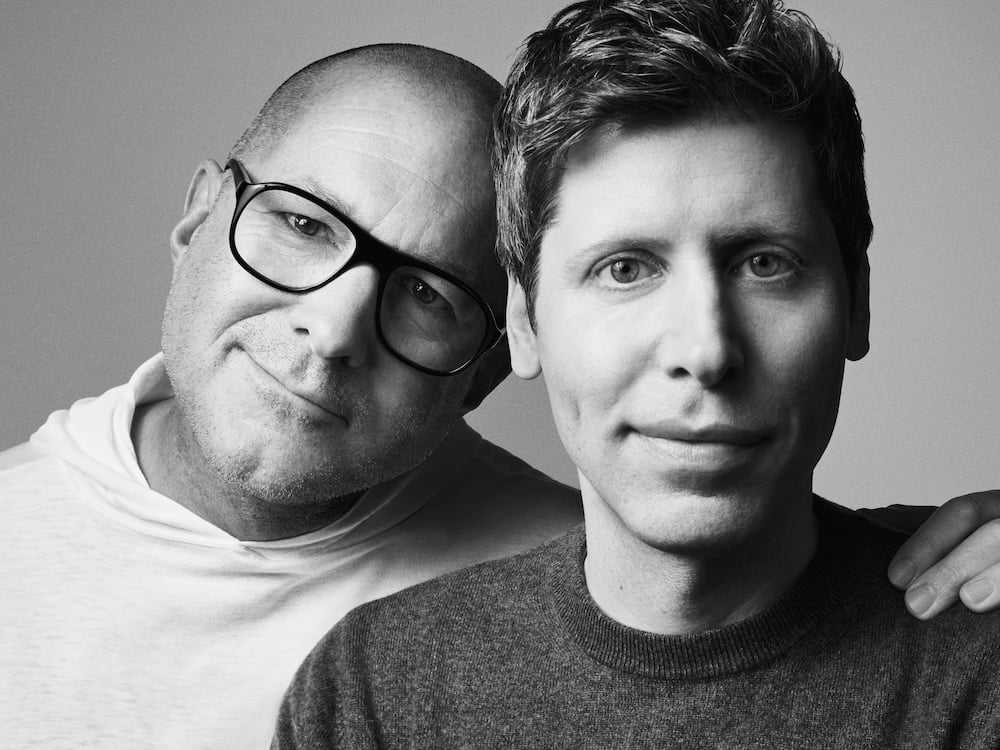
Technology made us more connected… and somehow more alone. Jony Ive wants to fix that.
The legendary designer has joined forces with OpenAI’s Sam Altman to create AI-powered devices that promise to make us not just more efficient, but more fulfilled.
“The devices should make us happy,” Ive said. “More peaceful, and less anxious.”
At OpenAI’s developer conference in San Francisco, Ive and Altman shared their vision for a new generation of hardware — one that reimagines how humans relate to their machines. The pair revealed they’re developing a “family of devices,” though they stopped short of offering technical details or launch dates.
“As great as phones and computers are, there’s something new to do,” Altman said on stage, according to WIRED.
For Ive — who helped design the iPhone, iPad, and MacBook — this next chapter is about reshaping technology’s emotional impact as much as its physical form. “I don’t think we have an easy relationship with our technology at the moment,” he said. “Rather than seeing AI as an extension of those challenges, I see it very differently.”
A device without a screen — and possibly without a launch date
While the details remain secretive, multiple reports suggest that the first device from OpenAI and Ive will be a palm-sized, screenless gadget that can respond to users through audio and visual inputs. It’s expected to use cameras and microphones to understand its environment and interact naturally, more like a companion than a tool.
However, the road to launch hasn’t been smooth.
The Verge, citing The Financial Times, reports the team is still dealing with major “technical issues,” particularly around the device’s personality and how it should speak or behave. There are also privacy concerns about a gadget that may always be listening. As one source put it, OpenAI and Ive are trying to make the device “accessible but not intrusive.”
Furthermore, computing power could pose a significant bottleneck.
“Amazon has the compute for an Alexa, so does Google [for its Home device], but OpenAI is struggling to get enough compute for ChatGPT, let alone an AI device,” a source told the Financial Times.
More must-read AI coverage
- SS&C Intralinks DealCentre AI vs. Datasite: Which platform is built for the future of dealmaking?
- SS&C Intralinks FundCentre AI vs. Juniper Square: Which platform better supports modern private markets fund managers?
- Why Data, Not Models, Determines AI Success
- The Rise of the AI-Native Factory: How Physical AI Is Transforming Manufacturing
These unresolved issues might delay the product’s launch, reportedly slated for late 2026 or early 2027.
The collaboration between Ive and Altman began when OpenAI acquired Ive’s design company in May for a reported $6.5 billion. Since then, the partnership has sparked interest in the potential role hardware could play in OpenAI’s future.
Both Ive and Altman have acknowledged the difficulty of the task.
“Hardware is hard. Figuring out new computing form factors is hard,” Altman said, according to WIRED. “I think we have a chance to do something amazing, but it will take a while.”
As other AI devices like the Rabbit R1 have struggled to find their footing, the pressure is on for Ive and OpenAI to deliver a device that truly changes our relationship with technology, rather than just adding another gadget to the mix.
In other OpenAI news: the AI giant has partnered with Samsung to provide memory chips, data center infrastructure, and undisclosed future projects for the Stargate build-out initiative.