


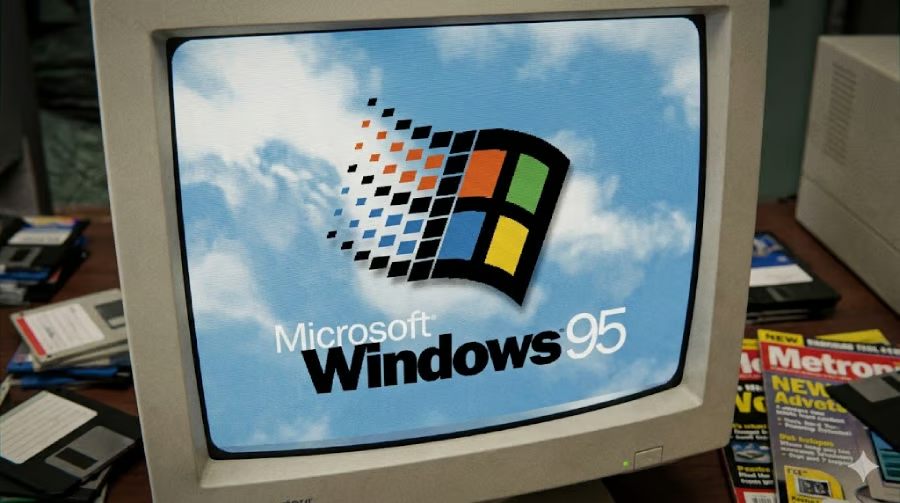
Microsoft has long promoted Windows 11 as its most advanced desktop operating system yet, but one of the company’s top executives has now confirmed that a major part of Windows still relies on technology built in the 1990s.
The focus is on the Win32 API, a core software layer introduced during the Windows 95 era that developers still depend on today for traditional desktop applications. Microsoft Azure CTO Mark Russinovich discussed the surprising longevity of Win32 in a recent video shared by Microsoft Dev Docs.
“Did anyone in the 90s expect Win32 to still be a first-class API surface in the year 2026? And I think I can safely answer, ‘No,’” Russinovich said in the video. “Nobody, I think, would’ve expected that because we were thinking flying cars and moon stations by the year 2026. Not Win32 that was designed back in Windows 95 days.”
Why it still exists today
Despite multiple attempts over the years to replace it, Win32 survived largely because of compatibility.
Millions of applications, especially business and professional tools, still depend on it. Enterprise software often requires deep system access that newer, more restricted frameworks cannot fully provide. Microsoft also tried several replacements over the years, including WinRT and the Universal Windows Platform (UWP), but adoption never fully took off.
Each effort fell short of entirely replacing Win32. Developers, in turn, became cautious after repeated shifts in Microsoft’s direction, leading many to stick with the older, more reliable Win32 ecosystem.
More recently, the company has leaned heavily into web-based app technologies using Chromium-based wrappers. Apps like Microsoft Teams, Clipchamp, and the new Outlook have all adopted this approach, but it has also raised concerns about performance and system resource usage.
Instead of fully replacing Win32, Microsoft now appears to be gradually modernizing Windows.
Windows Latest reports that the company is improving parts of the system using newer tools like WinUI 3 and the Windows App SDK. Some system components, such as redesigned dialogs and updated system tools, are already being rebuilt with modern frameworks.
At the same time, Microsoft is still refining the legacy system rather than removing it, suggesting a cautious, layered approach rather than a full restart.
More Microsoft news
- Inside Microsoft’s Real-Time War Against Cybersecurity Threats
- Project Ire: Microsoft Tests AI That Autonomously Detects Malware
- Microsoft Targets ‘Critical AI Talent’ from Meta to Dominate Next AI Breakthroughs
- Windows 10 Support Ends Soon, Though Extended Security Updates Offers Are Available
Legacy tools become permanent
The survival of this ancient code is so absolute that tools once meant to be temporary are now being baked directly into the OS.
Russinovich pointed to his own Sysinternals suite, created in 1996, as proof of this longevity. He admitted he would have “bet a million dollars” that those tools would be irrelevant by now. Instead, Sysmon was officially integrated as a native Windows feature in the March 2026 update.
As Windows 11 prepares for major changes this year, including reduced Copilot integration and a native Start menu, it seems Microsoft has finally accepted that its 30-year-old foundation isn’t a liability, but a permanent part of the future.
Also worth reading: what Windows users need to know before Secure Boot certificates expire in 2026.