


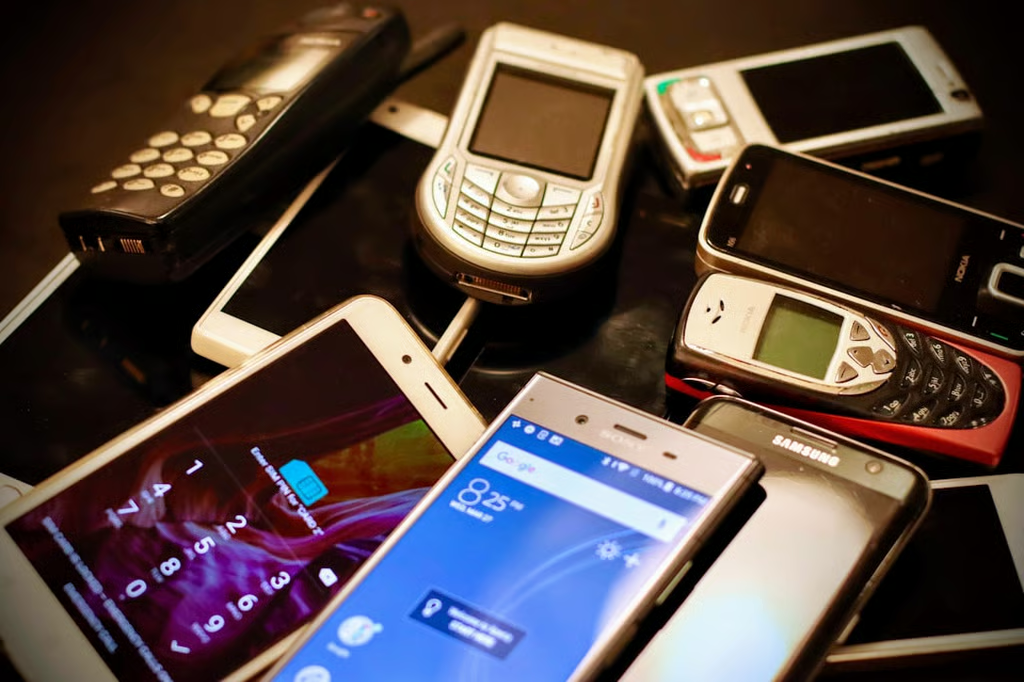
An old phone can still work in 2026, but age alone does not determine whether a carrier will activate it. A hand-me-down smartphone from several years ago may work perfectly, while an older 4G phone can fail because it lacks the right voice support or carrier compatibility.
Four checks matter most: the phone needs current network support, VoLTE, a compatible IMEI result, and an unlocked status. Software support matters too, especially if you’ll still use the phone for apps, payments, email, or other sensitive tasks.
T-Mobile’s current BYOD guidance recommends checking the IMEI, the phone’s unique device identifier, and unlock status before activation. Its compatibility tool can return fully compatible, partially compatible, incompatible, or blocked.
2G and 3G phones are effectively out
The major US networks have moved beyond the technologies many older phones were built around.
T-Mobile’s Network Evolution page says its 2G GSM network was retired on August 3, 2026. Its 3G UMTS network was retired in July 2022, following the shutdowns of Sprint’s 3G CDMA and LTE networks earlier that year.
AT&T phased out 3G in February 2022. Verizon completed the retirement of its 3G CDMA network at the end of 2022 and says 4G devices without VoLTE also lost calling, texting, and data service.
That means a 2G- or 3G-only phone is no longer a practical option on the major US networks. A 4G label alone is not enough either. The phone still needs VoLTE and carrier support.
Run these four checks before activating an old phone
| Check | Pass | Warning or failure |
|---|---|---|
| Network | Supports the carrier’s LTE or 5G bands | 2G/3G-only or missing important bands |
| Voice | Supports VoLTE on the destination carrier | LTE data works, but voice support is missing |
| IMEI | Carrier reports fully compatible | Partial, incompatible, or blocked |
| Unlock | Device is unlocked | Still locked to another carrier |
Network support depends on the exact model. Phones sold for different carriers or countries can support different frequency bands, so an imported phone may connect to LTE while still missing bands needed for reliable US coverage.
VoLTE, or Voice over LTE, is just as important. A phone can support LTE data without supporting the carrier’s LTE voice service. Verizon’s shutdown guidance specifically says 4G non-VoLTE devices are no longer supported.
Run the IMEI through the destination carrier’s compatibility checker rather than relying only on the specifications. A fully compatible result is the safest sign that activation should work, while a partial or incompatible result deserves a closer look before buying a SIM or switching service.
The phone also needs to be unlocked if it is moving to another carrier. Unlock requirements vary, but carriers commonly require eligible devices to be paid off and in good standing.
Software longevity belongs in the decision too. Recent Samsung and Google phones now receive much longer software support windows, while older models may already have stopped receiving security updates.
A new SIM cannot fix an incompatible phone
Once the phone passes those checks, activation itself is usually straightforward.
A compatible device can use either a physical SIM or eSIM if the phone and carrier support it. Changing the SIM type cannot add missing LTE bands, VoLTE support, or carrier approval.
T-Mobile says many smartphones released since 2020 support eSIM, although availability varies by model and region. With eSIM, activation can often complete within minutes.
After activation, test voice calls, texts, and mobile data. If data or MMS does not work, check the APN settings. Some older and imported devices may require manual configuration.
If you’re transferring an existing phone number, keep the old service active until the port finishes. T-Mobile says number transfers can take from a few minutes to several hours.
A phone can connect and still be too old to use safely
Carrier compatibility is only one part of keeping an old phone useful.
Older devices may no longer receive security patches or current app versions. More than a billion older Android devices were estimated to be outside Google’s current security-update coverage earlier this year, making unsupported Android phones a separate concern from whether they can connect to a cellular network.
Apps can impose their own cutoffs too. WhatsApp, for example, is ending Android 5 support in September 2026.
Before putting an old phone back into regular use, check whether it still receives security updates and whether the apps you rely on still support its operating system.
If the phone supports the carrier’s LTE bands and VoLTE, passes the IMEI check, is unlocked when necessary, and still receives acceptable software support, it can remain perfectly usable in 2026. If one of those checks fails, a new SIM is unlikely to rescue it.
Also read: If replacement is unavoidable, our guide to the most repairable phones in 2026 compares current models by repairability, parts access, and software support.