


OpenAI is making some of its newest AI models on a half-price sale.
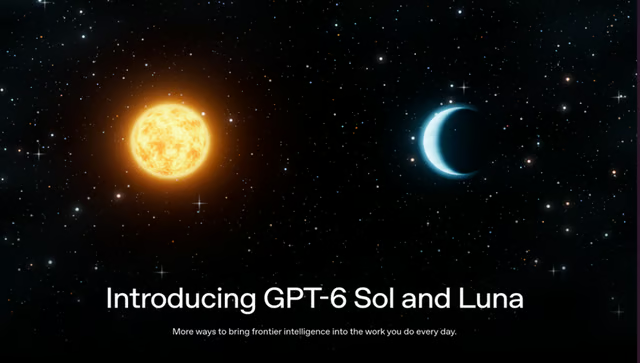
The company this week introduced GPT-6 Sol and GPT-6 Luna, following the flagship GPT-6 Astra earlier this month. Sol is aimed at complex work such as coding and long-running agent tasks, while Luna targets high-volume jobs such as summarization.
OpenAI says both models were trained using methods similar to Astra and are priced at half the promotional API rates of their GPT-5.6 predecessors. GPT-6 Sol costs $2 per 1 million input tokens and $10 per 1 million output tokens, while GPT-6 Luna costs $0.10 and $0.50, respectively.
For developers, the bigger change may be economic rather than technical: lower model and caching costs could make it practical to let AI agents work longer, process more context and attempt more steps before cost becomes the limiting factor.
Sol targets more expensive agent work
The biggest potential impact is on AI agents that need to run for extended periods. On OpenAI’s AutomationBench evaluation, GPT-6 Sol scored 33.2% at maximum reasoning effort, compared with 30.3% for GPT-6 Astra at low effort.
OpenAI said Sol completed those tasks at $0.27 each, compared with 11.1 times that cost for Claude Opus 5 at maximum effort.
On DeepSWE v1.1, GPT-6 Sol scored 68.8% on complex software-engineering tasks, within 1.1 percentage points of Claude Fable 5’s 69.9% score, while costing about 80% less per task, according to OpenAI.
GPT-6 Luna also improves on its predecessor. At high reasoning effort, it raises GPT-5.6 Luna’s AutomationBench score by 5.4 percentage points while cutting cost per task by 58%.
Lower costs could change how companies use agents
The more important development may be economic rather than purely technical. AI agents become expensive when they repeatedly process large amounts of context, call tools and work through multi-step tasks. Cutting the underlying model price gives developers more room to let those systems iterate instead of limiting their usage because of API bills.
OpenAI said GitHub has already seen the effect of better caching, with more than half of prompt tokens across billions of requests no longer requiring fresh processing in recent months. That could make sustained agent workloads more practical, particularly for software development and other processes where an agent repeatedly works with the same context.
Accuracy and alignment still matter
OpenAI said GPT-6 Sol makes about half as many mistakes as GPT-5.6 Sol on its internal factuality evaluation. Luna also improves substantially over its predecessor.
The company said both models build on the alignment work used for Astra. However, the models still operate in a rapidly evolving area where reliability and agent behavior remain important concerns. OpenAI’s claims are also based largely on its own evaluations, so performance can vary across real-world workloads.
More must-read AI coverage
- SS&C Intralinks DealCentre AI vs. Datasite: Which platform is built for the future of dealmaking?
- SS&C Intralinks FundCentre AI vs. Juniper Square: Which platform better supports modern private markets fund managers?
- Why Data, Not Models, Determines AI Success
- The Rise of the AI-Native Factory: How Physical AI Is Transforming Manufacturing
What this means for users
The introduction of these models delivers a direct financial benefit to organizations, primarily by reducing API costs for advanced AI tools. These lower rates enable software developers to run higher volumes of automated agent tasks within existing budgets, allowing enterprise teams to reserve top-tier models like Astra for their most complex operations.
Access for individual end-users varies according to their current subscription plan:
- ChatGPT Work and Codex Users: Subscribers on Plus, Pro, Business, Enterprise, and Edu plans can access both Sol and Luna.
- Free and Go Tier Users: Subscribers on free or Go plans can utilize Luna through the desktop application.
The broader shift is toward matching model cost to task difficulty rather than defaulting every workload to the most capable model available. For enterprises deploying agents at scale, that could matter as much as benchmark gains.
Want to learn more AI tips, tricks, and prompting techniques? eWeek readers get free 7-day access to The Neuron Academy, our practical learning platform designed to help professionals use AI more confidently at work. Browse all lessons →
Let us teach you How to Talk to AI for free! Try our six-minute course at The Neuron Academy and learn a few simple ways to write better prompts and get more useful results from AI, or browse our other AI course for free for seven days. Check out all the lessons here →