


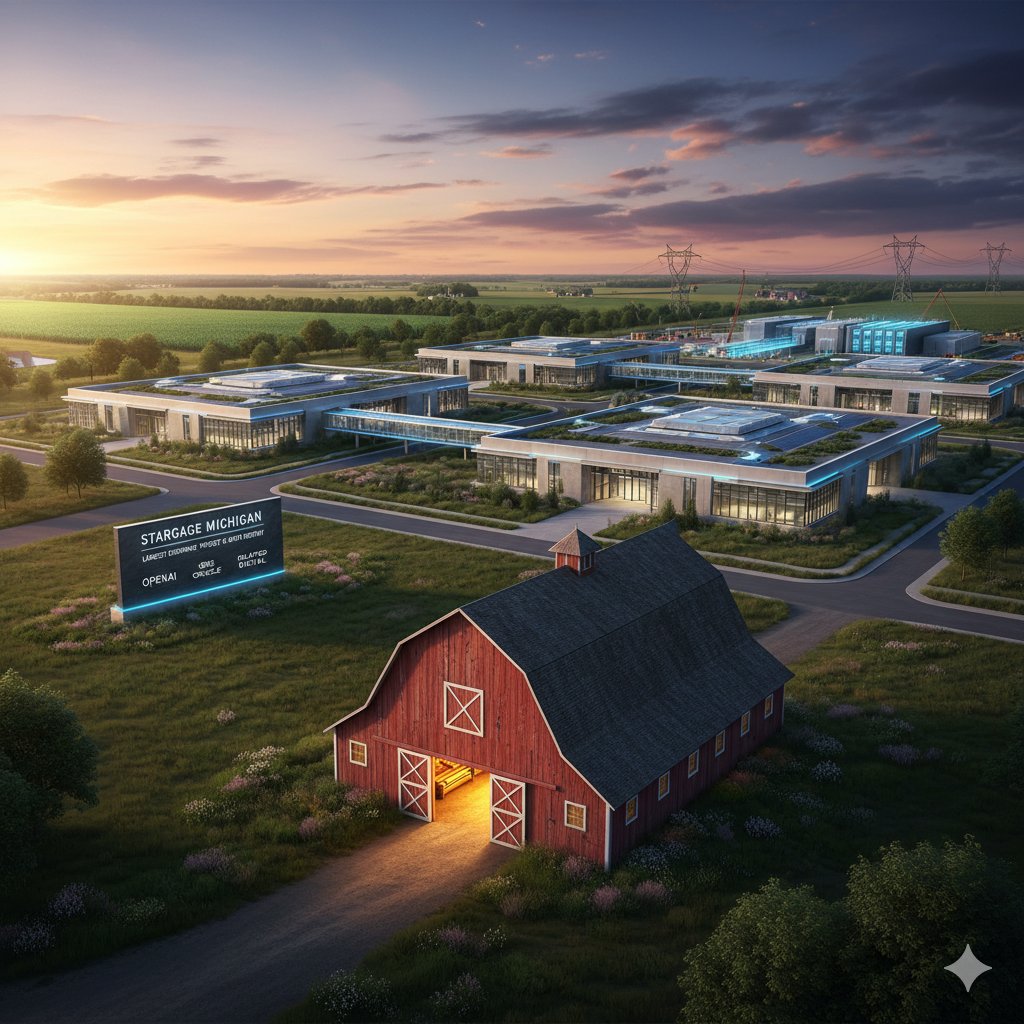
OpenAI is planting its biggest flag yet in the US, teaming up with Oracle and Related Digital on a $7 billion hyperscale data center campus in Michigan — a project billed as “the largest economic project in the state’s history.”
According to press releases, the Stargate Michigan site is set to break ground in early 2026 in Saline Township. It will consolidate multiple data center buildings into a single campus, delivering more than a gigawatt of capacity and anchoring OpenAI’s nationwide infrastructure expansion to power the next generation of artificial intelligence tools.
A gigawatt gamble on America’s AI future
The Michigan campus is part of OpenAI’s sweeping Stargate initiative: a $450 billion, multi-state buildout with Oracle and SoftBank that will add more than eight gigawatts of computing capacity nationwide. OpenAI calls it an opportunity to “reindustrialize the country,” using AI infrastructure to spark a new wave of economic and technological renewal across the country.
Planned for 250 acres in Saline Township, the 2.2-million-square-foot facility will feature three single-story buildings of around 550,000 square feet each. Internally dubbed “The Barn,” the site pays homage to the historic red barn that will be preserved at its entrance, a nod to Michigan’s manufacturing and agricultural roots.
The plan’s design aims for LEED certification, a green-building standard for energy efficiency and sustainability. It features a closed-loop cooling system that reduces water usage to office-building levels.
“This project will help ensure Michigan is a key part of building the AI infrastructure that will power the next generation of American innovation,” said Peter Hoeschele, OpenAI’s vice president of industrial compute.
Billions in investment and thousands of jobs
The multibillion-dollar Stargate Michigan investment is expected to bring a major boost to the region.
State officials said the project will create 2,500 union construction jobs, more than 450 permanent high-skill roles on site, and another 1,500 community and support jobs once operations begin. Gov. Gretchen Whitmer called it a “transformational win” that cements the state’s role in the next wave of advanced industry.
Aside from the workforce impact, developers have pledged $14 million in local investments spanning farmland preservation, public safety, and community infrastructure, commitments requested by the Saline Township Board as part of the deal. Detroit-based Walbridge will serve as general contractor, extending the city’s century-long tradition of leading complex industrial builds.
Tax breaks under Michigan’s 2024 data center law helped clinch the deal, a step Whitmer said carries the state from “making things to making the future.”
Power stability with no rate hikes
The project is expected to draw an estimated 1.4 gigawatts of power from DTE Energy, leveraging existing grid capacity supported by a developer-funded battery storage facility and a $6 billion investment in grid modernization over the next five years. DTE said the setup will prevent strain on the grid, shield residents from higher rates, and help manage surging AI-related energy demand.
Company president and CEO Joi Harris called it “an exciting milestone” that will bring “affordability benefits for existing customers,” Bridge Michigan reported.
Environmental safeguards are also built into the agreement. The project will preserve 700 acres of farmland, wetlands, and forest, and Michigan’s 2024 clean energy law requires data centers to source 90% renewable power to qualify for tax credits, a target the Stargate campus is expected to meet through its LEED-certified design.
More about data centers
- Stargate Norway: OpenAI’s First AI Data Center in Europe
- AI Data Centers’ Soaring Energy Use: Who Pays for Higher Utilities Costs?
- China’s Submerged AI Data Center Could ‘Influence Global Sustainable Computing’
- Google to Power Data Centers With Nuclear Energy by 2030 in First-Of-A-Kind’ Agreement
Progress or price tag?
Not everyone in Saline Township is ready to trade cornfields for server racks.
The billion-dollar plan faced months of resistance from residents worried about noise, energy use, and the erosion of the area’s rural character. “You can’t live in the horse-and-buggy days no more,” township commissioner Ronald Kohler told Bridge Michigan, after approving a revised deal that included new environmental safeguards and local investments.
The plan only moved forward after a zoning dispute ended in court. Developer Related Digital sued the township for exclusionary zoning, and a settlement cleared the way for construction to proceed.
Environmental groups, meanwhile, warn that the state’s growing data center boom could derail Michigan’s 100% clean energy goals. The Michigan Environmental Council has voiced concern that new gas generation built to meet rising power demand could undermine those commitments.
Despite the tension, officials frame the Stargate campus as part of a broader transformation that could turn Michigan’s industrial legacy into digital infrastructure for the AI age.
The investment adds to a busy stretch for OpenAI, which also recently finalized a revised partnership agreement with Microsoft to clarify IP ownership and AGI development oversight.