


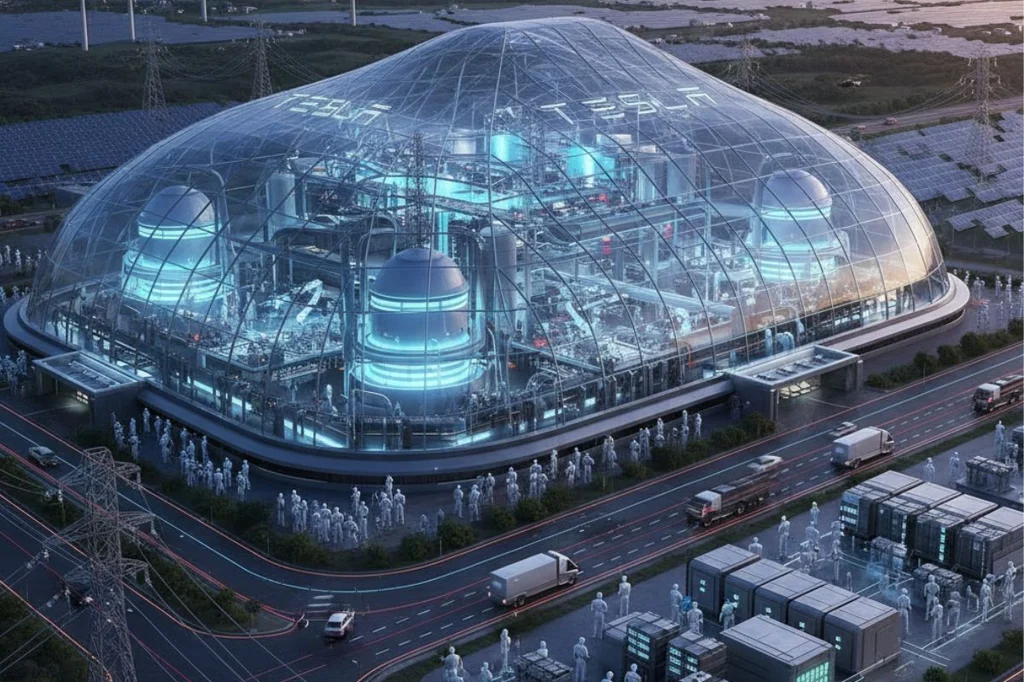
Elon Musk is plotting Tesla’s next big leap beyond cars: building its own “terafab,” a chip manufacturing plant designed to fuel the company’s growing AI ambitions.
Speaking at Tesla’s 2025 Annual Shareholder Meeting, Musk said global supply from partners like TSMC and Samsung may not be enough to meet Tesla’s AI chip needs. He floated the idea of a “gigantic chip fab” to secure Tesla’s AI supply, calling chips and electricity the company’s main constraints ahead.
Taking chipmaking into its own hands
Musk said Tesla’s long-term strategy is to control every layer of its AI hardware, from chip design to production. He told shareholders that relying on outside foundries could slow the company’s expansion into robotics and autonomous systems.
Tesla currently works with TSMC and Samsung to manufacture its custom chips, but may explore deeper partnerships or new routes altogether. Musk confirmed he has spoken with Intel about possible collaboration, but clarified that no deal has been signed.
“It’s probably worth having discussions with Intel,” he stated, adding that Tesla’s main concern is securing enough chips to meet future demand. Musk said that Tesla has agreed to take full output from a partner fab, but even that may fall short of projected needs.
Chips promising big gains in power and performance
Musk said Tesla’s in-house AI5 processor is nearing production, with volume to follow after initial runs. Designed for the company’s autonomous and robotics programs, it’s tuned to run Tesla’s neural networks more efficiently than existing hardware.
He told shareholders the chip uses roughly one-third the power of Nvidia’s Blackwell at under one-tenth the cost. Its integer-first design, optimized for Tesla’s AI software, maintains high performance while significantly reducing energy consumption.
Within a year of AI5’s production start, AI6 is expected to roll out and roughly double its performance.
Giga… but way bigger
Tesla’s proposed terafab would begin with a target capacity of 100,000 wafer starts per month, according to Musk, a scale he expects to multiply tenfold as the company’s AI footprint expands.
He told shareholders that such volume is necessary to power Tesla’s growing ecosystem of autonomous vehicles and humanoid robots. Without it, he said, the company risks being bottlenecked by chip supply just as demand for its AI systems accelerates. If supplier capacity can’t keep up, he added, building a very large fab becomes the only option.
Calling the plan “giga, but way bigger,” Musk presented terafab as the platform that will carry Tesla’s AI ambitions to industrial scale.
More must-read AI coverage
- SS&C Intralinks DealCentre AI vs. Datasite: Which platform is built for the future of dealmaking?
- SS&C Intralinks FundCentre AI vs. Juniper Square: Which platform better supports modern private markets fund managers?
- Why Data, Not Models, Determines AI Success
- The Rise of the AI-Native Factory: How Physical AI Is Transforming Manufacturing
The future of Tesla is built on chips
Musk told shareholders he’s “super hardcore on chips right now,” highlighting the central role semiconductors play in Tesla’s direction. He said chips and electricity are the two factors that will ultimately determine the pace of the company’s expansion.
The technology, he added, goes far beyond powering vehicles. Tesla’s AI chips will also power its Optimus humanoid robots, autonomous fleets, and large-scale inference systems — the infrastructure behind its broader AI push.
By investing more deeply in silicon, Musk noted, Tesla aims to secure the computing backbone needed to sustain its next wave of AI and robotics growth.
Google, meanwhile, is touting new breakthroughs in AI silicon with the debut of its Ironwood TPU and Arm-based Axion chips.