
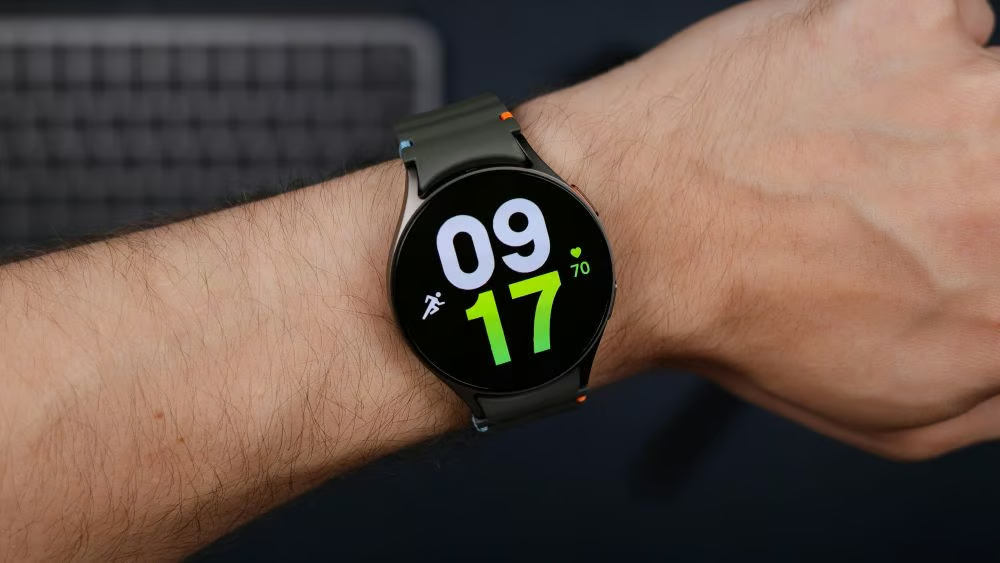


The dream is simple: glance at your wrist, check your blood sugar, skip the finger prick.
Samsung has pushed the Galaxy Watch deeper into health tracking, from ECG and sleep features to body composition, blood pressure monitoring, and AI-powered wellness tools. But blood sugar tracking remains the elusive prize. Despite years of rumors and research around non-invasive glucose monitoring, no current Galaxy Watch can directly measure blood glucose on its own.
That makes Samsung’s next move worth watching. If the company can develop an accurate, reliable, and regulator-approved glucose-monitoring feature, the Galaxy Watch could evolve far beyond its current role as a fitness and wellness device.
- Can the Samsung Galaxy Watch track blood sugar today?
- What works today: CGM integrations, not watch-based glucose sensing
- Why blood sugar tracking is so difficult
- Samsung’s glucose monitoring timeline
- What Samsung research suggests
- Could Samsung beat Apple to smartwatch glucose tracking?
- What to watch next
- Bottom line
Can the Samsung Galaxy Watch track blood sugar today?
No. Current Samsung Galaxy Watch models do not directly measure blood sugar.
Galaxy Watches can track health signals such as heart rate, sleep, blood oxygen, body composition, and ECG. Samsung has also expanded blood pressure monitoring in some markets, including a phased U.S. rollout, though availability depends on region, device model, app support, phone compatibility, and local availability requirements.
Where supported, users typically need the Samsung Health Monitor app, a Galaxy Watch 4 or newer, a Galaxy phone running Android 12 or later, and calibration with a traditional blood pressure cuff, followed by periodic recalibration. Samsung notes that the feature is not intended to diagnose hypertension or replace professional medical equipment.
Blood sugar is different. Glucose readings are used by people with diabetes to make serious health decisions, including food intake, medication, and insulin dosing.
That raises the regulatory bar. In 2024, the US Food and Drug Administration warned consumers not to use smartwatches or smart rings that claim to measure blood glucose without piercing the skin. The agency said it had not authorized any smartwatch or ring to measure or estimate blood glucose values on its own.
That warning does not apply to smartwatch apps that display data from an authorized continuous glucose monitor, or CGM. A watch can show glucose data from another medical device. It cannot replace that device unless regulators approve it.
What works today: CGM integrations, not watch-based glucose sensing
For now, the practical option is still a CGM from companies such as Dexcom or Abbott. These systems use a small sensor placed under the skin to monitor glucose in the interstitial fluid and send readings to a phone, a receiver, or a compatible watch app.
That distinction matters. A Galaxy Watch may serve as a display or notification surface for glucose data, depending on app support and device compatibility. But the watch itself is not the glucose sensor.
This is the same reality across the smartwatch market. Apple, Samsung, Garmin, Oura, and other wearable makers are chasing richer health insights, but true non-invasive glucose monitoring remains one of the hardest problems in consumer health tech.
Why blood sugar tracking is so difficult
Smartwatches are good at measuring signals that can be detected optically or electrically from the wrist, such as heart rate trends, blood oxygen estimates, and movement. Glucose is trickier.
Blood sugar levels fluctuate in the body, and accurate readings require separating a tiny biochemical signal from noise caused by skin tone, sweat, motion, temperature, hydration, blood flow, and sensor placement.
That is why most approved CGMs still use a sensor that goes under the skin. Non-invasive systems may eventually use light, spectroscopy, sweat analysis, or other methods, but the challenge is not simply detecting glucose. The challenge is detecting it accurately, consistently, and safely enough for real-world health decisions.
Samsung’s glucose monitoring timeline
Samsung has been linked to non-invasive glucose monitoring for years, but the timeline has stretched longer than early rumors suggested.
2020: Public summaries describe Samsung and MIT research on spectroscopy
Public summaries describe 2020 Samsung research with MIT scientists exploring non-invasive glucose monitoring using Raman spectroscopy, a light-based sensing technique that could potentially estimate glucose levels without piercing the skin. The findings generated significant interest in wearable health circles, though the research remained far from a commercial, regulator-cleared product.
The research helped fuel expectations that Samsung might bring glucose monitoring to a future Galaxy Watch. But a research breakthrough is not the same as a consumer-ready, regulator-cleared product.
2022–2024: Rumors grow, but no launch
Reports and industry chatter repeatedly pointed to glucose monitoring as a possible future Galaxy Watch feature. Some speculation centered on whether Samsung could introduce the feature before Apple, which has also been widely reported to be exploring non-invasive glucose tracking.
But Samsung did not ship blood sugar tracking with the Galaxy Watch 5, Watch 6, or Watch 7 lines. The feature also did not appear in the Galaxy Ring, which focuses on sleep, activity, and wellness tracking rather than glucose measurement.
2026: Samsung expands health features, but glucose remains absent
Samsung’s health platform continues to grow. Recent Galaxy Watch and Samsung Health updates show a clear strategy: combine more sensors, more passive monitoring, and more AI-driven interpretation.
That direction could eventually yield insights into metabolic health. But as of now, Samsung has not announced a Galaxy Watch that can directly measure blood glucose.
What Samsung research suggests
Patents do not guarantee products, but they can offer clues about where a company is investing its research efforts. Still, Samsung’s most concrete public signal is research rather than a confirmed roadmap for a Galaxy Watch glucose patent.
Samsung has spent years exploring non-invasive glucose monitoring technologies. Public summaries describe the company’s 2020 research with MIT scientists on Raman spectroscopy as a potential method for estimating glucose levels without piercing the skin.
Public reports and patent summaries have linked Samsung to optical sensing systems, biometric analysis technologies, and other health-monitoring concepts that could support future metabolic-health features. However, Samsung has not publicly tied any specific patent filing to a future Galaxy Watch glucose-monitoring product, and patents alone should not be viewed as evidence that a feature is nearing release.
The likely goal is not just a single reading. Samsung would need a system that works across different skin tones, activity levels, temperatures, hydration states, and real-world conditions. It would also need regulatory clearance before being marketed as a glucose-monitoring solution.
For now, Samsung’s research and patent activity suggest long-term interest rather than an imminent product launch.
Could Samsung beat Apple to smartwatch glucose tracking?
Possibly, but there is no confirmed timeline.
Samsung has moved quickly in wearable health, and the company already has a broad Galaxy Watch lineup, Samsung Health, and the Galaxy Ring. Apple has an enormous wearable scale and has also been widely reported to be exploring non-invasive glucose tracking.
The race is less about who files the most patents and more about who can prove accuracy, reliability, safety, battery efficiency, and regulatory compliance. A glucose feature that is wrong at the wrong time would be far worse than no feature at all.
That is why the first version may not look like a full CGM replacement. Samsung could start with glucose-adjacent insights, risk scoring, nutrition trends, or alerts based on indirect signals rather than direct blood sugar values.
What to watch next
The clearest signs of progress would be a Samsung announcement that specifically mentions glucose, metabolic health, or non-invasive sensing; new Galaxy Watch sensors designed for spectroscopy or biochemical measurement; FDA filings or regulatory activity tied to glucose monitoring; or deeper partnerships with CGM companies such as Dexcom or Abbott.
Samsung Health could also move closer to metabolic tracking by connecting meals, activity, sleep, and risk signals more directly. That would not be the same as blood sugar monitoring, but it could be a stepping stone.
Until then, blood sugar tracking on the Galaxy Watch should be treated as a future possibility, not a current feature.
Bottom line
Samsung Galaxy Watches cannot directly track blood sugar today. They can support a growing set of wellness and heart-health features and may display glucose data from compatible external devices, but they are not a replacement for a CGM or blood glucose meter.
The real story is not that Samsung is late. It is that glucose tracking is one of the hardest remaining frontiers in wearable health.
For now, the safest answer is also the most useful one: use an approved glucose monitor for blood sugar readings, treat smartwatch rumors carefully, and watch Samsung’s next health features for signs that the company is inching closer to metabolic health tracking.
Curious how Samsung’s efforts compare to Apple’s? Read our deep dive into the Apple Watch blood sugar tracking timeline, including the patents, rumors, and challenges facing non-invasive glucose monitoring.