


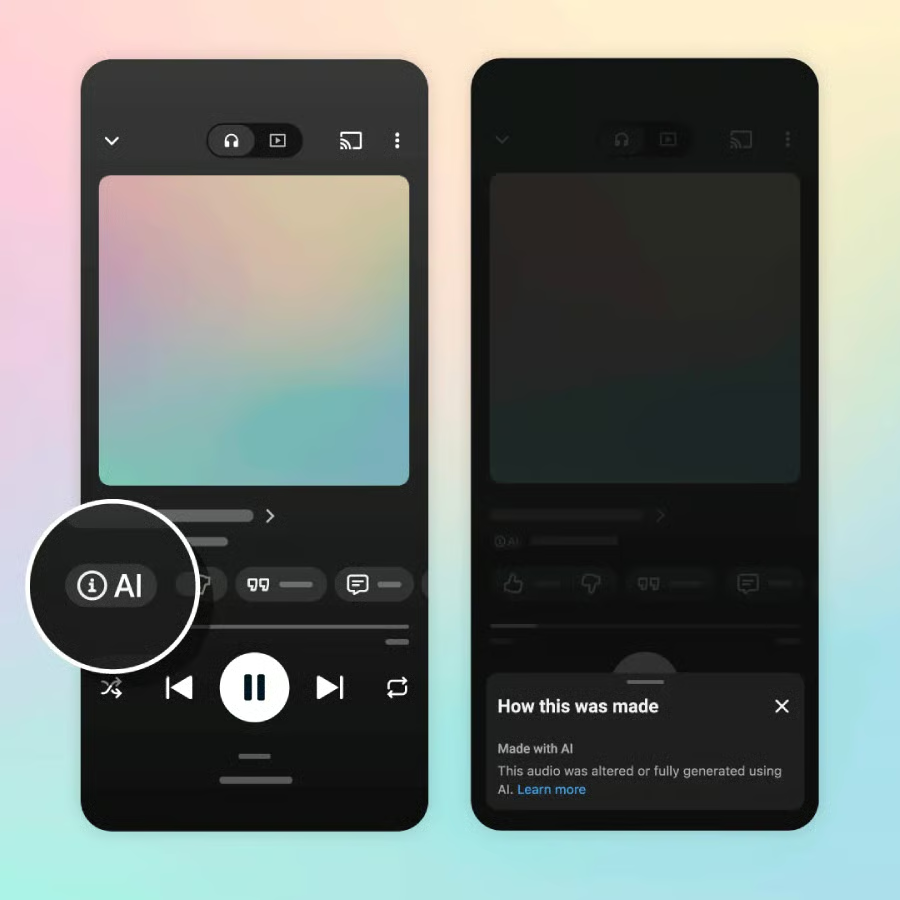
YouTube Music is putting an AI label where listeners can see it before deciding whether a song deserves a spot on their playlist.
The streaming service began rolling out labels on Oct. 14 for songs created primarily using generative AI, including generated compositions and vocals.
A label now appears on the YouTube Music player page, and tapping it opens a menu with more information. YouTube says the music labels will also expand to its main app.
“Generative AI is opening up new ways for artists to create, experiment, and share music,” YouTube wrote in a blog post. “As these tools evolve, our listeners have told us they want transparency when they’re hearing an AI-generated track.”
A three-tiered verification net
YouTube combines its own detection tools with partner disclosures. Record labels and distributors can submit “Fully Gen AI,” “Partly Gen AI,” or “No Gen AI” declarations through supported DDEX or CSV metadata feeds.
YouTube’s examples distinguish generative contributions from routine production assistance. A prompt-based song generated entirely by software can be declared “Fully Gen AI,” while live vocal tracks layered over an AI-composed bassline can be declared “Partly Gen AI.” Industry-standard studio utilities, such as Auto-Tune or automated mastering equalizers, remain classified as “No Gen AI.”
If partners omit a declaration, YouTube treats the content’s status as unknown unless other signals support a classification. Missing metadata therefore does not prevent labeling, but an unlabeled song is not necessarily free of generative AI.
Industry fractures over synthetic audio
Streaming services are splintering over how to handle algorithmic content. Deezer revealed in July that it was receiving roughly 90,000 fully AI-generated tracks every day. Deezer excludes detected AI-generated tracks from recommendations and editorial playlists and removes fraudulent streams from royalty payments. Tidal separately makes recordings it identifies as wholly AI-generated ineligible for royalties and lets users block AI-labeled recordings in Settings.
YouTube says an AI disclosure label alone does not affect recommendation treatment or monetization eligibility. Other platform rules still apply. That differs from Spotify’s approach to AI Persona accounts, which focuses on synthetic artist identities rather than how individual songs were produced.
For listeners comparing services, disclosure, filtering, and payment restrictions serve different purposes. A label helps explain a track’s production; a filter controls whether it plays; and monetization rules determine whether it can earn money. YouTube’s announcement centers on disclosure rather than a new listening filter.
Labels also cannot establish whether listening activity is legitimate. AI music streaming fraud involves manipulated engagement and royalty payments, which requires separate checks on accounts and playback patterns.
More must-read AI coverage
- SS&C Intralinks DealCentre AI vs. Datasite: Which platform is built for the future of dealmaking?
- SS&C Intralinks FundCentre AI vs. Juniper Square: Which platform better supports modern private markets fund managers?
- Why Data, Not Models, Determines AI Success
- The Rise of the AI-Native Factory: How Physical AI Is Transforming Manufacturing
What listeners should check before saving a song
Check the player-page label and tap it for more information. YouTube’s partner guidance distinguishes fully generated content from work with partial generative AI contributions, but listeners should not assume the badge identifies every generated instrument, lyric, or vocal. An AI-generated bassline beneath a human performance differs from a song generated entirely from a prompt.
Use that information to guide playlist choices rather than treating every labeled recording as equivalent. Artist credits and release information may provide additional context when a disclosure lacks detail, although neither independently verifies how a recording was made. An absent badge also does not certify human authorship: YouTube has not established that its system identifies every AI-generated track.
Labels should also be assessed separately from listening controls. A disclosure does not automatically skip a song, remove it from recommendations, or prevent it from earning money. YouTube’s announcement does not describe a setting for excluding AI-generated tracks, leaving listeners with strong preferences responsible for individual playback and playlist decisions.
For anyone comparing streaming subscriptions, ask what each service labels, whether labeled recordings can be blocked, and whether those controls affect playback, recommendations, or search. Those differences determine how much control listeners actually receive. YouTube Music’s update adds production context, but users seeking an exclusively human-made catalog should not treat labeling alone as a complete screening tool.
Read more: Beyond streaming labels, Australia’s music charts are drawing a line between AI-assisted recordings and songs whose primary creative elements are generated by AI.