


Two new studies found that people are curious about augmented reality but skeptical that the tech infrastructure is ready for prime time. However, there are some glimmers of progress mixed in with all the metaverse hype that could bring virtual worlds to the mainstream of business and consumer products.
More about Innovation
- Sovereign AI Explained
- The Rise of the AI-Native Factory
- Why Data Determines AI Success
- SS&C Intralinks DealCentre AI vs. Datasite: Which platform is built for the future of dealmaking?
Kiran Raj, practice head of disruptive tech at GlobalData, said that latency is the biggest barrier to the adoption of virtual reality.
“Potential solutions could be in terms of network protocols, software applications or hardware such as chips and AR and VR devices,” he said.
Abhishek Paul Choudhury, senior disruptive tech analyst at GlobalData, said data flow needs to be fast and continuous.
SEE: Why a safe metaverse is a must and how to build welcoming virtual worlds
“Decentralized routing protocols along with technological advancements like Wi-Fi 7, blockchain, and edge computing can bring in better throughput and low latency as compared to the existing network capabilities,” Choudhury said.
GlobalData lists these advances as potential solutions to latency and other metaverse barriers:
- Syntropy’s relay network which uses decentralized autonomous routing protocol to connect data centers around the world
- TYXIT’s SaaS-based conferencing app with low latency and high-fidelity audio that allows for optimal latency of under 30 milliseconds
- Broadcom’s Wi-Fi 7 chips for residential and enterprise access points and mobile devices that feature advanced multi-link operation
- Vuzix’s AR smart glasses that incorporate a proof-of-concept program that uses Verizon’s 5G and edge computing platform to run applications at the ‘edge’ of the network
Gamers are curious but skeptical about the metaverse
Research from tech consulting firm Amdocs reinforces the Global Data research around barriers to adoption. A survey of gamers in the U.S. and the U.K. found that consumers are interested in the metaverse, but concerns around poor connectivity and hardware costs are barriers to adoption. Findings from the research include:
- The majority of gamers would consider going all-in on cloud and skip purchasing new hardware.
- The gaming community is evenly split between men and women gender and includes a significant number of baby boomers.
- The biggest barriers to the metaverse from a gamer’s POV are poor internet connectivity, expensive hardware and relevant use cases.
- Gamers would pay more for their cloud gaming subscription if it was bundled with a dedicated 5G connection.
- Gamers put the quality of games from cloud gaming providers at the top of the list ahead of price and quantity of games.
Gil Rosen, chief marketing officer at Amdocs, said in a blog post about the research that virtual worlds have the potential to be as important as email or social media but first the industry has to address hardware costs and network readiness among other factors.
“Just like the iPhone turned the internet into mobile, the metaverse will disrupt the internet as we know it and gamers will be at the front lines of this evolution,” he said. “While metaverse experiences for gaming are certainly a meaningful step in mainstream adoption, it’s only one aspect.”
Warming up the metaverse flywheel
A new report from Boston Consulting Group, “The Corporate Hitchhiker’s Guide to the Metaverse” predicts that the metaverse flywheel powered by cheaper and better technology will build the user base, content and virtual assets and the creator ecosystem. The report estimates a $250 billion to $400 billion market opportunity.
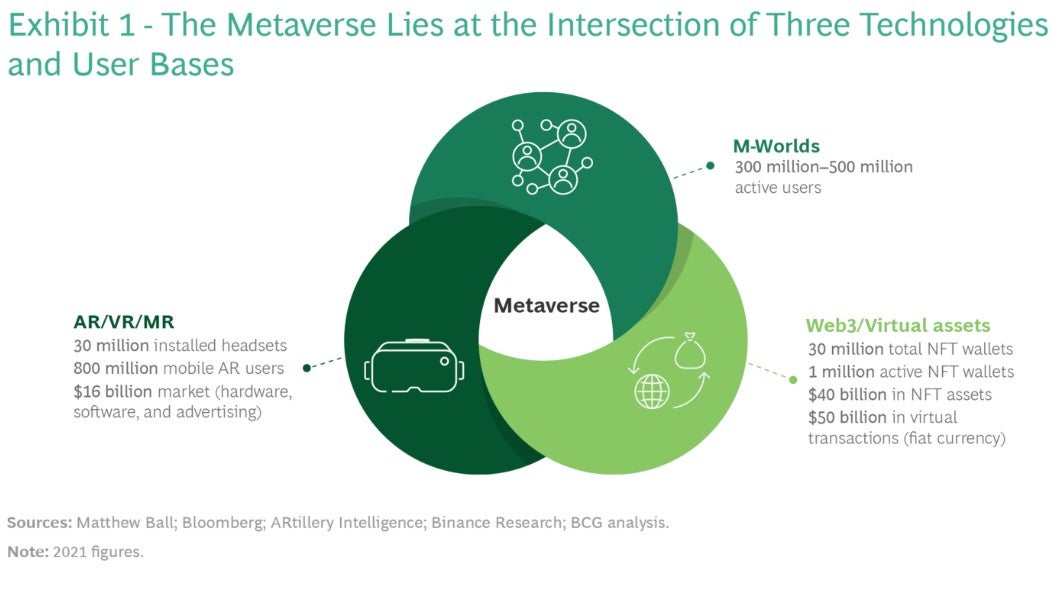
A BCG report predicts that sales of AR and VR headsets will hit 88 million in 2025 up from only 16 million in 2020. The analysts see phones as a bridge in this transition via mobile AR:
“More than half of the 6 billion smartphones in use today are sufficiently powerful to enable mobile AR. In addition, the software development kits from Apple for iOS, and from Google for Android, can be extended to AR and VR development. According to research from ARtillery Intelligence, 800 million users actively use mobile AR, a number that it projects will grow to 1.7 billion in 2025.”
Business use cases for this tech include analysis and simulation, augmented workforce, virtual collaboration and training and development.
According to the report, this will require the convergence of several factors, all of which involve step changes in technological capability:
- Metaverse worlds—m-worlds—are gathering hundreds of millions of active users thanks to the powerful computing capacity and mass-market availability of phones, tablets and PCs, as well as improvements in cloud services and connectivity, such as fiber and 5G.
- A mass market for augmented, virtual and mixed-reality (AR, VR and MR) headsets is growing fast, with devices such as Meta Quest 2 affordable and easy to use.
- Virtual assets powered by an innovative Web3 technology stack are rising in popularity as objects to acquire and exchange.