


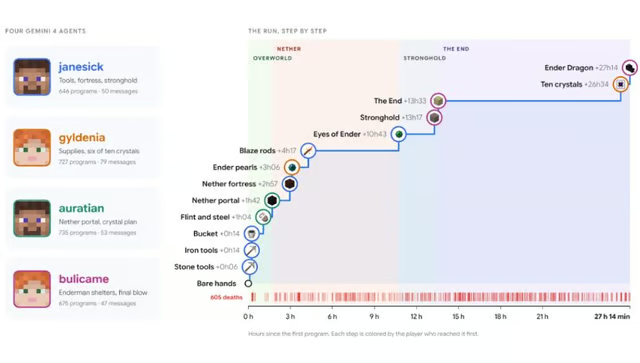
Four AI agents just defeated Minecraft’s Ender Dragon without human assistance. It took them more than 27 hours and hundreds of failed attempts.
In a research paper published on arXiv, Google DeepMind researchers described how four agents powered by Gemini 4 Argon worked together to complete the game in 27 hours and 14 minutes.
Starting empty-handed in a randomly generated survival world on Easy difficulty, the agents gathered resources, crafted equipment, and eventually defeated the final boss.
“To our knowledge, this is the first end-to-end autonomous completion of Minecraft by AI agents, achieved using only the standard Mineflayer library without pre-scouted seeds or other game-specific tools written by humans,” wrote DeepMind researchers Maxence Faldor, Satinder Singh, and Roberta Raileanu.
The experiment offers a glimpse of how AI agents can coordinate on complex tasks over extended periods. But the costly, error-prone run also highlights the challenges of deploying similar systems in real-world environments.
How four AI agents worked together to beat Minecraft
Rather than pressing keys or looking at pixels, each bot interacted through Mineflayer, an open-source JavaScript library. The agents operated by writing short code snippets to walk, mine, or fight, reading text feedback after each action. Across the run, they authored 2,783 custom programs and exchanged 229 in-game chat messages.
Without humans assigning individual roles during the run, the agents divided responsibilities among themselves. Janesick manufactured tools, gyldenia gathered food, auratian activated the portal, and bulicame constructed defenses and landed the final strike.
When auratian drowned while carrying all 12 Eyes of Ender, teammates calculated the despawn countdown and rushed to rescue the dropped gear.
The run was far from flawless: the agents died 605 times, 22% of their programs threw errors, and a fifth bot dubbed “the Observer” tracked the session to verify no rules were broken. The run burned 1.35 billion input tokens, totaling roughly $520 at introductory list rates, or $1,620 for the full session at standard pricing.
Beyond the sandbox
The experiment’s significance extends beyond Minecraft. It demonstrates how multiple AI agents can coordinate over an extended period, divide responsibilities, and recover from repeated failures while working toward a shared objective.
Rather than following a fixed sequence of instructions, the agents generated code, interpreted feedback, and adjusted their actions as the game progressed. Their ability to continue after hundreds of deaths illustrates the potential of persistent, multi-agent collaboration.
The transition from isolated prompt-and-response bots to persistent multi-agent collaboration signals a shift in computational problem-solving.
The real-world friction
For enterprise leaders evaluating autonomous agents, the experiment highlights sharp limitations. The bots succeeded in an environment where underlying data such as block coordinates and entity health were directly exposed via an API.
They did not have to perceive messy visual interfaces as human workers do.The reported 22% program error rate also raises questions about reliability.
Errors that agents can recover from in a video game may carry far greater consequences in enterprise environments, particularly when workflows involve sensitive data, financial transactions, or production systems.
More Google coverage
- New Google Search AI Mode is ‘Total Reimagining,’ Says CEO Sundar Pichai
- In Major Ruling, Judge Finds Google ‘Willfully Acquired and Maintained Monopoly Power’ Over Digital Ad Market
- Google’s Big Bet on Nuclear Energy: ‘The Race to Power AI-Driven Data Centers is Accelerating’
- Computer History Museum Releases Original AlexNet Code: Why It Matters
How this affects everyday users
For everyday gamers and knowledge workers, autonomous multi-agent systems are moving from novel research into practical software.
- Smarter game companions: Players will soon encounter non-player characters (NPCs) that act as genuine collaborators, managing inventories, building bases, and learning tactics dynamically instead of relying on canned dialogue trees.
- Delegating complex digital chores: Instead of micro-managing basic AI assistants for single queries, professionals will soon hand off open-ended, multi-step workflows, such as aggregating complex market data or refactoring codebases to teams of specialized digital agents that debug their own missteps in real time.
The Minecraft experiment offers an early example of how that collaboration might work. Rather than relying on a single AI assistant to handle every step, multiple agents divided responsibilities, communicated with one another, and adapted when their plans failed.
Similar approaches could eventually help users manage complicated tasks that require different skills or repeated adjustments.
However, the experiment also shows why these capabilities are not yet a substitute for human oversight. The agents required more than 27 hours, generated thousands of programs, and experienced hundreds of deaths before completing their objective.
While those setbacks were recoverable in Minecraft, comparable mistakes in financial transactions, workplace systems, or sensitive data handling could carry much greater consequences.
Other news: Apple claims Safari delivers up to five more hours of video streaming than Chrome on MacBooks, but independent testing paints a more complicated picture.