


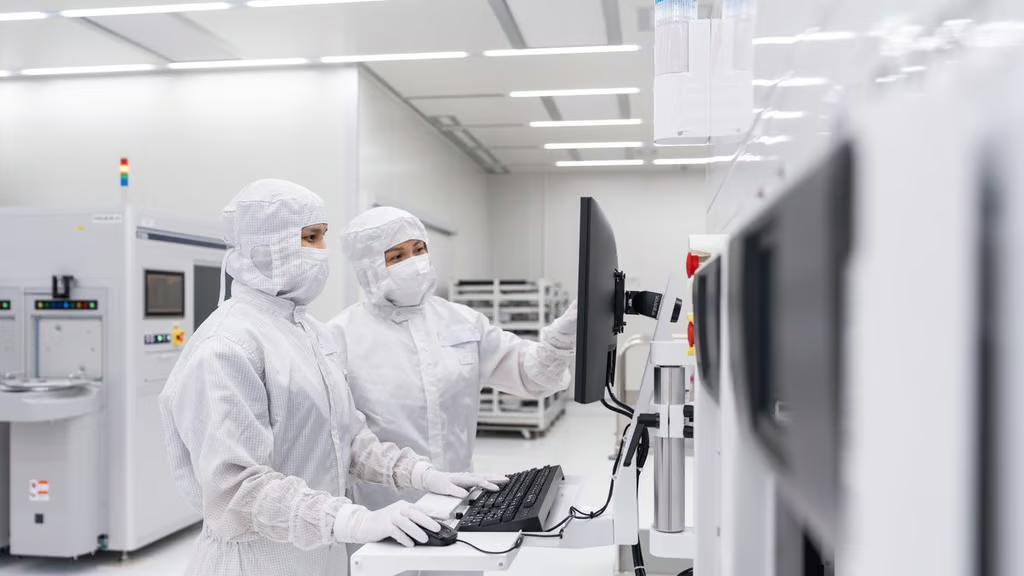
Infineon is scaling up its manufacturing footprint in Southeast Asia. The German chipmaker opened a backend semiconductor hub in Samut Prakan, Thailand, on Oct. 1, 2026, with about 350 employees and plans to grow the workforce to roughly 1,000 as its first production building ramps up.
The site adds assembly, testing, and wafer-test capacity in Southeast Asia while giving Infineon another regional manufacturing base. For Thailand, the opening supports a wider push beyond electronics assembly into higher-value semiconductor manufacturing.
Similar investment is spreading across Southeast Asia. Singapore recently opened a $7.8 billion chip fab targeting specialty chips for automotive, industrial, computing, and consumer applications.
What Infineon is building in Thailand
The Samut Prakan site handles semiconductor backend processes, including assembly and testing after wafers are fabricated, as well as wafer testing. Infineon’s Oct. 1 announcement says Module A is the first building on a site designed to expand to as many as five modules.
Module A includes about 30,000 square meters of cleanroom space and highly automated production equipment. Infineon says the site uses 100% green electricity and incorporates solar generation, rainwater collection, and water recycling.
The company expects the workforce to grow from about 350 to roughly 1,000 as Module A ramps. Infineon’s Bangkok site says 95% of its local employees are Thai, while Nation Thailand reports that about 80% of the workforce consists of engineers and technicians. Nation also says Module A could reach full utilization in 2027 under current production plans and demand assumptions.
The site focuses on power modules and discrete products, wafer testing, and research and development. These technologies support electric vehicles, industrial systems, energy infrastructure, and other applications tied to electrification and energy efficiency.
Southeast Asia is also drawing more investment in data centers, power infrastructure, and advanced computing hardware. Aolani, for example, plans a deployment of 22,000 Nvidia Blackwell Ultra GPUs across Malaysia and the Philippines in early 2027.
Thailand’s role in Infineon’s supply chain
The location puts Infineon close to major electronics, automotive, and industrial supply chains while connecting it to markets across Asia. That geographic spread gives Infineon more manufacturing flexibility as governments and technology companies work to reduce concentration risks across chip supply chains.
Thailand, meanwhile, wants to capture more of the semiconductor value chain. The country has prioritized power semiconductors, advanced packaging, testing, sensors, and related technologies that build on its existing automotive and electronics base.
The Thailand Board of Investment says Infineon’s broader investment program is expected to create more than 5,000 skilled local jobs across planned phases, or about 1,000 positions per phase. It also says Infineon is working with universities and industry groups on at least 60 semiconductor courses, training for 1,100 undergraduate students, and 18 joint research projects.
Infineon has not disclosed product-level output volumes or announced when construction of a second module will begin. The longer-term question is whether projects such as this can turn Thailand’s established automotive and electronics base into a deeper semiconductor manufacturing ecosystem.
Read more: Semiconductor manufacturers are also facing higher production costs, with TSMC reportedly preparing manufacturing price increases of up to 10% in 2027.