


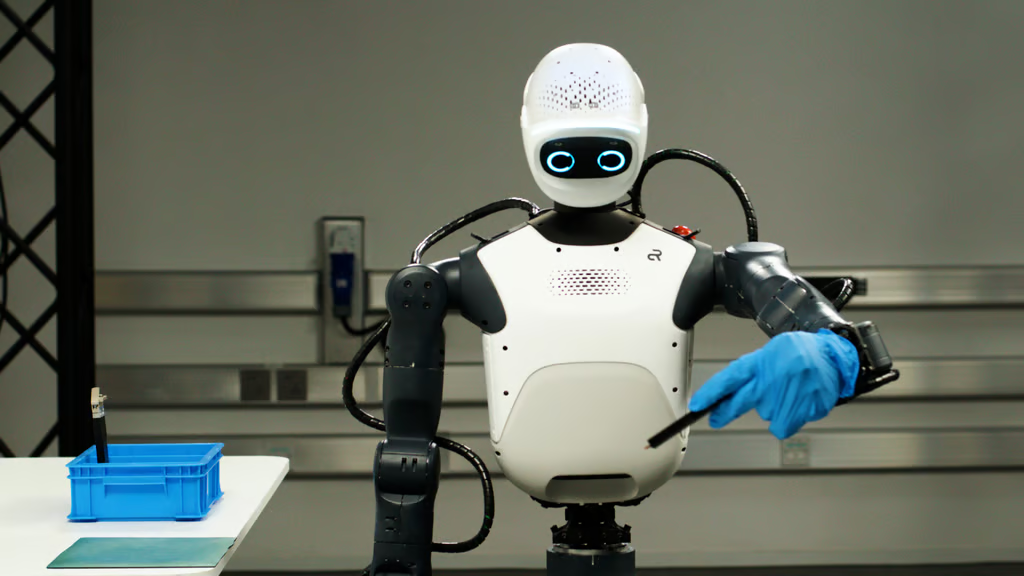
Agile Robots and Nvidia have unveiled Agile ONE SN, a compact humanoid robot that comes with the computing power and AI tools researchers need to teach machines new skills. Instead of building a robotics development system from separate components, labs can start with an integrated platform.
Introduced Oct. 21 at Nvidia GTC in Berlin, the robot combines Agile Robots’ hardware with Nvidia’s Jetson Thor processor and Isaac GR00T software. The companies say the setup can cut integration work from weeks to days, although that estimate hasn’t been independently tested.
What can the Agile ONE SN humanoid robot do?
Agile ONE SN uses Agile Robots’ smaller Agile ONE S body, with Nvidia’s computing platform and robotics software preconfigured. It is designed for research, while the company’s full-sized Agile ONE targets industrial applications.
According to Agile Robots’ announcement, the robot’s specifications include:
- Height: 1.4 meters, or approximately 4 feet, 7 inches.
- Weight: 43 kilograms (95 pounds), according to Agile Robots. Nvidia lists 40 kilograms (88 pounds).
- Movement: 31 degrees of freedom in the body and 20 in each hand, totaling 71.
- Payload: Up to 3 kilograms (6.6 pounds) per arm.
- Hands: Two five-fingered Wuji hands with tactile sensing and force control.
- Sensors: Head-mounted RGB-D cameras, wrist cameras, 3D lidar, and motion sensors.
- Connectivity: Wi-Fi 7, Bluetooth, and an emergency stop button.
The companies haven’t explained the difference between their published weight figures.
The robot’s hands are designed for grasping and manipulating objects, while its cameras and sensors help it interpret its surroundings. Researchers can use those capabilities to develop coordinated movements and test how the robot responds to different tasks.
Agile Robots also intends for skills developed on ONE SN to transfer to its larger industrial humanoid. However, the companies haven’t published independent results demonstrating how reliably that transfer works.
How Nvidia’s AI tools help train the robot
Agile ONE SN runs on Nvidia’s Jetson Thor platform, which processes sensor data and supports AI-driven movement and control.
According to Nvidia’s announcement, the onboard system provides 128GB of unified memory and up to 2,070 FP4 teraflops of AI computing performance.
The robot also comes preconfigured with Isaac GR00T, including Nvidia’s GR00T 1.7 vision-language-action model.
Researchers can use the software to move through four stages of development:
- Capture demonstrations: Record examples of tasks or movements the robot should learn.
- Create simulations: Use Isaac Sim and Isaac Lab to recreate the robot and its surroundings.
- Train and evaluate: Develop control policies and test their behavior before trying them on hardware.
- Deploy and test: Transfer trained skills to Agile ONE SN and evaluate how they work in the real world.
Agile Robots supplies simulation assets that let developers bring the robot into Nvidia’s tools without creating a digital model from scratch.
The company also describes the platform as modular. Researchers can use the complete development workflow or combine individual components with their existing software.
The approach differs from humanoid demonstrations focused on individual physical feats. For example, Unitree’s recently unveiled H2-X humanoid robot was shown performing martial arts and simulated rescues, while Agile ONE SN is being positioned as a platform for developing and testing robotic skills.
When will Agile ONE SN be available?
Agile ONE SN is scheduled to become available in early 2027. Neither company has announced a price.
Stanford University and ETH Zurich are among the institutions that have expressed interest, but neither has been confirmed as a customer.
Agile Robots is also exploring integration with Nvidia’s Halos safety platform. That work remains in development, and the announcement doesn’t establish that the robot is certified for unsupervised industrial use.
The company says researchers will retain control of their data and can choose which parts of the development platform to use.
Agile ONE SN’s launch comes as robotics developers work to turn laboratory demonstrations into repeatable performance. In another experiment, Figure AI’s humanoid robots sorted packages during a livestreamed warehouse test, illustrating a different stage of the effort to move humanoids into practical tasks.
Agile ONE SN takes an earlier step in that process. It gives researchers a compact robot and a connected set of training tools, with the goal of reducing the time spent integrating hardware and software before experiments can begin.
Its planned 2027 release will give labs an opportunity to test that claim, along with the robot’s movement, manipulation, and ability to transfer learned skills to larger machines.
Also read: Figure AI’s 348-mile humanoid endurance test examines the challenges of keeping robots moving reliably over extended periods.