


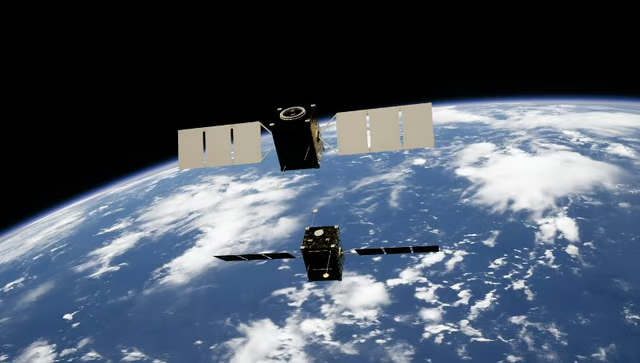
Google’s latest AI achievement is out of this world, literally. One of its AI models has written a poem from orbit and sent it back to Earth.
The tech giant launched the prototype satellite on Oct. 1 aboard a SpaceX Falcon 9 rocket, alongside more than 100 other spacecraft. After several weeks of commissioning, engineers powered up its onboard hardware, including the company’s Tensor Processing Units (TPUs), and began running machine learning tests.
On Friday, Oct. 30, Google announced that the satellite had completed its first successful AI response using Gemma 4, an open model developed by Google DeepMind and loaded onto the spacecraft before launch. During a ground-station pass, engineers sent the model a prompt asking it to write a haiku about space. The satellite generated the poem and transmitted it back to Earth as it passed Svalbard, Norway.
The result was:
“Blue marble below
Data streams in silent grace
Starlight feeds my core. ✨.”
Google also tested space-themed limericks and prompts requesting telemetry information about the satellite’s onboard systems. The company described the achievement as its first successful AI response from a data center-class TPU operating in orbit.
The hardware still faces some tough tests
The successful demonstration does not mean Google has a fully operational orbital data center. The satellite is still an experimental platform, and its computing hardware must survive conditions that are difficult to reproduce on Earth.
The spacecraft carries four TPUs and generates up to 1 kilowatt of electricity. However, its available power reportedly limits operation to one TPU at a time for approximately 20 minutes. Radiation presents another concern. Exposure can cause memory errors known as bit flips, potentially corrupting stored information without triggering conventional monitoring systems.
Google says its next round of tests will examine how the processors handle radiation exposure and thermal stress in orbit. These results will help determine whether the chips can reliably support AI workloads beyond short demonstrations.
Google is already planning the next launch
Google’s next milestone is to put two interconnected satellites into orbit in 2027. Unlike the current prototype, the planned spacecraft will have greater power-generation capabilities and demonstrate optical links that allow satellites to communicate directly with one another.
This connection is important because Google’s longer-term vision goes beyond running AI models on individual satellites. The company wants networks of closely positioned spacecraft that can exchange data and distribute computing workloads across multiple systems. That approach could eventually support larger AI inference workloads without requiring every satellite to operate as an isolated computing platform.
However, getting there will require more than successful chip tests. Spacecraft must manage heat without conventional air or water cooling, withstand radiation, and remain operational without the relatively straightforward maintenance available in terrestrial data centers. Launch costs and access to heavy-lift rockets such as SpaceX’s Starship will also influence whether the concept becomes economically practical, TechCrunch reported.
Could space-based data centers solve AI’s energy problem?
Google’s experiment comes as technology companies face growing pressure to secure sufficient electricity and computing capacity to meet increasingly demanding AI workloads.
Space-based infrastructure could offer an alternative. In suitable orbits, solar panels can receive sunlight for longer periods than comparable installations on Earth, potentially providing orbital computing systems with substantial access to renewable energy.
However, that advantage comes at a high cost. Launching processors and supporting equipment into orbit is expensive, while radiation exposure, heat management, and the difficulty of repairing hardware introduce challenges that conventional data centers do not face to the same degree.
For Google, the central question is whether the potential energy advantages can eventually outweigh those costs. The company’s planned 2027 satellite demonstration could provide more evidence about the technical feasibility of interconnected orbital computing, although it will not establish whether the technology is commercially competitive.
The business case for moving AI computing into space
Google’s experiment addresses a growing infrastructure challenge for the AI industry: finding enough electricity, land and computing capacity to support increasingly demanding workloads.
Space offers a potential alternative through solar energy and orbital computing infrastructure. Google has previously argued that solar panels in suitable orbits could generate substantially more energy than comparable installations on Earth.
But the economics remain uncertain. Launching heavy computing equipment, replacing failed components and maintaining satellites could make orbital infrastructure considerably more expensive than conventional data centers. Google is therefore testing a long-term infrastructure idea rather than preparing an immediate replacement for its terrestrial facilities. The 2027 satellite demonstration should provide a better indication of whether interconnected orbital computing can move beyond isolated experiments.
More Google coverage
- New Google Search AI Mode is ‘Total Reimagining,’ Says CEO Sundar Pichai
- In Major Ruling, Judge Finds Google ‘Willfully Acquired and Maintained Monopoly Power’ Over Digital Ad Market
- Google’s Big Bet on Nuclear Energy: ‘The Race to Power AI-Driven Data Centers is Accelerating’
- Computer History Museum Releases Original AlexNet Code: Why It Matters
What this means for AI users
For consumers and businesses using Google’s AI products, there is no immediate change. Project Suncatcher does not introduce a new Gemini feature, subscription option, or publicly available space-based computing service.
Developers also cannot currently deploy workloads to Google’s orbital infrastructure.
The Gemma 4 demonstration only confirms that an onboard TPU could run a model and return its response through a ground-station connection. If Google eventually makes the technology commercially viable, however, it could give cloud providers another way to expand AI computing capacity as demand for processing power and electricity increases.
For enterprise customers, that could eventually translate into additional infrastructure options for AI workloads. But reliability, connectivity, data security, operating costs and the ability to maintain hardware remotely will need to be established before businesses can consider space-based computing a practical cloud alternative. For now, Google’s first orbital AI response is an encouraging engineering achievement, but the more important test will be whether its chips can keep working reliably in space for extended periods.
Related reading: As AI computing moves beyond Earth, TechRepublic examines Google’s $30 billion SpaceX computing agreement and what it could mean for enterprise cloud capacity.