



Twenty-eight layers do double duty in Z.ai’s new coding model.
The Chinese AI developer launched GLM-5.4 on Nov. 23. Built from the roughly 750-billion-parameter GLM-5 base, it runs the same block of layers twice during each forward pass.
Developers can already try it through the GLM Coding Plan. For teams weighing a switch, the first test is whether that extra processing helps them get to a patch they can merge any faster.
A different way to scale AI
Traditional Transformers process each layer once during a forward pass. GLM-5.4 instead sends information through the same 28-layer block twice, allowing the model to refine its internal representations without adding another set of parameters.
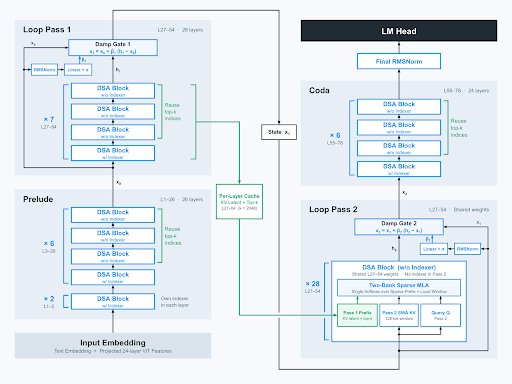
Rather than building the architecture from scratch, Z.ai converted its pretrained GLM-5 base through continued training. The approach addresses a growing problem in AI development: bigger models require more computing resources, but certain tasks benefit more from additional reasoning than simply storing more information.
Z.ai designed three mechanisms to keep the extra computation manageable:
- Gated updates: Token-level controls regulate how much each processing pass changes the model’s internal state.
- Hybrid KV cache: The second pass reuses previously selected context information while storing only additional local information.
- Sparse attention reuse: The model carries forward attention indices from the first pass, avoiding another indexing operation.
Z.ai reports streaming speeds of 70–80 tokens per second under peak load and up to 200 off-peak. The time needed to finish a task also depends on how long the model spends reasoning.
From software development to generalized coding
Z.ai wants GLM-5.4 to do more than write and debug software. Its Generalized Coding strategy uses programming as a foundation for tasks traditionally handled by specialized creative and engineering tools.
The company demonstrated several applications:
- Video production: Creating and editing a self-narrated music video.
- Mechanical engineering: Designing a six-axis robotic arm using FreeCAD.
- Game development: Building a complete game with character movement, physics, maps and combat systems.
- 3D modeling: Creating an interactive bird-watching experience using mathematical geometry and custom shaders.
GLM-5.4 accepts text, images, video, and files and has a one-million-token context window. It outputs text, including the code used to create or edit assets in Z.ai’s demos.
Early results leave questions unanswered
Z.ai’s strongest published evidence comes from a controlled experiment involving a separate 30-billion-parameter model, not the 750-billion-parameter GLM-5.4 flagship.
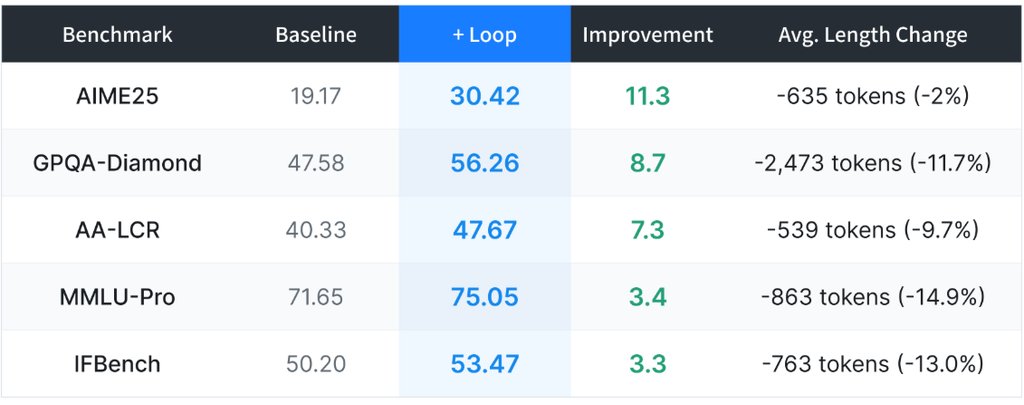
With identical parameter counts and about 10% more training compute, the looped version improved on mathematics, scientific reasoning, and long-context tasks. It also reduced average output lengths by 10% to 14% on selected benchmarks.
Z.ai says GLM-5.4 can match models with 2 trillion to 3 trillion parameters. The company published a win-rate chart for the flagship without explaining how it ran the comparison.
In early third-party testing reported by VentureBeat, GLM-5.4 placed seventh on the KingBench 4 coding benchmark. At maximum reasoning effort, it took about four times as long as Gemini 4 Neon to finish the suite.
Z.ai also acknowledges a tendency toward excessively long reasoning loops, which can increase the time required to complete tasks.
More must-read AI coverage
- SS&C Intralinks DealCentre AI vs. Datasite: Which platform is built for the future of dealmaking?
- SS&C Intralinks FundCentre AI vs. Juniper Square: Which platform better supports modern private markets fund managers?
- Why Data, Not Models, Determines AI Success
- The Rise of the AI-Native Factory: How Physical AI Is Transforming Manufacturing
What to test before switching to GLM-5.4
Developers can try GLM-5.4 in Z.ai Chat, ZCode, or compatible tools on the GLM Coding Plan. Eligible subscribers can use 50% more tokens at the same plan quota than with GLM-5.3. For teams comparing subscriptions, ChatGPT and Codex will move to a shared usage allowance in December.
Run GLM-5.4 and your current coding model on the same routine bug fix and the same change that touches several files. Give both models the same starting code and time budget, then compare three things:
- Time to a mergeable patch. Count retries and manual fixes as well as the initial wait.
- Review burden. Check whether the patch passes CI and how much work the reviewer needs to do before approving it.
- Usage per completed task. Track how much of the plan allowance each run consumes, including retries.
ZCode defaults GLM-5.4 to its highest reasoning setting. Try a lower setting on the routine fix to see whether it finishes sooner and still passes the same checks. If your workflow requires a standalone API or self-hosting, those options are still pending. Z.ai has given no release date for either.
Thinking about putting AI agents to work on your team? Explore AI courses from The Neuron Academy to build the skills to evaluate where agents can help and where you still need a human in the loop.