


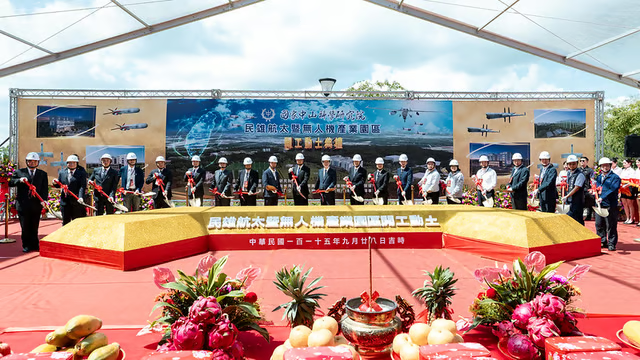
Taiwan is putting new infrastructure behind its push to build a domestic drone industry. President Lai Ching-te on Sept. 28 opened the National Chung-Shan Institute of Science and Technology’s new Minxiong campus in Chiayi County and broke ground on an adjacent NT$6.86 billion, or roughly US$217 million, aerospace and drone industrial park.
The campus began operating that day, while the industrial park is scheduled for completion in 2028. The two sites are intended to connect government-backed drone research and testing with private manufacturing as Taiwan works to reduce reliance on Chinese suppliers and expand its role in the Asia-Pacific drone supply chain.
Taiwan builds out its Chiayi drone cluster
NCSIST invested more than NT$1.1 billion in the Minxiong campus, adding system-integration testing, R&D facilities and infrastructure for military-grade drone research, verification and production, according to Taiwan’s Ministry of National Defense. The adjoining industrial park will add factories, test equipment, R&D space and a flight-test area.
After completion, the park is projected to accommodate about 100 companies, create 1,200 jobs and generate NT$8 billion in annual output, according to Sept. 29 reporting. Chiayi already hosts the Asia UAV AI Innovation Application R&D Center, giving the county an established base of drone companies and research organizations.
Taiwan’s semiconductor, information and communications technology, and precision-manufacturing industries provide an existing foundation for drone electronics and components. TSMC’s expanding $265 billion US chip investment also illustrates the global scale of Taiwan’s advanced-manufacturing footprint.
The government’s drone-industry plan calls for NT$44.2 billion in investment from 2025 through 2030 and aims to make Taiwan an Asia-Pacific hub for a democratic drone supply chain. More than 267 Taiwanese companies were involved in systems integration and key-component manufacturing as of April.
Taiwan targets a ‘non-red’ supply chain
Taiwan uses “non-red” for supply chains designed to reduce dependence on Chinese suppliers for critical drone hardware and software. Similar concerns are driving efforts to diversify China-linked hardware supply chains across semiconductors, communications equipment and other strategic technologies.
Drone sourcing has also become more exposed to trade restrictions. China tightened drone export controls in August, highlighting how licensing and sourcing rules can affect access to hardware and components across borders.
Taiwan has identified flight-control, communications and satellite-positioning chips, along with flight-control and ground-control software, as areas where it wants stronger domestic capacity. A June government update said the country is working toward a fully non-red drone supply chain by 2027 while acknowledging that domestic capacity remains insufficient for some components.
Drone-sector output reached NT$12.9 billion in 2025, more than 2.5 times the 2024 level. Finished-drone exports totaled NT$2.95 billion, or about US$93.5 million.
From January through July 2026, exports climbed to about 210,000 drone units worth NT$7.56 billion, or US$237.6 million, surpassing the value recorded for all of 2025, according to a Sept. 2 DSET report.
The Minxiong campus adds research and testing capacity now; the bigger test is whether the 2028 industrial park can turn Taiwan’s export growth into production at scale.
Also read: Singapore is making a parallel infrastructure bet in semiconductors, with a new $7.8 billion chip fab adding capacity for specialty hardware across the region.