


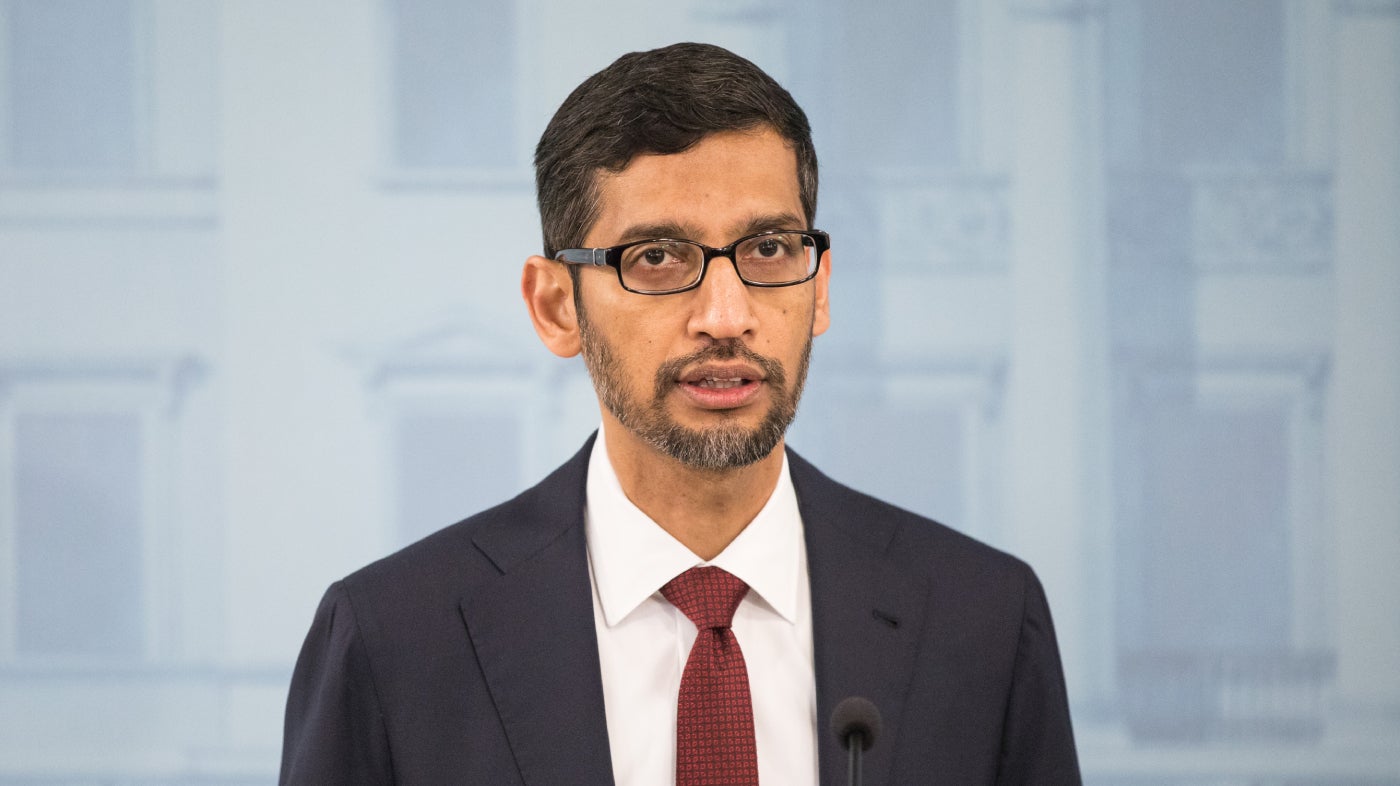
Google CEO Sundar Pichai on Wednesday told a US federal court that forcing the company to license its user data on search behavior to rivals would amount to “de facto divestiture of search.” He appeared as a witness to the Department of Justice’s ongoing antitrust trial, where the government accused Google of unlawfully maintaining its monopoly in search and search advertising through exclusionary deals and business practices.
In 2024, Judge Amit Mehta ruled that Google “is a monopolist, and it has acted as one to maintain its monopoly.” The current phase of the trial seeks to determine how that monopoly might be dismantled. The DoJ argues that the tech giant’s dominance has enabled it to amass a huge volume of search behaviour data and maintain a web index so comprehensive that competitors struggle to replicate it.
One of the remedies the department has suggested to de-monopolise Google is for the company to license this data for a “marginal cost,” which Pichai strongly objected. According to Bloomberg, he described the proposal as “so far-reaching, so extraordinary” that it would fundamentally reshape Google’s entire search operation.
SEE: OpenAI Eyes Google’s Chrome Browser If Forced Sale Happens, Exec Reveals in Court
“It would be trivial to reverse engineer and effectively build Google search from the outside,” Pichai said, according to Reuters, adding that it would make it “unviable” to continue investing in innovative research for Google Search as it has done for the past two decades.
He also warned of “many unintended consequences,” per Bloomberg, including exposing sensitive user searches and cybersecurity risks that other companies may struggle to handle. By giving up its search index, rivals could essentially “reverse-engineer” Google’s proprietary technologies, undermining its ability to compete.
The Justice Department has proposed other far-reaching remedies to curb Google’s power, including forcing the company to divest Chrome and prohibiting exclusive agreements with hardware manufacturers like Samsung and wireless carriers such as AT&T.
More Google coverage
- New Google Search AI Mode is ‘Total Reimagining,’ Says CEO Sundar Pichai
- In Major Ruling, Judge Finds Google ‘Willfully Acquired and Maintained Monopoly Power’ Over Digital Ad Market
- Google’s Big Bet on Nuclear Energy: ‘The Race to Power AI-Driven Data Centers is Accelerating’
- Computer History Museum Releases Original AlexNet Code: Why It Matters
Pichai: Google can’t be that dominant, just look at Google Plus
During his 90 minutes on the stand, Pichai pushed back on the notion that Google is the unstoppable giant the DoJ portrays. He wants to keep the Chromium infrastructure within Google as a way to ensure user security and that it stays open source, even if that’s not the most profitable path. “No one has shown a commitment to the level of investment we put in,” he said, according to The Verge.
He also mentioned that Google doesn’t always offer the best product, and in those instances, it loses. The example cited here was the ill-fated Google Plus, the company’s attempt at a social networking platform that was shuttered in 2019 due to low user engagement and security vulnerabilities that exposed user data.
Finally, Pichai revealed that Google is happy to strike non-exclusive deals, as it is in the middle of tying one up as we speak with Apple. Currently, Apple Intelligence processes workloads on-device but, if they are too big, offloads them to ChatGPT’s servers. DoJ lawyer Veronica Onyema asked Pichai whether Google would permit Apple to offer Gemini as an alternative to ChatGPT “by the middle of the year” and launch shortly thereafter, and he confirmed, according to the The Verge.