


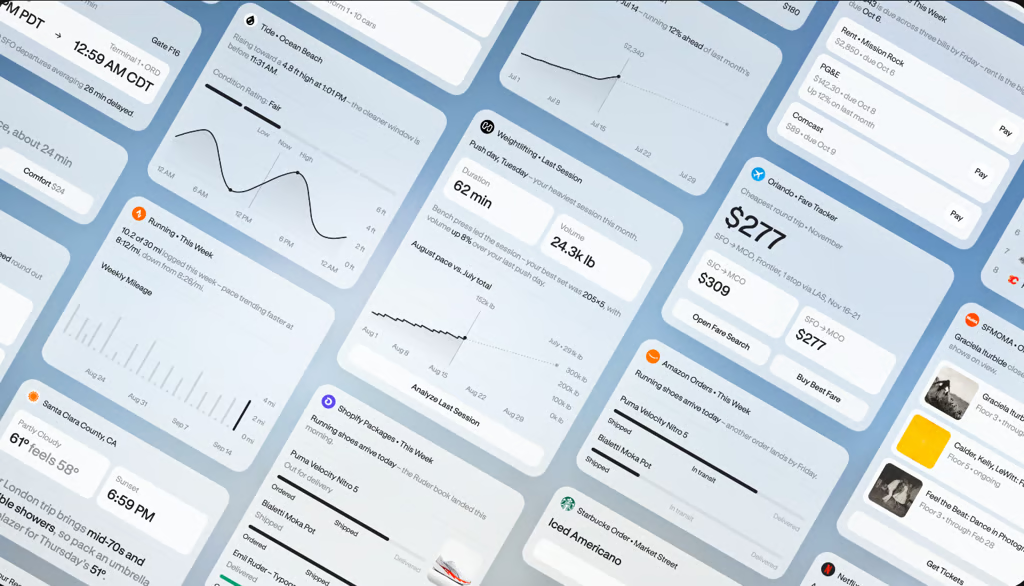
Hark wants your next AI assistant to do the boring stuff before you even remember to ask.
The AI startup, founded by Brett Adcock, launched Hark Pro on Oct. 6. The free AI agent is designed to handle everyday digital tasks and anticipate what users may need next. The service is available on the web, iOS and Android, with paid plans offering higher usage limits.
Hark Pro costs nothing for its standard version, while $20 per month provides twice the normal usage and $100 per month provides 10 times the usage, according to the company. The launch is also a preview of Hark’s larger hardware plan. Bloomberg reported that Hark plans to begin shipping its first devices in 2027, although their designs remain undisclosed.
An AI that acts before the user asks
Hark Pro combines memory, web automation and proactive suggestions. Its cloud computer, Handoff, can operate as many as six browsers simultaneously and log into millions of websites on a user’s behalf, according to Hark.
Hark says the service can go beyond answering questions to order groceries, pay bills, book transportation and handle other online errands. It can also notice unfinished tasks and suggest a solution. For example, Hark says it can recognize that a child’s lunch card is running low and offer to refill it. For a movie outing, it could find seats, check parking availability, offer to reserve a garage space and later provide the entry QR code.
The company also uses Action Buttons that let users approve actions such as paying a bill or canceling a subscription with a tap.
Hark is betting on trust
Hark Pro’s usefulness depends heavily on how much information users give it. The company says Hark remembers preferences, connects to services such as email and calendars, and can store passwords and payment information in its encrypted “Secured by Hark” vault.
Hark says even the company cannot see inside the vault, and promises not to sell user data or share it with advertisers.
But giving an AI access to credentials, financial information and personal communications creates an obvious security risk. The more independently an agent can act, the greater the consequences if an account is compromised or the system makes a mistake.
The bigger bet is the hardware
Hark is entering an increasingly crowded market. Meta and OpenAI are also developing agentic AI products, while Meta has previewed Muse Charm, a dedicated device for its Muse assistant. Hark’s difference may ultimately depend less on Hark Pro itself and more on what arrives in 2027.
Abidur Chowdhury, Hark’s head of design, told Bloomberg the devices will be “portable, and useful in the home and workplace,” while ruling out camera glasses and wearable pins. AT&T will provide cellular service for the hardware, Bloomberg reported.
What Hark Pro means for users
Hark Pro could save users time on repetitive digital chores, particularly when a task requires searching several websites or coordinating multiple services. Its proactive suggestions could also catch things users might otherwise forget.
For professionals, the trade-off is time saved versus access granted to work accounts and sensitive information. Start with low-stakes tasks, review results before authorizing payments, and check company policy before connecting business email or calendars.
Read more: Why AI guardrails need data boundaries explains how limiting credentials and account access can help organizations control what AI agents are allowed to do.