
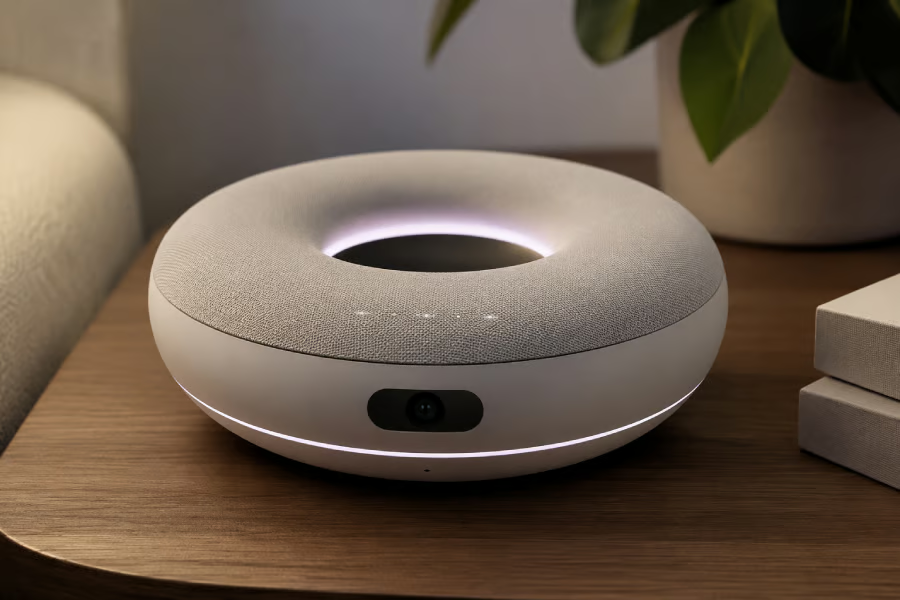


OpenAI’s next big bet could sit on your table and look suspiciously like a doughnut.
The AI company is reportedly developing a compact, battery-powered, displayless smart speaker expected to cost somewhere between $300 and $400. Bloomberg reports that the device could cost more than $300, while TechCrunch puts the expected price between $300 and $400.
Those details are still unconfirmed, and the device is reportedly targeting a 2027 release. But if the reports prove accurate, OpenAI’s hardware ambitions suggest something considerably larger than an attempt to build a better smart speaker:
The real prize may be removing the screen, keyboard, and even the smartphone from the conversation entirely.
OpenAI may be betting that AI needs its own hardware
For most users today, interacting with generative AI still begins with opening something. You launch ChatGPT on a phone. Open a browser tab. Tap an app. Type a prompt.
That creates friction, however small, between having a question and asking an AI to act on it. A dedicated OpenAI device could attack that friction directly.
The Verge reports that the device is expected to be roughly the size of a hockey puck, with a doughnut-like shape, battery power, cameras and other sensors, lights, and moving components. Mashable also describes the unusual smart-speaker form factor and the premium price expected.
The reported lack of a display may be especially significant. Without a screen competing for attention, conversation would presumably become the primary interface.
The Verge reports that the device could offer something resembling a more advanced version of ChatGPT Voice Mode, potentially powered by more capable AI models. Its moving components may even allow it to physically react during interactions, although exactly how that would work remains unclear.
A portable device matters because it could change the relationship between the user and the assistant. Instead of ChatGPT living inside a computer or phone, the AI could become something sitting nearby and ready for conversation throughout the day.
Generative AI systems such as ChatGPT are increasingly designed around conversations, reasoning, research, writing, planning, and multi-step tasks. Put those capabilities inside dedicated hardware and a smart speaker could stop being merely a voice-controlled appliance. It starts looking more like an always-available AI interface.
The $300 price could reveal OpenAI’s real target
The reported price is arguably more revealing than the doughnut shape.
At $300 to $400, OpenAI would be entering premium-device territory rather than chasing the inexpensive smart-speaker market. That would be a curious strategy if the goal were simply to compete for countertop space against Amazon Echo or Google Nest devices.
But OpenAI may not need millions of consumers to think they need another speaker. It needs them to believe that a dedicated AI device can do something their existing devices cannot.
Smartphones already have microphones, speakers, cameras, screens, processors, and increasingly capable AI assistants. Apple, Google, Samsung, and other device makers also control operating systems that can integrate AI deeply into products people already own.
OpenAI does not have that advantage.
Its own hardware could give the company more control over how users interact with ChatGPT, from the physical design and sensors to the conversational interface, rather than relying entirely on devices and operating systems controlled by other technology companies.
In that sense, the rumored speaker may be less an Alexa competitor than an attempt to reduce OpenAI’s dependence on the smartphone as the primary gateway to ChatGPT.
More must-read AI coverage
- SS&C Intralinks DealCentre AI vs. Datasite: Which platform is built for the future of dealmaking?
- SS&C Intralinks FundCentre AI vs. Juniper Square: Which platform better supports modern private markets fund managers?
- Why Data, Not Models, Determines AI Success
- The Rise of the AI-Native Factory: How Physical AI Is Transforming Manufacturing
What an OpenAI device could mean for users
For consumers, the bigger question is not whether OpenAI can make an attractive AI speaker. It is whether owning one would meaningfully improve how they use AI every day.
A dedicated ChatGPT device could make common interactions faster and more natural. Instead of pulling out a phone to ask a question, summarize information, brainstorm an idea, manage a task, or get help while cooking or working, users could simply speak to an assistant that is always within reach.
The reported cameras and sensors also suggest that the device could eventually understand more about its surroundings than a conventional voice-only speaker, although OpenAI has not publicly confirmed what those components would do.
However, that potential convenience comes with trade-offs.
An always-available AI device equipped with microphones, cameras, and other sensors would inevitably raise questions about privacy, data collection, account security, and how much personal context users are comfortable sharing with an assistant sitting inside their homes.
OpenAI would need to give buyers clear answers about when those sensors are active, what information the device collects, what gets stored or transmitted, and what controls users have over their data.
Then there is the $300 to $400 question. At that price, consumers will have to decide whether a dedicated AI device offers enough value to justify buying another piece of hardware when ChatGPT already runs on phones, laptops, and tablets they own.
That makes OpenAI’s challenge unusually simple to describe and difficult to solve: The device cannot merely make ChatGPT more convenient. It has to make ChatGPT meaningfully better.
If it does, users could get an early glimpse of a computing model in which AI becomes less of an app and more of a persistent interface to information, services, and everyday tasks. If it does not, the device risks becoming another expensive gadget competing for an outlet and attention.
Jony Ive’s influence makes the form factor more important
The unusual design is another clue that OpenAI may not want consumers to think of this as an ordinary smart speaker.
TechCrunch reports that OpenAI is developing the device with LoveFrom, the design firm founded by former Apple design chief Jony Ive. That involvement raises expectations that the eventual product will emphasize a different kind of human-computer interface rather than simply placing ChatGPT inside familiar electronics.
A doughnut-shaped, screenless device with moving components certainly qualifies as unfamiliar. But industrial design alone will not determine whether the experiment works.
OpenAI has to answer a much harder question: What is substantially easier, faster, or more useful when ChatGPT has its own piece of hardware? Without a compelling answer, even beautifully designed AI hardware risks becoming an expensive microphone connected to capabilities consumers already have on their phones.
The battle for AI could become a battle for the interface
The larger significance of OpenAI hardware is that the AI industry is beginning to confront an old technology lesson: controlling the software is powerful, but controlling how people access it can be just as important.
Apple has the iPhone and its operating systems. Google has Android. Amazon put Alexa into millions of homes. Meta is pushing its AI deeper into smart glasses and other devices.
OpenAI became one of the defining companies of the generative AI boom without owning a major consumer hardware platform. That leaves the company in an unusual position. ChatGPT can be enormously popular while still depending on phones, computers, app stores, and operating systems controlled by other technology companies.
A successful OpenAI device could begin changing that equation by giving the company a direct hardware interface built around ChatGPT. Instead of asking users to find ChatGPT inside someone else’s ecosystem, OpenAI could begin building a hardware experience around ChatGPT itself.
That is what makes this rumored device worth watching.
The strange shape will attract attention. The reported $300-plus price will generate debate. But the experiment underneath both is much more consequential: whether consumers want artificial intelligence badly enough to buy hardware designed around AI first, rather than simply adding AI to devices they already own.
If OpenAI can make people want dedicated AI hardware, it could reshape how we think about the next generation of personal computing.
Related reading: The rumored device could also give OpenAI another way to reach its rapidly expanding audience, with the company now reporting more than 1 billion active users across its models.