


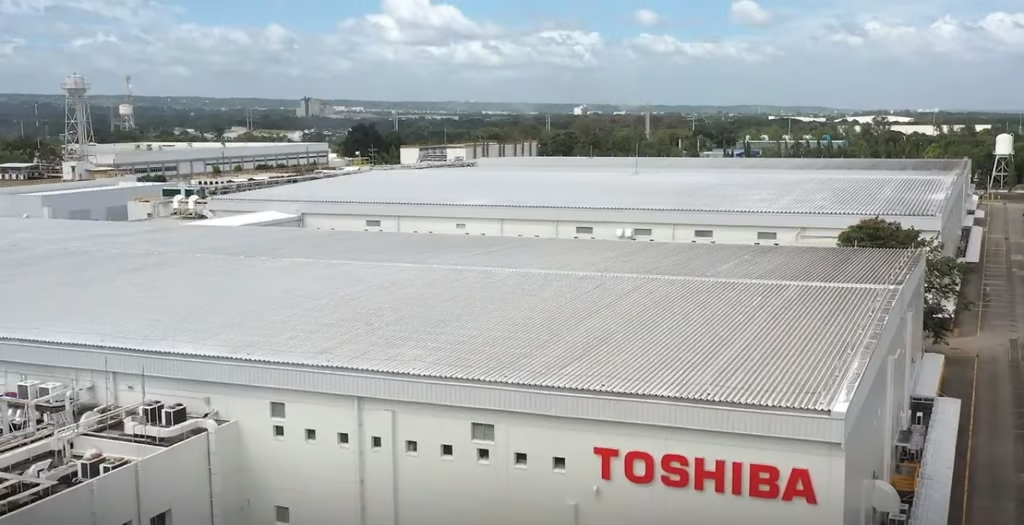
Toshiba has begun shipping hard disk drives (HDDs) from an expanded Philippine production line, adding manufacturing capacity as AI and cloud data centers increase demand for high-capacity storage.
The company confirmed the first shipments from its Laguna Technopark facility on Oct. 2. Three days later, the Philippine government announced a multibillion-peso investment planned over three years, expected to generate approximately 3,000 jobs.
The expansion strengthens the Philippines’ role in Toshiba’s global storage supply chain as the company competes with Seagate and Western Digital. How quickly the added capacity will reach enterprise customers remains unclear.
Toshiba increases HDD production in Laguna
Toshiba Information Equipment (Philippines), Inc. (TIP) began manufacturing nearline HDDs at Laguna Technopark and shipped its first products from the expanded line, according to the company’s Oct. 2 announcement.
The facility previously focused primarily on HDDs for personal computers. Nearline production now extends beyond Toshiba’s existing operations at Carmelray Industrial Park in Calamba.
Toshiba aims to nearly double annual production capacity at its Laguna Technopark facility by fiscal 2027 compared with fiscal 2025. The target is measured by total storage capacity rather than drive shipments, so higher-capacity models could contribute to the increase without a corresponding rise in unit output.
The Philippine Department of Finance said the expansion is expected to generate around 3,000 jobs. Separately, industry reporting citing Nikkei valued the investment at approximately ¥60 billion ($380 million). Toshiba has not disclosed that amount in its official announcement.
Toshiba has manufactured storage products in the Philippines since 1996. Its Laguna operations produce HDDs and solid-state drives for global customers, with the expansion potentially creating more opportunities for local electronics suppliers and skilled workers.
The investment also comes as the Philippines pursues a $34.4 billion AI infrastructure plan, targeting 1.5 gigawatts of data center capacity by 2033. Toshiba’s expansion concerns manufacturing for global markets, not a new domestic data center.
AI storage demand drives capacity expansion
AI workloads are increasing data center storage requirements alongside computing power. Training datasets, generated content and backups require substantial capacity, while nearline HDDs offer lower costs per terabyte than solid-state drives for data that does not require the fastest access speeds.
Toshiba faces competition from Seagate and Western Digital, which control larger shares of the global HDD market. Expanded Philippine production could improve Toshiba’s supply position, although the company has not disclosed additional shipment volumes or customer delivery schedules.
Toshiba is also developing higher-capacity products. In March 2026, it began sampling 30TB to 34TB M12-series drives using shingled magnetic recording (SMR) technology for hyperscale and cloud customers. The company has not identified which models were shipped from the expanded Philippine line.
Regional computing investments add to the demand outlook. Aolani plans to deploy 22,000 Nvidia Blackwell Ultra GPUs across Malaysia and the Philippines in early 2027, while OpenAI has agreed to anchor two planned AI data centers in Malaysia.
For enterprise procurement teams, the key remaining details are production volumes, customer qualifications and delivery timelines. Until Toshiba provides those figures, the expansion represents potential future supply rather than a confirmed change in HDD availability.
Read more: Indonesia is also expanding its AI infrastructure pipeline through a planned 360-megawatt Nvidia-powered data center in Batam, with initial operations targeted for 2027.