


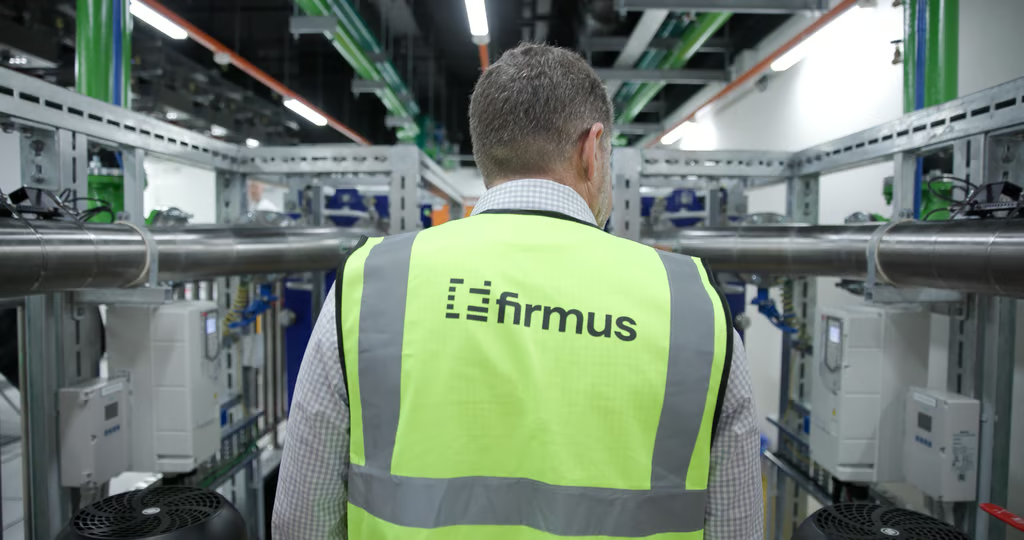
OpenAI is reserving future AI compute in Malaysia before the facilities are even online. The move gives the company another foothold in Asia-Pacific’s fast-growing infrastructure buildout.
Firmus said Sept. 8 that OpenAI will become an anchor customer for two Malaysian AI Factory sites under a multi-year agreement for dedicated computing capacity. The deal lifts the Nvidia-backed infrastructure company’s total contracted capacity across all customers above 900 megawatts.
OpenAI’s allocation, the contract value, exact site locations, and service dates remain undisclosed. That leaves the scale and timing of the Malaysian capacity unclear even as demand for AI infrastructure accelerates across the region.
What the Firmus deal actually secures
OpenAI Vice President of Compute Strategy Sachin Katti said the Malaysian facilities will help meet growing demand in Asia-Pacific and elsewhere. Firmus said in its partnership announcement that it operates two AI factories, in Australia and Singapore, with five more under development.
Firmus has not disclosed how many megawatts OpenAI has contracted or where the two Malaysian facilities will be located. Reuters reported that Firmus declined to disclose the contract value; the 900 MW figure covers contracted capacity across Firmus’s entire customer base, not OpenAI alone.
The company plans to deploy Nvidia Vera Rubin systems across its Asia-Pacific infrastructure. The Malaysian sites will use Nvidia’s DSX AI Factory Platform to integrate Vera Rubin NVL72 rack-scale systems with Firmus’s HyperCube design, which combines liquid cooling, mechanical systems, and electrification.
Malaysia is part of a wider Southeast Asian expansion for Firmus. The company is also planning a 360 MW Nvidia-powered AI data center in Indonesia, with initial operations targeted for 2027, while Firmus lists seven AI factories across Australia, Singapore, Indonesia, and Malaysia.
Malaysia’s AI infrastructure squeeze
Malaysia is already drawing heavy digital infrastructure investment. The Malaysian Investment Development Authority said data center and cloud projects accounted for RM95.8 billion, or about $23.6 billion, in approved investment in the first half of 2026. That was close to 44% of the country’s total approved investment during the period.
The buildout is tightening demand for power, water, cooling, and connectivity. Johor alone has an 8,542 MW data center pipeline but a colocation vacancy rate of just 0.7%, underscoring the gap between announced projects and capacity enterprises can actually use.
Malaysia’s Data Centre Task Force now clears projects only when developers can demonstrate secured electricity and water supplies and green compliance. Singapore remains the region’s dominant base for data center equity funding, even as more physical capacity spreads into neighboring markets such as Malaysia and Indonesia.
Firmus has not said when either Malaysian site will begin serving OpenAI workloads. The Sept. 8 agreement secures future capacity rather than infrastructure available for immediate deployment.
OpenAI’s deal adds another major customer to Malaysia’s AI infrastructure pipeline. The next significant disclosures will be OpenAI’s allocated megawatts, the Malaysian sites’ locations and launch dates, and whether the added capacity eventually changes regional availability for OpenAI services.
Read more: OpenAI is also widening its enterprise presence in APAC, with Vietnam’s FPT joining its partner network to support AI deployments across the region.
Let us teach you How to Talk to AI for free! Try our six-minute course at The Neuron Academy and learn a few simple ways to write better prompts and get more useful results from AI, or browse our other AI course for free for seven days. Check out all the lessons here →