


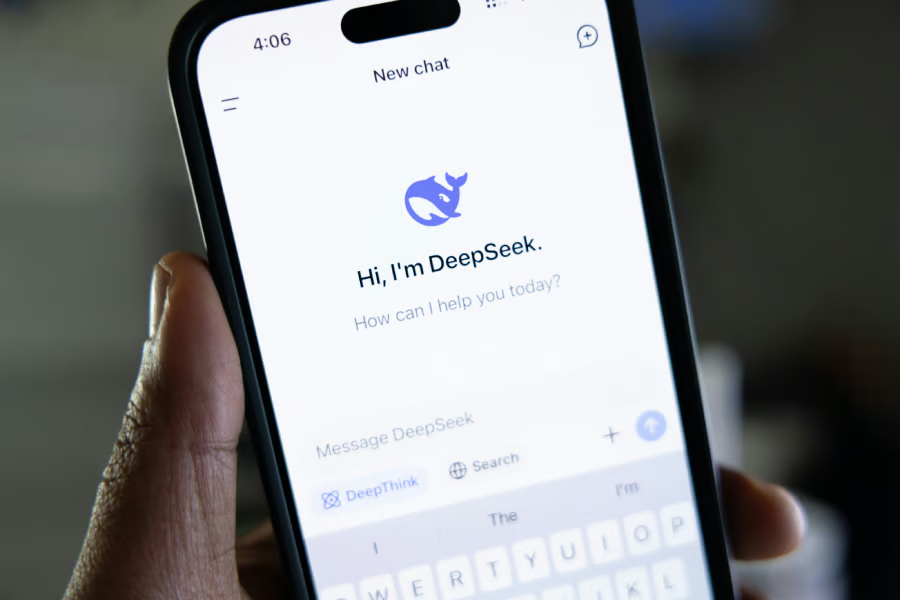
Some US companies are taking a closer look at China’s DeepSeek as the cost of Silicon Valley AI tools continues to climb.
DeepSeek topped Ramp’s June list of “trending software vendors,” reflecting new business spending on the Chinese AI startup. The shift remains small compared with the dominance of OpenAI and Anthropic, but it suggests some companies are willing to test cheaper AI models even when that raises questions about data security, hosting, and vendor risk.
DeepSeek gains ground with cost-conscious companies
According to the South China Morning Post, DeepSeek ranked first on Ramp’s “trending software vendors” list in June. Ramp, a New York-based corporate spending platform, tracks when businesses first purchase from a software vendor.
Ara Kharazian, lead economist at Ramp Economics Lab, said in the report that US firms appeared to be making direct payments to DeepSeek, rather than only running DeepSeek’s open-source models on their own infrastructure.
“In probably the biggest sign that companies are looking for cheaper alternatives to OpenAI and Anthropic, some are willing to use cheaper, Chinese models, sending US data back and forth from China-hosted servers,” Kharazian said in a social media post quoted by SCMP.
More must-read AI coverage
- SS&C Intralinks DealCentre AI vs. Datasite: Which platform is built for the future of dealmaking?
- SS&C Intralinks FundCentre AI vs. Juniper Square: Which platform better supports modern private markets fund managers?
- Why Data, Not Models, Determines AI Success
- The Rise of the AI-Native Factory: How Physical AI Is Transforming Manufacturing
DeepSeek interest grows from a small base
DeepSeek is not close to overtaking the largest US AI providers in business adoption. Kharazian said DeepSeek had a “modest hype cycle” in January 2025, when corporate adoption on Ramp rose to 0.3% before falling back to 0.1%, according to SCMP. By April 2026, DeepSeek’s adoption rate was still 0.1%.
By comparison, Anthropic and OpenAI led the Ramp AI Index at 34.4% and 32.3%, respectively, in April. Ramp did not provide June market share figures in the SCMP report.
Still, the trend arrives as enterprise AI budgets come under greater scrutiny.
Many companies have moved from experimenting with chatbots to embedding AI into coding, customer support, analytics, and operations. As usage grows, token costs, subscription tiers, and infrastructure demands can become harder to ignore.
Funding could sharpen the competition
Proactive reported that DeepSeek was raising $7.4 billion in its first external funding round at a valuation between $52 billion and $59 billion. The report named Tencent, CATL, NetEase, and JD.com among investors and said founder Liang Wenfeng was also committing capital.
If finalized, that funding could help DeepSeek compete on infrastructure, product development, and enterprise sales while reinforcing demand for lower-cost AI models outside the usual Silicon Valley vendor set.
DeepSeek’s rise also puts more attention on how companies manage AI vendor risk. Kharazian’s comments suggest some US firms may be sending data through DeepSeek’s hosted service rather than only using its open-source models internally.
DeepSeek’s rise on Ramp’s list suggests enterprise AI buying is becoming more selective. The winners may not always be the vendors with the biggest brands. They may be the ones that help companies control costs without creating a new governance problem.
Read how SpaceX’s expected IPO could fuel the next phase of AI infrastructure investment.