
.webp "Dell Logo")

When it comes to AI adoption in state and local government, the challenge is no longer testing innovative uses for the technology — it’s operationalizing and scaling high-value use cases.
Many organizations are stuck in the experimentation phase. Nearly 90% of state and local governments say they are more likely to launch a new pilot than expand an existing one, according to joint research from Dell and NVIDIA. The same study found only 20% of state and local governments have scaled AI across multiple workflows agencywide.
90% of governments are more likely to launch a new AI pilot than expand an existing one.
Today, the real test for state and local governments is moving from pilots to true enablement, and from AI hype to everyday, real-world applications that deliver measurable public impact.
It’s time for AI pilots to translate into measurable improvements in service delivery, workforce productivity and community outcomes.
“Pilots should be viewed as the beginning of a journey, not the destination,” says Jayson Dunn, Senior Business Manager for State and Local Government at NVIDIA. “Organizations that succeed are those that start small, prove value, understand the path to scale and ensure the solution aligns with their long-term objectives.”
20% Only 20% have successfully scaled AI across multiple agency workflows.
The next phase of government AI adoption will be defined by:
- Responsible governance and trust
- Workforce readiness
- Infrastructure that supports scale rather than experimentation
- Community-centered outcomes
- Return on investment
Here’s a roadmap for how state and local governments can make AI a key enabler of responsive, effective and equitable service delivery.
Why Governments Struggle to Scale AI
Governments struggle with AI maturity for a number of reasons, ranging from strategy and operational gaps to data quality and institutional trust issues.
“Pilot fatigue isn’t a failure of ambition. It’s a symptom of misaligned incentives, disconnects between agency priorities and vendor solutions, and the absence of a business case,” says Rob Lloyd, Executive Director for the Center for Digital Government and Head of the Center for Public Sector AI.
Strategy gaps
As Lloyd notes, one of the most common mistakes governments make is treating AI pilots as standalone initiatives instead of aligning them with agency priorities.
Pilots often occur in controlled, siloed environments that require little cross-functional collaboration. One agency or team may test an AI tool in a sandbox. Conversely, some governments launch open-ended pilots, where agencies have an enterprise license to a generative AI (GenAI) tool like ChatGPT and tell employees to start using it without a solid governance framework or a defined process for documenting what works and what doesn’t.
The result is that many employees avoid employer-sponsored AI tools altogether. Nearly 4 in 10 state and local government employees say they never use AI tools in their work, even though they have access to them.
Operational gaps
Programs tend to get stuck when there’s no transition plan from pilot to production. “Pilots often get funded on curiosity. Production requires a business case and going through the budget process,” Lloyd says. “Most agencies never build the ownership bridge between the demo, the department director and the teams that have to sustain it.”
Undefined success criteria, poorly defined key performance indicators (KPIs) and unclear ownership of outcomes also keep AI projects stuck in pilot mode. Shaping success criteria requires baseline metrics, alignment on goals and technology to effectively track KPIs. However, governments often struggle to bring together these elements quickly enough to keep pace with rapidly evolving AI technology. State and local agencies may also lack the resources and expertise needed to manage AI deployments at scale, especially agentic AI.
Risk tolerance is another issue. Governments generally cannot embrace the “fail fast and adapt” mindset common in the private sector.
“In the public sector, the risk threshold is much lower,” says Derek Williams, State and Local Government Strategist at Dell Technologies. “Government agencies need to meet higher standards for explainability and transparency of AI processes and accountability for unforeseen outcomes.”
Dell and NVIDIA’s joint research supports this, as 79% of state and local leaders surveyed said their organizations hesitate to move even successful pilots to production due to perceived risk.
Data gaps
Data is the foundation of AI. It’s critical for improving the accuracy of AI outputs, surfacing quality insights that support program decisions and powering agentic workflows that improve productivity
Governments have long struggled with poor data quality and overall data maturity. In addition, legacy systems can make data difficult to access and share. Agencies may need to upgrade existing infrastructure to support AI at scale.
But in some cases, the pursuit of perfection may be standing in the way of meaningful progress. Many governments think they need pristine data to implement and scale AI, but that’s not true, Lloyd says.
“The reality is, the communities and states that have been most effective with AI are very adept at containing and cordoning off the problem set,” he says. “So, it’s not a complete overhaul that allows them to be effective, it’s the ability to curate the right infrastructure, the right targets and the right integrations to solve a specific problem.”
Institutional and trust barriers
AI also isn’t immune to the institutional barriers and trust challenges agencies encounter whenever they implement new technology. Nearly 55% of American adults have used GenAI at work and in their personal lives, and adoption continues to accelerate.
Slow budget and procurement cycles also create obstacles. Many governments operate on a two-year budget cycle that cannot keep pace with the rapid evolution of AI. Agencies may secure funding for an initial pilot but struggle to sustain the investment needed to move from pilot to production.
Given these strategic, operational, technological and policy challenges, it is not surprising that many governments have yet to move beyond the pilot stage.
“The challenge isn’t technology,” says NVIDIA’s Dunn. “It’s alignment, integration and leadership. The agencies making the most progress aren’t waiting for perfect conditions. They’re focusing on governance, partnerships, collaboration and measurable outcomes.”
Scaling AI: Advanced Government Use Cases
- Vision AI agents: Monitor public infrastructure and operations in government facilities, such as airports, traffic intersections and wastewater treatment plants. Agents can support visual inspections, predictive maintenance, traffic safety and optimization.
- On-premises LLMs: Out-of-the-box large language models (LLMs) running in agency data centers can help governments automate manual workflows more cost-effectively, streamline complex processes and speed service delivery at scale. These tools can reduce end-to-end processing time for government programs by 40%.
- MCPs: Model context protocols (MCPs) act as a universal adapter, helping to extract data from siloed government systems for use in AI models. Rather than relying on centralized databases, MCPs enable AI applications to securely retrieve information directly from connected systems. Processes that usually take hours can be completed in a matter of minutes.
Where AI Already Delivers Value
AI initiatives that move beyond the pilot stage are typically tied to pressing pain points for both residents and government workforces.
Williams says the most effective approach is to identify solutions and use cases that have already been validated elsewhere and carry low implementation risk.
“Sometimes, we say we’re not going to do the art of the possible. We’re going to implement a part of the possible,” he says.
This “part of the possible” approach has already produced meaningful AI wins in multiple areas. The Dell/NVIDIA research indicates the most successful AI applications to date focus on public records processing and automation, cybersecurity and threat detection, and smart infrastructure and traffic management.
AI use cases seeing the most success
- 40% Public records processing and automation
- 36% Cybersecurity and threat detection
- 36% Smart infrastructure and traffic management
In addition, the research shows that AI typically delivers value in the following use cases:
- Permitting: Automates approval workflows to reduce backlogs, speed turnaround times and improve constituent satisfaction.
- Benefits eligibility: Accelerates application reviews and flags anomalies and missing or incorrect information, which allows caseworkers to focus on eligibility determinations rather than information gathering.
- Constituent communications: Powers self-service chatbots trained on organizational data to accurately answer constituent questions 24/7, freeing staff to provide personalized service for more complex cases.
- Translation: Automatically translates source text into multiple languages, enabling governments to provide timely, relevant local information to different audiences — especially during public emergencies.
- Service request management: Supports streamlined workflows for public works and other service requests, improving both operational visibility and transparency, which helps agencies deliver more responsive service.
- Employee productivity: Helps government workforces offload or optimize manual work. In Pennsylvania’s ChatGPT pilot, which involved 175 employees across 14 agencies, employees saved an average of 95 minutes per day on tasks such as research, writing and summarization.
AI Enablement in Action
Amarillo makes government more inclusive.
The city of Amarillo, Texas, is using GenAI to make information and services more accessible to residents, nearly 25% of whom speak a language other than English.
Amarillo worked with Dell to create Emma, a GenAI virtual assistant on the city’s website that communicates in multiple languages. Through Dell’s Professional Services and the Dell AI Factory with NVIDIA, Emma’s architecture was optimized for reliability and adaptability.
Emma provides real-time multilingual support, handling approximately 300 resident queries each day on the city’s website and kiosks at local libraries and other locations. Emma analyzes resident interactions and feedback to generate insights that help city officials improve services.
“Emma repositions Amarillo as a technological pioneer,” says Amarillo Assistant City Manager and CIO Rich Gagnon.
Emma currently has a 98% approval rating among residents.
Clark County harnesses augmented intelligence.
Clark County, Nevada, uses AI to empower its workforce to better serve 2.4 million residents. The county engages frontline staff in developing AI use cases, asking them what worked — and what didn’t — with previous technology implementations and using that feedback to shape how it integrates AI into their workflow.
“We’re not replacing people with technology. We want to augment the very smart and capable people that work for us to help them do their jobs in new, better and different ways,” says Clark County CIO Bob Leek.
Digital twins are one way the county uses AI. The county’s water reclamation department created a virtual replica of its physical infrastructure to predict maintenance needs and improve wastewater operations.
Leek says focusing on outcomes allows the county to apply AI in impactful ways.
“Embracing that thought around [...] AI for better, but attached to the outcomes of what it is that you’re measuring and the services that you provide — this continuous evolution, continuous quality improvement, and the opportunity to make lives better for people — that’s at the core of our mission,” he says.
“We’re building credibility with the community by listening.”
Workforce Readiness: A Crucial Success Factor
While technology enables AI at scale, people ultimately determine whether it succeeds. Workforce readiness is crucial for scaling AI use cases. Yet it often doesn’t get enough attention in the public sector.
Research from Code for America finds that only four states are advanced in terms of AI capacity building. The organization rated another 10 as “established,”
State and local organizations need clear employee learning and development pathways, along with transparent communication from leadership about what will change as they scale AI.
Lloyd says agencies need to reassure employees that adopting AI doesn’t mean replacing people with technology. “There are two things organizations need to say at all times: One, we’re going to make sure that people have a path and steer what we’re doing. Number two, here’s where we’re going to focus, so we’re always in control of our future.”
Governments should prioritize human-centered design, service redesign and design thinking as they integrate AI into existing workflows.
As new iterations of AI emerge, governments must continually refine their AI workforce readiness strategy. Governments should consider several strategies:
Internal learning communities
These groups provide an ideal avenue for sharing best practices, use cases, prompts and learnings that increase AI adoption. They can take multiple forms — from peer-to-peer learning sessions to internal Slack channels or designated AI champions who can answer questions and serve as a conduit between employees and leadership.
Leadership training
Leadership academies and certifications can also build AI confidence, says Alan Shark, Senior Fellow at the Center for Digital Government and Associate Professor for the Schar School of Policy and Government at George Mason University. Several non-technical, executive-level certification programs are emerging around AI transformation and GenAI leadership that combine hands-on training with leadership skills to help professionals get more organizational value from AI.
Focusing on entry-level employees
A workforce readiness plan for entry-level and junior employees is critical, since AI automates many tasks that these employees formerly handled.
Higher education partnerships
Partnering with local universities and community colleges to create learning development pathways can help state and local governments address workforce skills gaps and build a pipeline of qualified AI talent.
From Pilot to Scale: A Strategic Framework for Governments
As state and local governments work to embed AI into their operations and workflows, the following strategic framework can help them mature their capabilities.
Get started, then adapt.
Scaling AI requires data and infrastructure readiness, but agencies don’t need perfect data or a massive technology overhaul to advance their AI maturity. They should focus on targeted modernization to support clearly defined business needs.
Explore innovative procurement options like cooperative contracts to streamline technology acquisition, and consider professional services from industry partners to bridge skills gaps and assist with planning, building, deploying and operating AI solutions. Industry partners can also help agencies identify and apply for grants to fund AI deployment.
Focus on your mission.
Agencies should start with community outcomes, not technology, as they look for opportunities to further embed AI. This is what Clark County has done with great success.
“We start with those business outcomes, and then we look through those workflows and see where we have those opportune moments to apply AI,” Leek says.
Build AI leadership.
Too many governments lack clearly defined AI owners and executive champions. Instead, AI responsibilities are often fragmented across the C-suite or layered onto technology leaders’ existing responsibilities. One International City/ County Management Association (ICMA) survey found that only 10% of local governments have dedicated personnel to oversee their AI initiatives.
“Leadership requires people to be willing to take risks, to do their homework, to build a team and to build some continuous feedback loops,” Shark says.
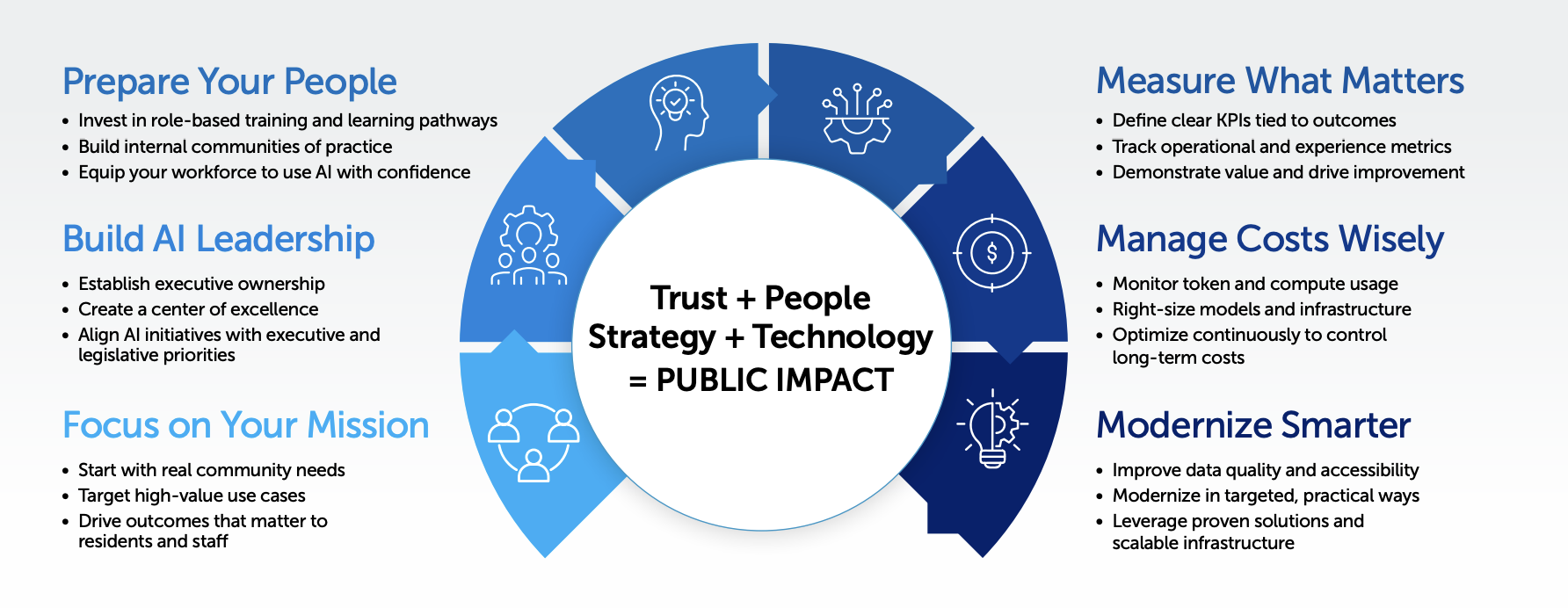
Prepare Your People
- Invest in role-based training and learning pathways
- Build internal communities of practice
- Equip your workforce to use AI with confidence
Build AI Leadership
- Establish executive ownership
- Create a center of excellence
- Align AI initiatives with executive and legislative priorities
Focus on Your Mission
- Start with real community needs
- Target high-value use cases
- Drive outcomes that matter to residents and staff
Measure What Matters
- Define clear KPIs tied to outcomes
- Track operational and experience metrics
- Demonstrate value and drive improvement
Manage Costs Wisely
- Monitor token and compute usage
- Right-size models and infrastructure
- Optimize continuously to control long-term costs
Modernize Smarter
- Improve data quality and accessibility
- Modernize in targeted, practical ways
- Leverage proven solutions and scalable infrastructure

15X Agentic AI workloads use up to 15x more 15X tokens than standard chat interactions.
State and local governments can strengthen AI leadership in several ways. One approach is creating a dedicated AI position, such as a chief AI officer, to ensure AI enablement is part of executive-level conversations. Agencies can also create a center of excellence that owns AI implementation and outcomes and makes AI wins more visible throughout the organization. Finally, aligning AI projects with executive and legislative priorities can increase visibility and long-term support.
Develop an AI cost containment strategy.
Scaling AI systems increases compute costs. Many AI vendors now price services based on consumption. Consumption typically is measured in tokens, which represent basic units of text, pixels or audio processed by AI models. Advanced AI workloads, especially AI agents, consume large amounts of tokens.
“Compared to standard chat interactions, agentic workloads consume orders of magnitude more tokens, with agents easily utilizing 4x to 15x more tokens,” a joint industry report from Signal65 Insights and Dell found.21 “As agentic workloads continue to evolve, token growth is expected to grow even further, with autonomous agents driving up to 1000x more inference demand than reasoning AI.”
To control these costs, agencies must choose their infrastructure partners carefully, assessing pricing models from a long-term lens and based on how their AI strategy will evolve. Avoiding API-based pricing models and using on-premises AI infrastructure can help to curb costs. For example, Dell Deskside Agentic AI solutions can reduce spend by as much as 87% over two years compared to cloud APIs.
Shark adds that proper provisioning of AI licenses will become increasingly important. “We’re going to have to determine which of our employees need which kind of agent, if they need one at all,” Shark says.
Prioritize proven solutions.
Agencies need partners with long-term stability, experience and implementation credibility. They should provide secure, on-premises AI infrastructure that helps agencies innovate more cost-effectively by reducing token costs, along with configurable solutions that integrate with existing systems to accelerate deployment, time to scale and time to value.
“In a nascent technology space, you want to be very careful which partners you pick, because 70% to 90% of AI companies, most experts say, will be gone in three to five years,” Lloyd says. “The technology foundations we’re defining now, a good chunk of those frameworks could be significantly different or gone in just a few years.”
Don’t just track productivity.
Agencies should define core KPIs to understand what AI success looks like. Although productivity is an important outcome, this isn’t the only metric governments should track. They should also assess:
- Time to service
- Processing time
- Resolution rate
- Case completion rate
- Error reduction
- Service accessibility
- Constituent satisfaction
- Time to first token
- Return on mission
Anchor on trust.
Ultimately, trust is what makes AI scalable. Agencies should engage employees early in AI initiatives and use their feedback to shape use cases. Agencies should also seek community feedback to help with prioritization and continuous improvement.
Equally important, they should establish a governance and accountability framework that encompasses human-in-the-loop oversight and privacy protections to safeguard the operational data they’ll feed into AI models. Role-based access controls, encryption, anonymized or synthetic data usage, third-party risk management and strong audit trails will be key for strengthening compliance, transparency and protecting critical infrastructure.
“Before agencies scale AI, they must first establish trust in their data, confidence in their governance and alignment around their mission,” says NVIDIA’s Dunn. “Technology can accelerate transformation, but only when built on a foundation of people, processes and purpose.”