
.webp "Dell AI Factory with NVIDIA Logo")
Introduction
This Economic Validation by Enterprise Strategy Group evaluates the business value of deploying and managing artificial intelligence (AI) infrastructure with the Dell AI Factory with NVIDIA. It focuses on the benefits organizations can expect compared to public cloud—including GPU-as-a-Service and API-based AI services, traditional on premises, and other pre-built AI solutions.
Challenges
AI has quickly evolved from being a promising technology to an essential component of most companies’ business strategies today. According to research conducted by Enterprise Strategy Group, nearly every organization (99%) has adopted, is testing, or is planning to adopt AI solutions in their operations.1 These initiatives reflect strategic commitments, and with 70% of those organizations already having AI in production, this shift to AI is happening rapidly. However, successful scaling of AI involves more than just the purchase of AI infrastructure such as GPUs and other hardware. Organizations must balance investments across people, processes, technology, and ongoing support to fully realize AI’s potential.
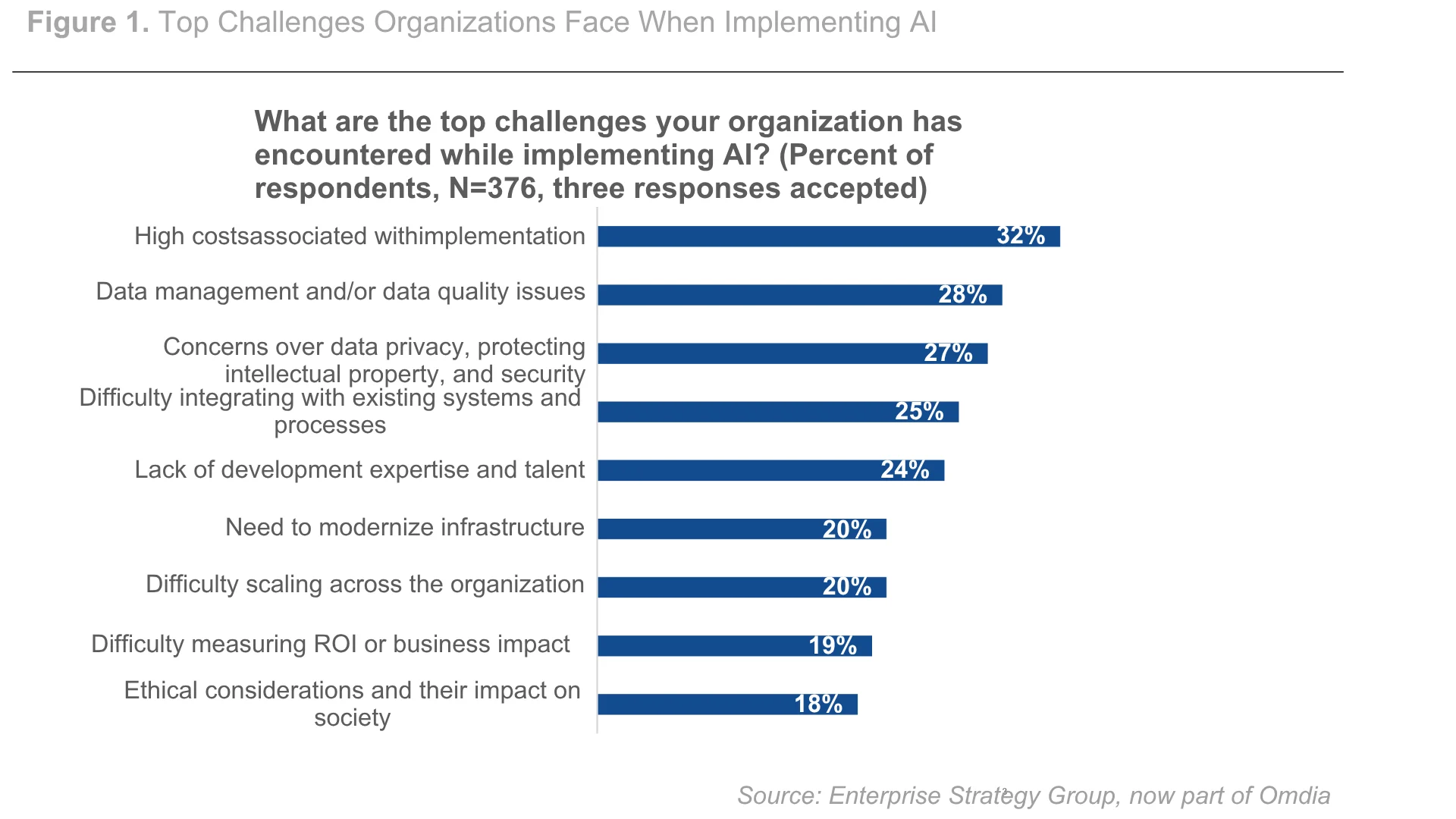
Figure 1 highlights the main challenges organizations encounter while implementing AI. The most identified challenge, which 32% of the respondents reported, was the high overall costs associated with the implementation, including the costs of the infrastructure and the operating costs thereafter. Data management and quality also emerged as a significant challenge for 28% of respondents since high quality data is a critical driver of the effectiveness of AI. Furthermore, security and privacy concerns were important issues to 27% of respondents due to the level of intellectual property and customer data that is exposed in AI workflows and the existence of strict regulations.
Other challenges included a lack of skilled AI professionals (24%), the use of legacy infrastructure that needs to be replaced (20%), the difficulty of ensuring the alignment of AI strategies across the entire enterprise (20%), the inability to measure the return on investment (ROI) of AI precisely (19%), and ethical and governance issues (18%).
Considering these complexities, enterprises should follow a simplified yet holistic approach to the adoption of AI. This means the ability to integrate easily with the existing IT environments, improving the manageability of the infrastructure and ensuring that scalability, security, and budgeting are predictable. Organizations don’t need to address these challenges alone. Partnering with AI solution providers that offer proven infrastructure, deep consultative expertise, and an open, flexible ecosystem can help accelerate implementation, reduce risk, and align AI efforts with evolving business needs. Enterprises that manage these factors effectively are best positioned to achieve long-term, sustainable value from their AI investments.
The Solution: The Dell AI Factory With NVIDIA
The Dell AI Factory with NVIDIA is an enterprise-ready approach designed to help organizations adopt and scale AI in an easier, more effective, and secure way. It brings together Dell’s AI-optimized infrastructure with NVIDIA’s leading-edge software and accelerated computing to simplify the deployment and management of AI across the organization. It is built to address the common challenges that organizations face when operationalizing AI, such as high infrastructure costs, complex data management, and security risks.
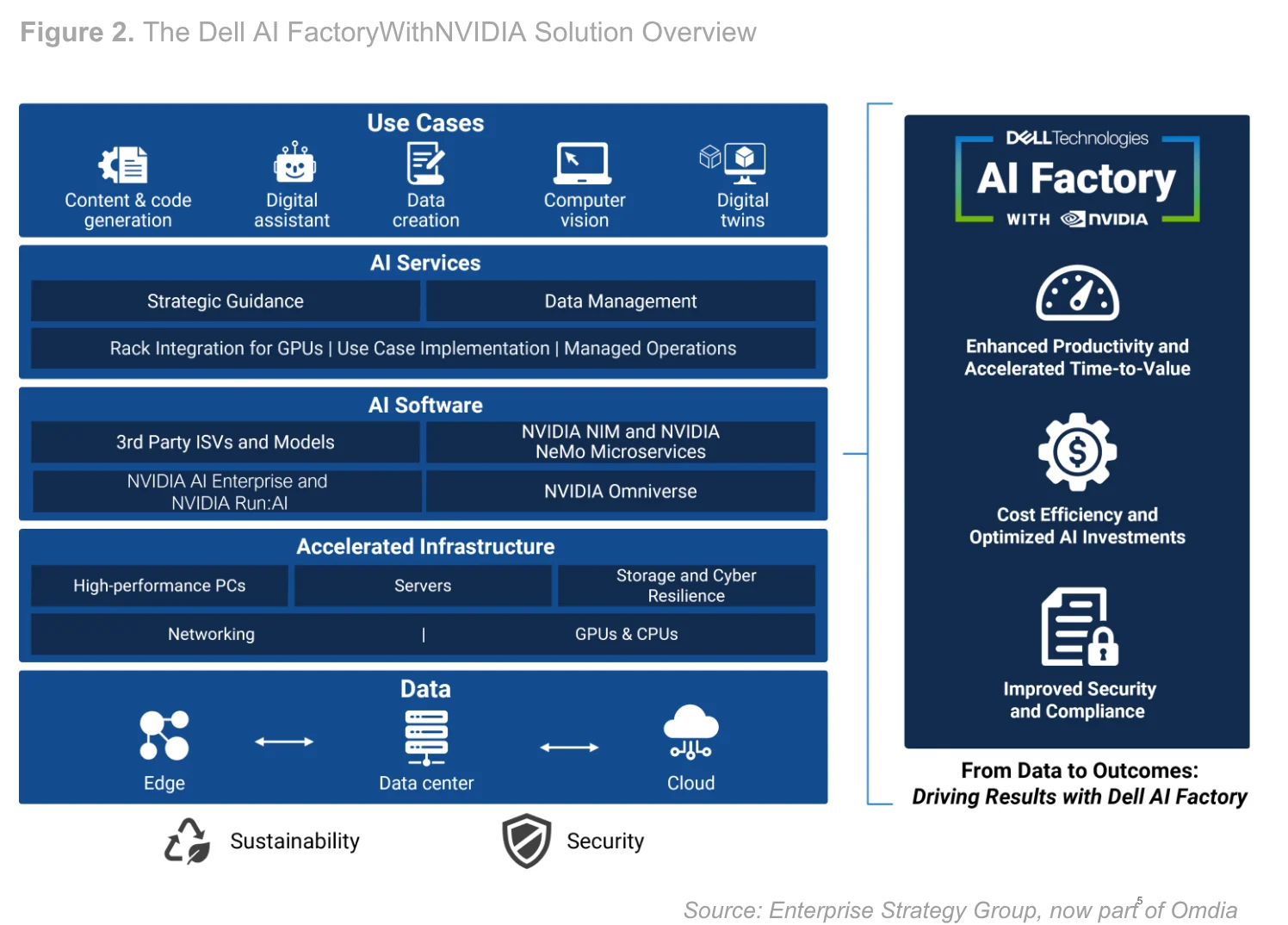
Figure 2 illustrates the five foundational pillars of the Dell AI Factory with NVIDIA—data, AI infrastructure, AI software, AI services, and AI use cases—and how they work together to deliver a comprehensive, end-to-end enterprise AI solution.
Key capabilities include:
- End-to-end integration. Combines compute, storage, networking, software, and services into pre integrated AI-optimized configurations for easier deployment and optimized AI performance.
- Flexible AI infrastructure. Offers scalable compute and storage options that are AI-, generative AI-, and agentic AI-ready. This includes Dell PowerEdge XE servers, PowerScale storage, NVIDIA networking, and Dell Pro MaxPCs—designed to support AI training and inferencing across diverse use cases such as content generation, digital assistance, data analytics, computer vision, and digital twins.
- Modern data management. Helps organizations discover, prepare, and govern data efficiently using solutions such as the Dell AI Data Platform with NVIDIA, and makes adoption and implementation easier with Dell Services for Data Management.
- Robust security and compliance. Built-in features support data protection, IP security, and regulatory compliance, making the Dell AI Factory with NVIDIA suitable for a range of environments, including sensitive edge and workplace locations.
- Expert services and support. Dell and NVIDIA provide expert guidance, deployment support, managed services, and educational resources that help organizations move confidently from AI strategy through pilot and full-scale production.
Enterprise Strategy Group Economic Validation
We completed a quantitative economic analysis of the Dell AI Factory with NVIDIA. Our Economic Validation process is a proven method for understanding, validating, quantifying, and modeling the economic value propositions of a product or solution. The process leverages Enterprise Strategy Group’s core competencies in market and industry analysis, forward-looking research, and technical/economic validation. We conducted in-depth interviews with end users to better understand and quantify how the Dell AI Factory with NVIDIA has impacted their organizations, particularly compared to public cloud, traditional DIY environments, and other pre-built AI solutions. These insights were used to build a simple economic model that reflects a real-world deployment scenario.
The Dell AI Factory With NVIDIA Economic Overview
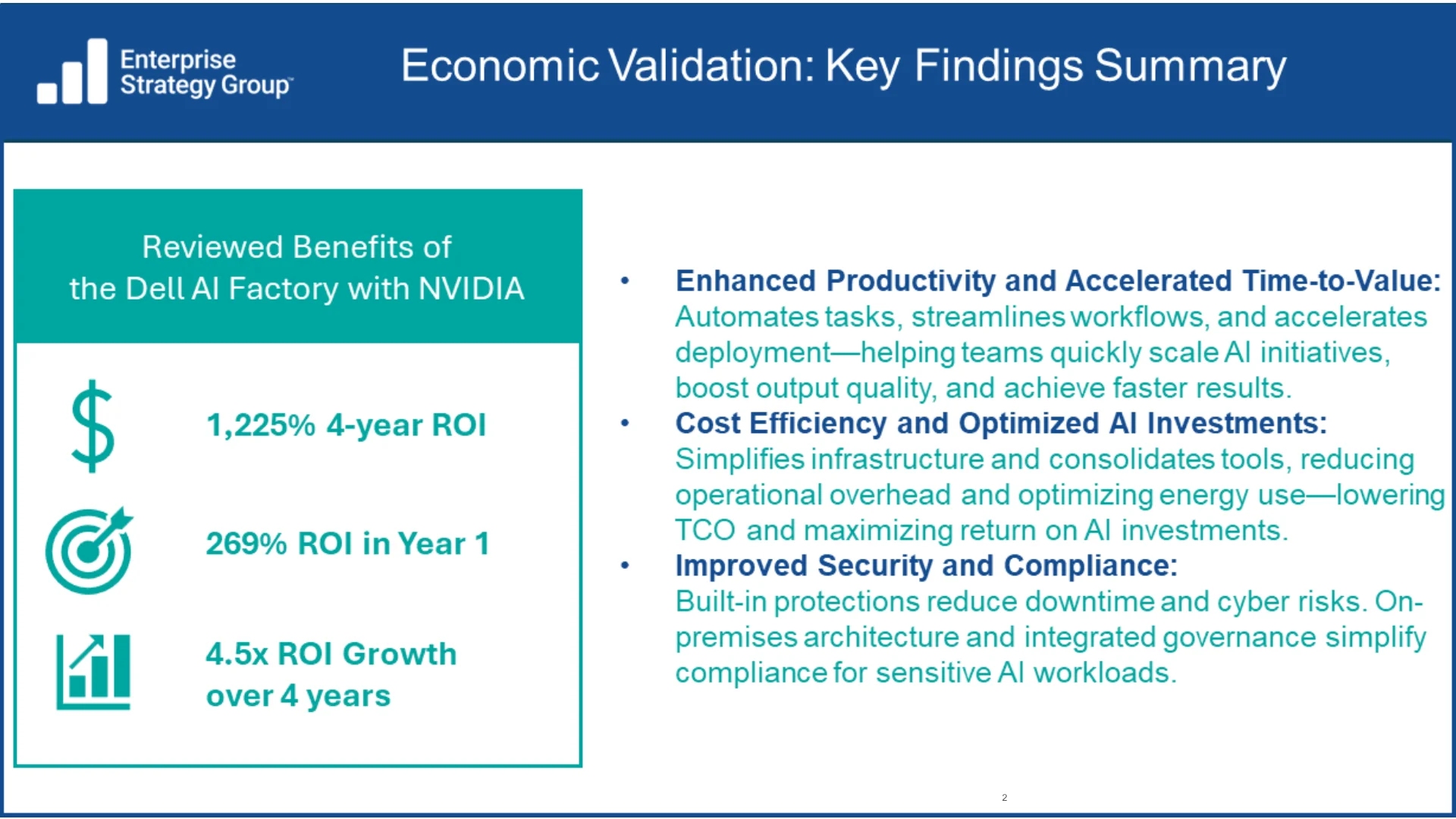
Our economic analysis revealed that, when deployed in on-premises environments, the Dell AI Factory with NVIDIA provides its customers with significant savings and benefits in the following key areas:
- Enhanced productivity and accelerated time to value. The Dell AI Factory with NVIDIA helps organizations boost productivity, accelerate AI deployment, and streamline day-to-day operations through automation, faster workflows, and IT efficiency.
- Cost efficiency and optimized AI investments. By reducing total cost of ownership (TCO), infrastructure complexity, and energy use, the solution helps organizations maximize the return on AI investments and scale more affordably.
- Improved security and compliance. The Dell AI Factory with NVIDIA enhances business continuity and governance by reducing downtime, mitigating cyber-risks, and simplifying compliance with built-in protections across the AI environment.
Enhanced Productivity and Accelerated Time to Value
The Dell AI Factory with NVIDIA enables organizations to move faster by boosting productivity and accelerating AI deployment. It automates routine tasks and shortens the time from concept to production, helping businesses scale initiatives more efficiently and deliver results sooner. Customers highlighted savings and benefits in the following areas:
- Improved productivity gains. Organizations leveraging the Dell AI Factory with NVIDIA reported tangible productivity gains by automating manual work, accelerating internal workflows, and producing higher-quality outputs. One customer estimated a conservative 6% improvement in win rates across 20% of their business, directly tied to faster proposal generation and improved bid quality powered by AI. “That 6% number is very conservative,” the customer added, explaining that other business leaders would likely report even greater improvements. At that scale, the organization estimated this benefit to be worth approximately $10 million annually. Another customer shared that using AI to automate tasks like non-disclosure agreement reviews had a direct impact on productivity. Legal teams now spend just 30 minutes reviewing the final version, compared to the previous two-hour manual process—a 75% time savings. Customers also reported broader time savings from automating internal tasks such as training material creation, policy checks, and email writing. These improvements freed up employees for higher-value work, enabling faster decisions and more efficient use of staff time.
“Before, we didn’t have the time to respond. Now, with our smart RFP generator, we do—and we’re winning.”
- Reduced time to value. Customers reported that the Dell AI Factory with NVIDIA enabled them to dramatically accelerate their time to value, moving from a proof-of-concept stage to production in just a matter of weeks. One customer described the speed as “unheard of” and credited this outcome to a combination of strong internal planning, Dell’s exceptional services, and NVIDIA’s technical support. Specifically, Dell helped close internal skills gaps, while the NVIDIA team accurately sized the cluster to avoid over- or under-provisioning, which was key to meeting an aggressive schedule. Once deployed, the customer scaled workloads across multiple global teams, enabled by the solution’s flexible architecture. Another customer shared that by launching their in-house platform early—before public cloud vendors could finalize legal and procurement agreements—they gained a one-year head start on their peers. These accelerated deployment timelines enabled organizations to unlock value sooner, drive innovation faster, and extend the impact of their AI initiatives.
“With the Dell AI Factory with NVIDIA, we got a one-year head start on everyone else, giving us time to innovate, deploy more use cases, and build internal expertise before others even got started.”
- Operational efficiency improvements. Organizations using the Dell AI Factory with NVIDIA reported notable gains in operational efficiency through automation, smarter staffing, and tool consolidation. One customer shared that AI now manages their engineering standards—a task that previously required 30 employees—stating, “The productivity improvement from that alone is massive.” Rather than reducing headcount, this shift enabled teams to focus on more strategic work. Another customer explained that AI-assisted bid evaluations helped avoid additional hiring, noting, “Some of our business cases factored in the need to hire more staff if we didn’t have this solution.” A separate organization highlighted cost savings from tool consolidation, reporting over $150,000 in immediate savings and projecting an additional $200,000 by eliminating external contracts and replacing them with an in-house chatbot. These improvements helped reduce manual workload, streamline operations, and free up resources for higher-value initiatives.
Cost Efficiency and Optimized AI Investments
The Dell AI Factory with NVIDIA helps organizations manage AI infrastructure costs more effectively by reducing reliance on public cloud services, streamlining operations, and optimizing resource use. This section explores how customers are lowering TCO, infrastructure expenses, and energy consumption. Customers reported savings and benefits in the following categories:
- TCO savings. Customers using the Dell AI Factory with NVIDIA reported significant cost advantages over traditional cloud-based and API-based AI inferencing models. According to a recent Enterprise Strategy Group economic analysis, the Dell AI Factory with NVIDIA delivered up to 2.6x more cost effective inferencing than infrastructure-as-a-service deployments and up to 4.1x more cost-effective inferencing than public API-based services for large language model (LLM) workloads.2 These savings improve further as usage scales, with higher inferencing intensity driving more favorable economics. Customers confirmed this trend in interviews. One commented they were “enjoying a cost structure about one tenth of what we’d pay in the cloud,” a critical factor in their decision to deploy on premises. Others highlighted predictable costs and avoided expenses such as cloud egress or token-based pricing as key financial benefits of staying in control of their AI infrastructure. Importantly, customers emphasized that this cost efficiency enabled them to unlock a wider range of use cases. As one explained, “When you reduce cost, you can tackle more mundane, long-tail tasks,” helping teams automate repetitive internal work and deliver more value without driving up expenses.
“We’re enjoying a cost structure about 1/10th of what we’d pay outside [in the cloud].”
- Reduced operational and infrastructure expenses. Organizations using the Dell AI Factory with NVIDIA described more efficient infrastructure management and reduced staffing needs to support AI operations. One customer cited a 20% reduction in production staff overhead, enabled by AI-driven efficiencies and streamlined workflows. Others noted that centralized management and on-premises deployment helped scale AI initiatives without requiring additional operational staff.
- Energy efficiency and optimized environmental footprint. Organizations reported that the Dell AI Factory with NVIDIA helped optimize their environmental impact and improve energy efficiency. One customer noted that energy savings extended beyond infrastructure choices, explaining that GPU orchestration capabilities enabled them to “power up when needed and sleep GPUs when not in use,” helping avoid unnecessary energy consumption and what they described as a “GPU tax.” These efficiencies not only support environmental, social, and governance (ESG) goals but also contribute to long-term cost savings and sustainable AI operations.
Improved Security and Compliance
The Dell AI Factory with NVIDIA helps organizations strengthen security, data control, and compliance by providing an isolated, on-premises environment for sensitive AI workloads. One customer described their setup as having “only a couple of avenues into this environment,” highlighting reduced attack surfaces and greater protection of intellectual property. Another emphasized the value of local control, stating, “If we went outside [to the cloud], we’d still be waiting on legal. We own the risk, but we also own the control.” These environments help organizations avoid legal and compliance delays—especially for research and public-sector use cases—by keeping sensitive data within their jurisdiction and under their governance. Built-in data protection and AI-native resilience not only reduce the risk of cyber incidents but also help avoid costly downtime, contributing to operational continuity. Integrated compliance tools and zero trust principles further simplify governance and regulatory alignment. According to Enterprise Strategy Group research, 70% of AI infrastructure is deployed outside the public cloud, reflecting a broader trend toward organization-controlled infrastructure that supports compliance and safeguards sensitive information.
“If we went outside [to the cloud], we’d still be waiting on legal. We own the risk, but we also own the control.”
Enterprise Strategy Group Analysis
Enterprise Strategy Group completed a quantitative economic analysis to estimate the potential ROI organizations could achieve by deploying the Dell AI Factory with NVIDIA to scale AI initiatives across their enterprise. We leveraged data from customer interviews, Dell-provided customer case studies, and our own market and technical expertise to build a modeled scenario reflecting real-world usage. This scenario was designed to evaluate the cost savings and business value the Dell AI Factory with NVIDIA can deliver compared to alternative approaches for deploying and managing AI solutions.
This analysis models the economic impact of deploying the Dell AI Factory with NVIDIA in a mid-to-large enterprise or public sector organization running production-scale generative AI (GenAI) workloads. These include LLM inferencing with retrieval-augmented generation, Dell professional services maintaining the underlying infrastructure, and internal AI-powered automation. The environment assumes 10,000 users, each running 50 queries per day at 3,000 tokens per query—based on previously validated assumptions from Enterprise Strategy Group’s TCO analysis of the Dell AI Factory with NVIDIA. While infrastructure costs were based on that validated solution, this paper focuses on the business value the Dell AI Factory with NVIDIA helps deliver—namely, productivity gains, faster time to value, improved operational efficiency, and reduced security and compliance risks. The model reflects a four-year, steady state deployment and is designed for organizations with sustained AI activity. For early-stage or low-volume use cases, public cloud options might appear more cost-effective, but the Dell AI Factory with NVIDIA is optimized for long-term value at scale.
4-year ROI Analysis
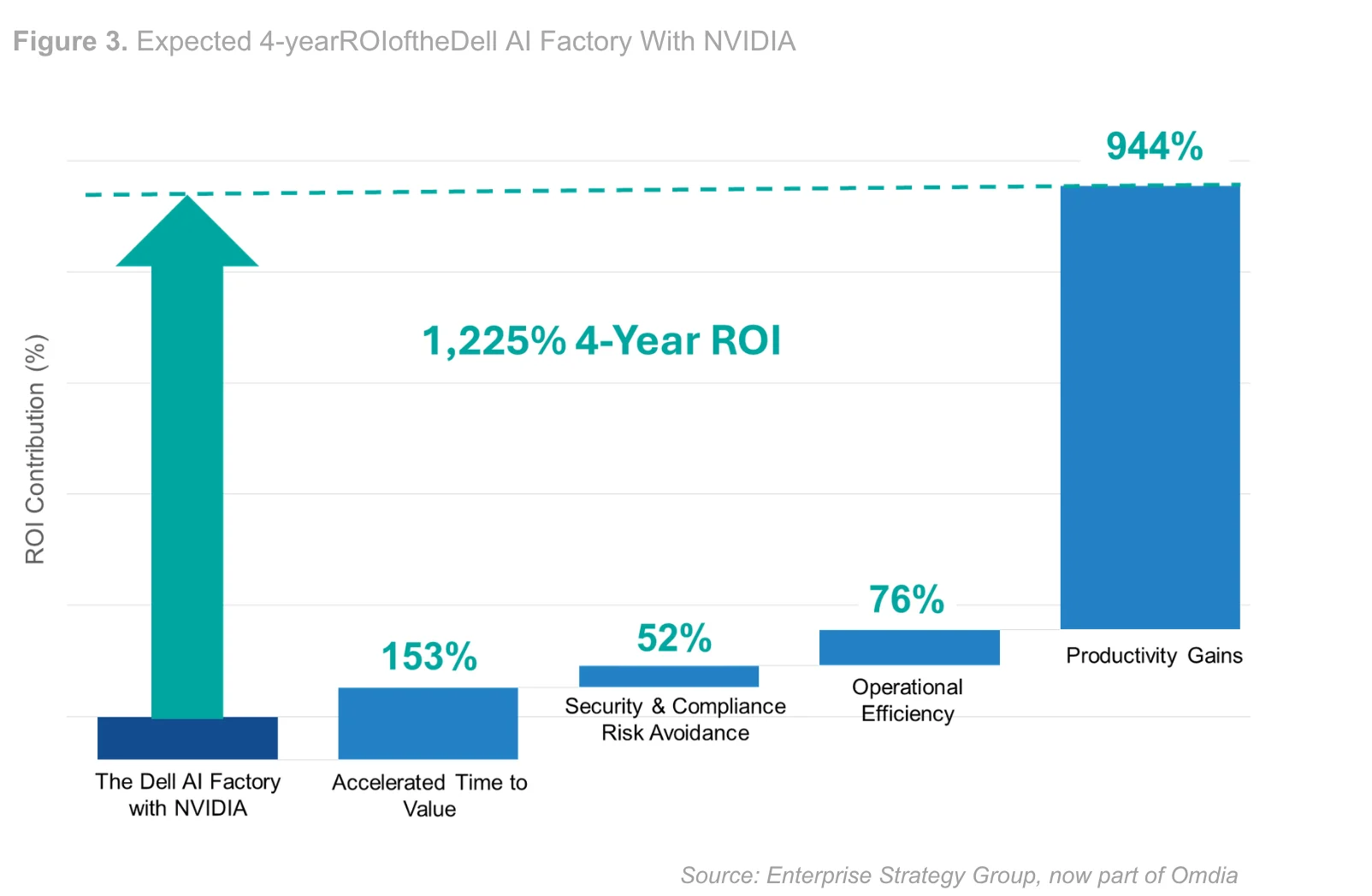
Our modeled scenario predicted that, by deploying the Dell AI Factory with NVIDIA, the organization could realize savings and benefits totaling $25.9 million over four years against a $1.96 million investment, resulting in a net benefit of $23.9 million and an ROI of 1,225% (see Figure 3). Modeled benefits were driven by productivity gains, accelerated time to value, operational efficiency improvements, and reduced risk related to security and compliance. Taken together, these results illustrate that, even with conservative inputs, the Dell AI Factory with NVIDIA can provide outsized economic returns once AI adoption scales beyond the pilot stage. Enterprise Strategy Group also modeled deployments at both lower and higher usage tiers (e.g., 5,000 and 50,000 users), which produced similarly strong or higher ROI percentages—indicating that economic value scales with broader adoption across teams and workloads.
Projected Benefits and Savings
- Accelerated time to value: We modeled this benefit based on the Dell AI Factory with NVIDIA’s ability to accelerate AI deployments and improve the success rate of AI projects. The model assumes organizations gain value three months earlier than they would with public cloud or DIY approaches, yielding $1.25 million in additional benefits based on a $5 million/year productivity benchmark (detailed in the “Productivity gains” section below). In addition, a 10% uplift in project success rate—enabled by faster deployments and fewer technical blockers—was estimated to generate another $2 million over four years. These assumptions were validated by multiple customer interviews, including one customer who reported a full-year advantage over competitors by launching their AI platform ahead of public cloud alternatives. This category contributed approximately 153% of the total 4-year ROI modeled in this analysis.
- Security and compliance risk avoidance: We modeled this category based on the Dell AI Factory with NVIDIA’s ability to reduce downtime risk, mitigate cybersecurity incidents, and streamline compliance activities. Downtime savings were estimated at $600,000, assuming one major hour-long outage avoided over four years—a conservative mid-point aligned with industry benchmarks that place typical downtime costs between $300,000 and $1 million per hour.4 Cybersecurity risk reduction was calculated at $317K over four years, based on an average breach cost of $4.88M.5 We assumed a 65% mitigation effect enabled by the Dell AI Factory with NVIDIA’s AI-driven automation and secure, on-premises architecture, applied to a conservative 10% breach probability, leading to a rounded, conservative estimate of $300,000 in avoided risk. Compliance related savings were conservatively estimated at $200,000 over four years, assuming modest annual efficiencies (~$50,000/year) in tasks such as audits, reporting, and governance. This estimate was based on proprietary assumptions and customer-validated inputs, reflecting a small percentage of the average compliance costs organizations typically incur. Industry estimates for annual compliance costs often range from hundreds of thousands to several million dollars depending on company size and sector. Combined, this category conservatively contributed approximately 52% of the total 1,225% 4-year ROI modeled in this analysis.
The next two ROI categories reflect benefits commonly associated with AI adoption. While not all gains can be attributed solely to the Dell AI Factory with NVIDIA, the solution plays a critical enabling role by providing the solutions that operationalize GenAI at scale.
- Operational efficiency improvements: With AI solution deployment, integration, and maintenance costs included in the TCO analysis, we modeled operational efficiency benefits based on time savings and automation across IT operations, engineering workflows, and legal or compliance tooling. The calculation assumes IT teams recovered 20% of their time (10 FTEs × $120,000/year; engineering review efforts were reduced for 2 FTEs (each modeled at $120,000/year) who previously spent 50% of their time on those tasks— resulting in approximately $60K/year in savings; and tool consolidation with legal automation yielded $100,000/year in avoided costs. Combined, these factors deliver approximately $400,000 in annual savings— or $1.6 million over four years. These estimates reflect customer-reported gains from centralizing infrastructure, reducing manual overhead, and streamlining internal processes. This category accounts for approximately 76% of the total 1,225% 4-year ROI modeled.
- Productivity gains: This benefit was modeled based on increased efficiency across a variety of knowledge and task-based roles. The base case assumes 10,000 users each gained $500 in annual productivity, resulting in $5 million per year—or $20 million over four years. We chose this figure as a conservative average, even though customers interviewed reported savings closer to $2,000 per user per year. Reported improvements spanned legal reviews, clinical workflows, content creation, and administrative tasks. This category accounts for approximately 944% of the total 4-year ROI modeled.
Year-by-year ROI Analysis
While the four-year ROI highlights the long-term value of the Dell AI Factory with NVIDIA, many organizations also want to understand how quickly those benefits are realized. The chart below illustrates the modeled ROI on an annual basis, showing positive ROI beginning in Year 1 and increasing steadily over time as productivity, operational efficiency, and security-related gains accumulate. While this model assumes a single upfront investment in Year 1, many organizations could expand their deployments over time as early use cases demonstrate value and broader AI needs emerge.
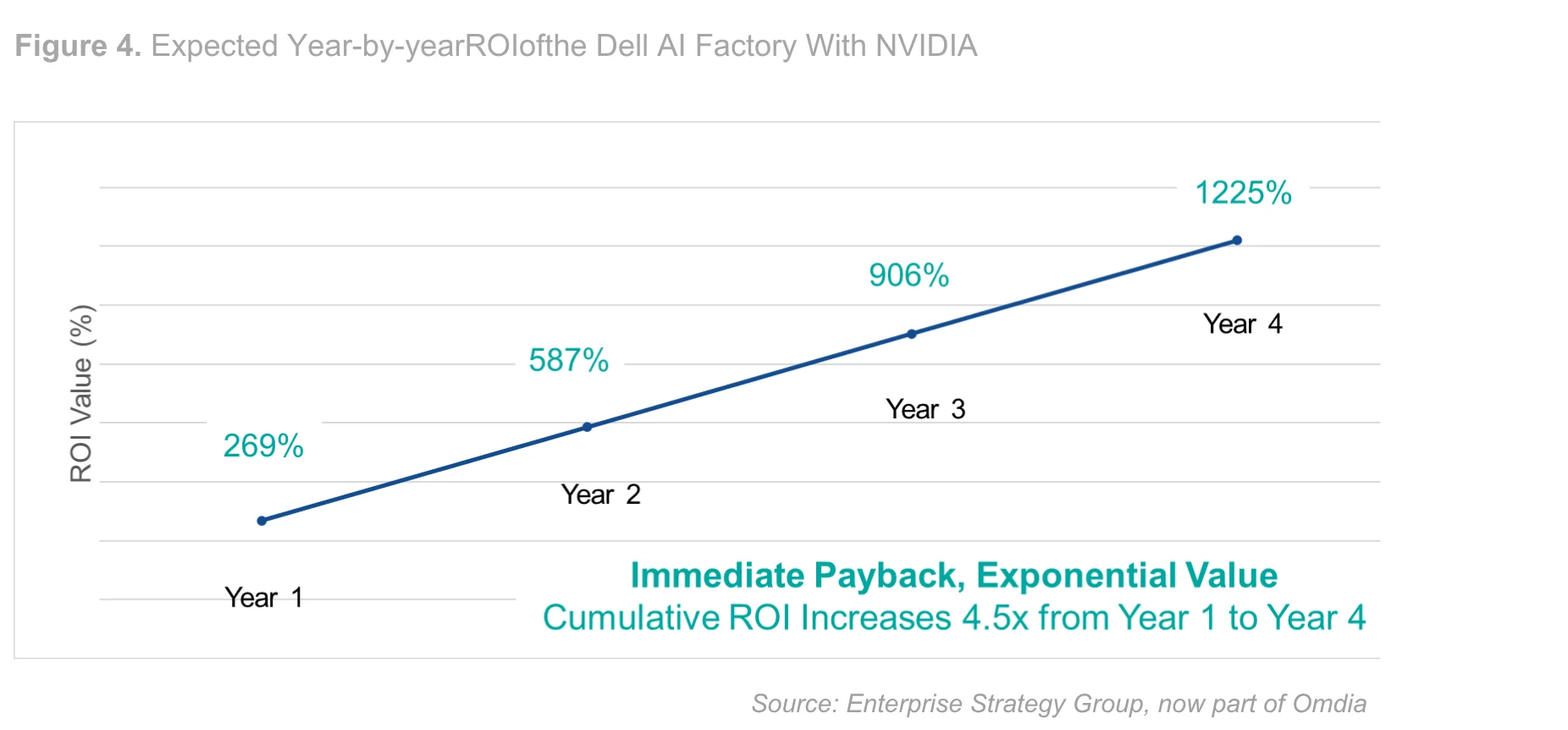
The table below provides a detailed breakdown of the modeled investment and cumulative ROI by year. While this scenario assumes a single investment in Year 1, many organizations might choose to expand their deployments over time as initial results demonstrate clear value.
Table 1. Modeled Year-by-year ROI Breakdown
| Category | Year 1 | Year 2 | Year 3 | Year 4 | 4-year Total |
|---|---|---|---|---|---|
| Investment in the AI Factory | $1.96M | $1.96M | |||
| Productivity gains | $5M | $5M | $5M | $5M | $20M |
| Reduced time to value | $1.75M | $500K | $500K | $500K | $3.25M |
| Operational efficiency | $400K | $400K | $400K | $400K | $1.60M |
| Security and compliance | $75K | $325K | $350K | $350K | $1.10M |
| Total annual benefit | $7.23M | $6.23M | $6.25M | $6.25M | $25.95M |
| Cumulative net benefit | $5.27M | $11.49M | $17.74M | $23.99M | |
| Cumulative ROI (%) | 269% | 587% | 906% | 1225% |
Source: Enterprise Strategy Group, now part of Omdia
The breakdown below offers key insights into how and when different categories of value are realized across the four-year period.
- Year 1: The Dell AI Factory with NVIDIA delivers immediate value in Year 1, achieving full payback. A one-time early productivity boost of $1.25 million is realized by accelerating time to value by three months, with an additional $500,000 from improved AI project success. Productivity gains across 10,000 users contribute $5 million, and recurring operational efficiencies add $400,000. Initial security and compliance improvements deliver $75,000 from early risk reduction and streamlined governance. Combined, these benefits result in a 269% ROI in the first year.
- Years 2-4: Following the initial deployment, the Dell AI Factory with NVIDIA continues to deliver strong, recurring value across all benefit categories. Productivity gains remain steady at $5 million annually, while operational efficiencies contribute $400,000 each year. Improvements in AI project success, modeled at $500,000 per year, persist as adoption scales. Security and compliance savings increase from $325,000 to $350,000, reflecting reduced risk exposure and streamlined governance as the solution matures. Together, these recurring benefits result in cumulative returns of 587% by Year 2, 906% by Year 3, and a total ROI of 1,225% by Year 4.
Issues to Consider
Enterprise Strategy Group’s ROI model is built in good faith upon conservative, credible, and validated assumptions; however, no single modeled scenario can capture the full range of environments, use cases, and outcomes possible with the Dell AI Factory with NVIDIA. Actual results will vary based on factors such as organization size, industry, AI maturity, AI solution implemented, and workload types. While this analysis focuses on quantifiable areas of benefit, several additional sources of value, such as energy efficiency, regulatory alignment, ESG impact, new revenue streams, and long-term AI cost control, were identified in customer interviews but excluded from the ROI model due to limited measurable data. Enterprise Strategy Group recommends using this analysis as a starting point and consulting with Dell and NVIDIA to understand and discuss the differences between solutions through your own proof-of-concept testing.
Conclusion
As artificial intelligence moves from pilot projects to essential business operations, organizations face significant challenges in deploying and scaling AI. Key barriers include high infrastructure costs, complex data management, stringent security requirements, legacy systems, limited AI expertise, fragmented internal alignment, and uncertainty around AI’s financial impact. To succeed, enterprises need solutions that seamlessly integrate, offer predictable scalability, and simplify governance and budget management.
Enterprise Strategy Group’s analysis validated that the Dell AI Factory with NVIDIA effectively addresses these challenges while delivering measurable economic value. In a modeled scenario, the solution achieved a 1,225% ROI over four years, translating into a net benefit of $23.9 million against a $1.96 million investment. It delivered rapid returns, with a 269% ROI in the first year alone. Key drivers included productivity gains, significantly faster deployment timelines—customers reported reaching production three months to one year ahead of alternatives— and notable improvements in operational efficiency, security, and compliance.
In our view, the Dell AI Factory with NVIDIA offers organizations a strategic path to overcoming the most common AI scaling obstacles. By simplifying deployment, accelerating productivity, and enhancing both security and operational efficiency, the Dell AI Factory with NVIDIA delivers sustainable, predictable long-term value. Enterprise Strategy Group recommends that organizations evaluating AI solutions engage directly with Dell and NVIDIA representatives to explore how this approach aligns with their specific strategic goals. To learn more about the Dell AI Factory with NVIDIA, visit www.dell.com/nvidia-ai.