
.webp "Dell Logo")

- From AI assistance to digital workforces
- The rise of the digital workforce
- The governance readiness gap
- The agentic AI platform model
- Architecting governed autonomy
- Autonomy by design
- The foundation: Dell AI Factory with NVIDIA
- Inside the Dell AI Factory with NVIDIA
- Enterprise use cases
- Building the foundation for governed autonomy
- Key takeaways
From AI assistance to digital workforces
Agentic AI marks a shift from isolated chatbots to coordinated digital workforces of agents that reason, plan, and act across enterprise systems.
But autonomy at scale introduces new demands. Multi-agent systems require observability, lifecycle management, and infrastructure-level control to operate safely and predictably.
The agentic AI platform establishes autonomy as a system capability, built on the Dell AI Factory with NVIDIA. Together, they provide a blueprint-driven, full-stack foundation to design, deploy, and scale secure, high-performance agent systems adjacent to your data - taking AI from idea to production-grade impact with one accountable partner.
The rise of the digital workforce
From AI assistance to autonomous execution
Across the enterprise, intelligent agents are transforming how work gets done.
They retrieve information, analyze context, coordinate actions, and execute tasks autonomously and in real time. Agents adapt to changing conditions, trigger workflows across systems, and collaborate with other agents to move work forward continuously.
For example, in an insurance claims operation, one agent retrieves policy and prior-claim data, another evaluates risk, and a third drafts a recommendation and next steps. All this happens in seconds and with a full audit trail for compliance.
From automation to coordinated execution
Agents unlock new levels of speed and precision, from financial risk analysis to clinical workflow coordination, supply chain optimization, and knowledge orchestration.
What was once isolated automation is becoming coordinated digital execution. Agents operate across systems and functions, extending human capability while accelerating complex decision-making.
The scaling imperative
The opportunity is clear. Enterprises are no longer asking whether agents can deliver value. They are asking how to turn AI ambition into measurable results, at scale, across use cases, teams, and infrastructure.
That shift changes everything.
The governance readiness gap
Scaling autonomy without losing control
Complexity accelerates quickly
As autonomous agents expand across enterprise workflows, complexity increases fast. What begins as targeted experimentation can evolve into a fragmented landscape of disconnected pilots, overlapping tools, and unmanaged reasoning loops.
From pilots to sprawl
Many organizations now operate multiple GenAI initiatives across business units - without a standardized path from pilot to production. As multi-agent systems grow more sophisticated, coordination becomes harder to manage and performance expectations rise.
Visibility determines trust
Without deep visibility into how agents reason and act, enterprises struggle to validate decisions, attribute outcomes, or ensure compliance. Organizations cannot trust what they cannot trace.
Cloud-only deployments can introduce data sovereignty concerns and increase the cost of moving sensitive data across boundaries.
From pilots to sprawl
And while adoption accelerates, governance maturity lags:
- 75% of organizations plan to deploy agentic AI in the next two years
- Only 21% report having a mature framework for governing autonomous agents
- 66% of IT leaders say their infrastructure is not ready for production-scale AI workloads
Autonomy introduces opportunity. At enterprise scale, it also introduces risk, from regulatory exposure and reputational damage to inconsistent customer outcomes and operational fragility.
The agentic AI platform model
Engineering autonomy at enterprise scale
Autonomous agents cannot operate as isolated models scattered across tools and teams. At enterprise scale, they must function as a coordinated system that’s designed, orchestrated, observed, and secured within a unified environment.
A system-level foundation
An agentic AI platform provides that foundation. It enables organizations to design, deploy, and operate a digital workforce with consistency and control. Multi-agent workflows are orchestrated across systems, integrating enterprise tools and data sources while maintaining performance and visibility.
Operational discipline
Governed autonomy requires operational rigor. Agents must be managed across their lifecycle, from development and testing to deployment and optimization. Deep observability and traceability provide insight into how agents reason, act, and interact, enabling enterprises to validate outcomes and sustain trust.
Blueprint-driven acceleration
Acceleration is equally critical. The Dell Automation Platform delivers a curated catalog of validated blueprints from ecosystem partners, enabling organizations to deploy complete agent stacks in just a few clicks.
Standardized, blueprint-driven deployments reduce integration friction and establish a repeatable path from pilot to production. This frees teams to focus on designing high-value agent behaviors rather than stitching tools together.
Embedded security and compliance
Security and compliance are integrated at the platform level, ensuring sensitive data remains protected and agent activity aligns with enterprise policy.
A structured platform transforms autonomy from experimentation into scalable enterprise capability, integrating best-of-breed orchestration, reasoning, and observability tools so organizations can adopt the right ecosystem without the integration friction of a DIY stack.
Architecting governed autonomy
From autonomous agents to enterprise-scale systems
A layered operational model
Autonomous agents do not operate safely by default. Enterprise-scale autonomy requires a layered architecture that integrates lifecycle management, observability, security, automation, and AI-optimized infrastructure into a unified operational framework.
Rather than treating control as an overlay, the agentic AI platform embeds visibility, orchestration, and protection directly into the stack.
This architectural discipline shifts agent deployment from experimentation to repeatable enterprise operations.
Agentic AI platform
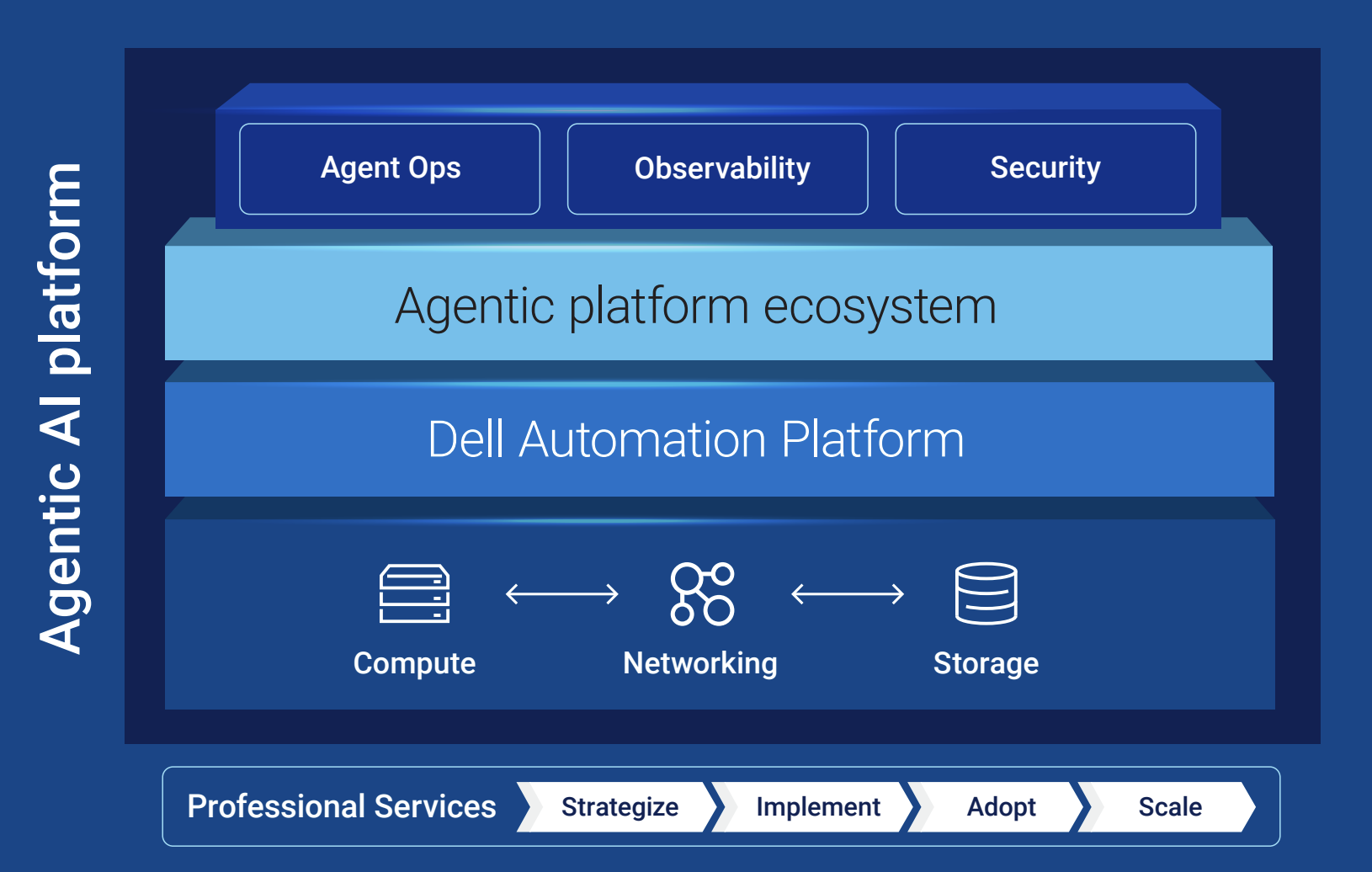
The layered architecture
The agentic AI platform is built as a layered operational stack:
Agent control plane: Agent Ops | Observability | Security
This is where enterprises establish guardrails and accountability for autonomous systems.
The control plane creates structured autonomy by ensuring agents are traceable, auditable, compliant, and continuously evaluated. Agent Ops manages lifecycle and orchestration.
Observability provides trace-level insight into reasoning flows and system interactions, enabling validation and accountability.
Security enforces role-based access, encryption, and policy alignment across environments.
Execution layer: Agentic AI platform
This is where agents perform coordinated work across enterprise systems.
The platform enables agents to reason, plan, and act within defined boundaries. It supports tool use, enterprise data integration, and coordinated multi-agent workflows while maintaining performance and visibility.
Acceleration layer: Dell Automation Platform integration
This layer accelerates deployment by turning agent initiatives into repeatable production systems.
Blueprint-driven deployment, automated dependency management, and standardized scaling reduce integration friction and create a repeatable path from pilot to production.
Infrastructure foundation: High-performance compute | Low-latency networking | Scalable storage
This foundation ensures agents remain fast, reliable, and predictable as deployments scale.
At the base is Al-optimized infrastructure delivering predictable performance, controlled data residency, and support for complex multi-agent coordination.
Agents operate adjacent to enterprise data - without uncontrolled cloud dependencies.
Autonomy by design
Governed autonomy is not a single capability. It is an architectural discipline. That discipline is what keeps innovation from becoming unmanaged risk. By layering control, automation, and AI-optimized infrastructure into a cohesive system, enterprises can scale digital workforces with confidence — without sacrificing control, and without multi-vendor risk.
The foundation: Dell AI Factory with NVIDIA
The full-stack foundation behind autonomous agents at scale
Multi-agent systems introduce new operational demands. Unlike traditional applications or even single-model AI workloads, agentic systems rely on coordinated reasoning loops, tool orchestration, and real-time inter-agent communication.
To operate safely and predictably, these systems require:
- Deterministic performance
- High-speed networking
- Secure data adjacency
- Predictable scalability
Governed autonomy is only possible when the underlying infrastructure is purpose-built for AI - engineered as a single, validated, full-stack foundation, not assembled from point products.
Why agentic AI requires a full-stack foundation
Deterministic, accelerated performance
Multi-agent reasoning loops depend on low-latency inference and consistent throughput. Variability in compute performance directly impacts response quality and system coordination.
NVIDIA-accelerated infrastructure ensures predictable, high-performance execution across agent workloads.
Infrastructure-level control
Traceability must extend from application layer to infrastructure layer. Infrastructure-level visibility enables performance tuning, resource isolation, and policy enforcement across compute, networking, and storage.
Secure data adjacency
Agents reason over enterprise data that’s often sensitive, regulated, or proprietary. Running agents adjacent to that data reduces risk, minimizes costly movement, and supports compliance requirements.
Predictable scalability
Agent systems expand quickly - from pilots to multi-department deployments. To enable enterprise confidence, scaling must be modular, repeatable, and predictable. Infrastructure must support incremental growth without introducing performance fragmentation.
Fully validated solutions deployed on modular infrastructure
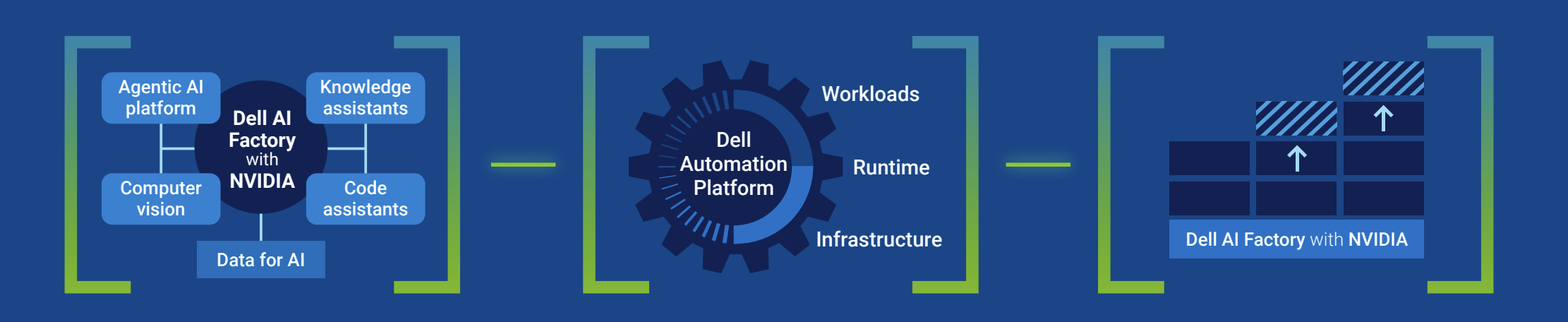
- Broad use case support: One solution, many outcomes
- Easy deployment: Automated to accelerate and optimize
- Enterprise flexibility: Start small, scale with pre-defined modules
Inside the Dell AI Factory with NVIDIA
A modular, validated, full-stack foundation engineered for AI workloads
NVIDIA-accelerated compute
Optimized GPU platforms deliver the performance required for inference-heavy reasoning engines and multi-agent coordination. Dell AI Factory configurations scale from single-node pilots to clusters with hundreds of GPUs supporting complex multi-agent simulations.
Enterprise storage architecture
High-throughput, scalable storage supports model versioning, embeddings, logs, and retrieval pipelines.
Validated AI ecosystem
Pre-validated integrations across AI software and orchestration tools reduce integration risk and speed time to value.
High-performance networking
Low-latency networking ensures fast inter-agent communication and efficient data movement across nodes. This reduces tail latency and keeps multi‑agent reasoning loops responsive under load.
Integrated automation
Dell Automation Platform enables blueprint-driven deployment, reducing configuration drift and accelerating production readiness.
Lifecycle services
Dell Professional Services support the full lifecycle with strategy, implementation, adoption, and scaling. With the AI Factory delivered to more than 5,000 customers since the beginning of 2024, Dell brings proven expertise that ensures multi-agent systems move from experimentation to sustained operational value.
Enterprise use cases
Achieving outcomes across industries
Agentic AI delivers measurable outcomes across industries where precision, traceability, and performance are critical.
Though use cases vary, the architectural pattern is consistent: coordinated agents operating within defined controls. Built on a scalable, full-stack foundation, digital workforces extend across departments and industries without sacrificing control.
Financial services: Risk triage and decision support
Manual review slows response and creates bottlenecks. Specialized agents retrieve data, assess exposure, and escalate exceptions in coordinated loops. Traceability and policy enforcement ensure every decision is auditable.
Outcome: Faster resolution and stronger compliance posture
Healthcare: Clinical workflow coordination
Fragmented systems delay care and increase administrative burden. Agents retrieve patient data, coordinate scheduling, and surface insights to clinicians. Role-based access and protected data handling maintain integrity.
Outcome: Improved workflow efficiency without compromising trust
Manufacturing: Supply chain coordination
Distributed systems create blind spots and volatility. Agents monitor signals, simulate scenarios, and recommend adjustments. Policy-aligned automation ensures operational discipline.
Outcome: Greater resilience and more predictable operations
Building the foundation for governed autonomy
Agentic AI is not defined by a model. It is defined by the system that supports it. When lifecycle management, visibility, security, and automation are integrated into a unified architecture, enterprises can deploy digital workforces with confidence, scaling innovation without sacrificing control.
The future of enterprise AI is autonomous, built on an intentional foundation.
That foundation is Dell AI Factory with NVIDIA. Built for intelligence. Built to deliver.
Key takeaways
- Agent lifecycle management: Structured orchestration and continuous evaluation of multi-agent systems.
- Deep observability: Trace-level insight into reasoning flows, system interactions, and performance.
- Security integration: Role-based access, encryption, and infrastructure-level controls embedded across the stack.
- Blueprint standardization: Repeatable deployment patterns that accelerate the move from pilot to production.