
.webp "Dell Logo")

Executive summary
Across industries, artificial intelligence (AI) is embedded in business-critical workflows, from customer engagement and product development to IT operations and supply chain optimization. Yet while AI adoption accelerates, most enterprise infrastructure was designed for traditional, transactional workloads, not the data-intensive, highly parallel and latency-sensitive demands of modern AI.
AI workloads place extraordinary demands on compute acceleration, memory bandwidth, storage throughput and east-west networking. As AI becomes pervasive, infrastructure mismatches are a significant barrier to scaling from pilots to production, making purpose-built, right-sized infrastructure essential for unlocking AI’s full potential.
Infrastructure that aligns with data preparation, model training, fine-tuning and inference includes accelerated compute, high-performance networking and an optimized software stack that works cohesively from the data center to the edge. Dell PowerEdge servers with NVIDIA GPUs, combined with Dell PowerSwitch SN-series switches, provide a proven foundation for AI-ready infrastructure. With the flexibility and choice of network operating systems — including Dell SONiC or NVIDIA Cumulus® — this integrated approach optimizes performance, utilization and scalability, enabling you to scale AI reliably while supporting operational efficiency and sustainability goals.
This white paper outlines the critical components of AI-ready infrastructure and how they enable smarter decisions, faster innovation and future-ready businesses.
The AI imperative: Why infrastructure matters
AI is no longer confined to a specialized set of workloads. Many analysts believe it will become a pervasive layer across the IT landscape, touching nearly all workloads over time. For example, a recent Gartner® survey found that by 2030, CIOs expect 0% of IT work to be performed by humans without AI involvement, with the majority of work carried out by humans augmented by AI.
Recent industry research shows that AI adoption has reached a tipping point.
- 88% of organizations are using AI in at least one business function
- 62% are exploring AI agents
- 64% AI is already enabling innovation
As AI expands across functions, workloads are shifting from isolated experiments to always-on, businesscritical systems.
This shift has profound infrastructure implications. AI workloads demand exceptional performance at every stage of the pipeline. Data preparation and ingestion require high-throughput storage and fast interconnects. Model training and fine-tuning rely on massively parallel, unaccelerated compute with high-bandwidth memory. Inference workloads, increasingly deployed closer to users and data sources, require predictable latency, scalability and energy efficiency.
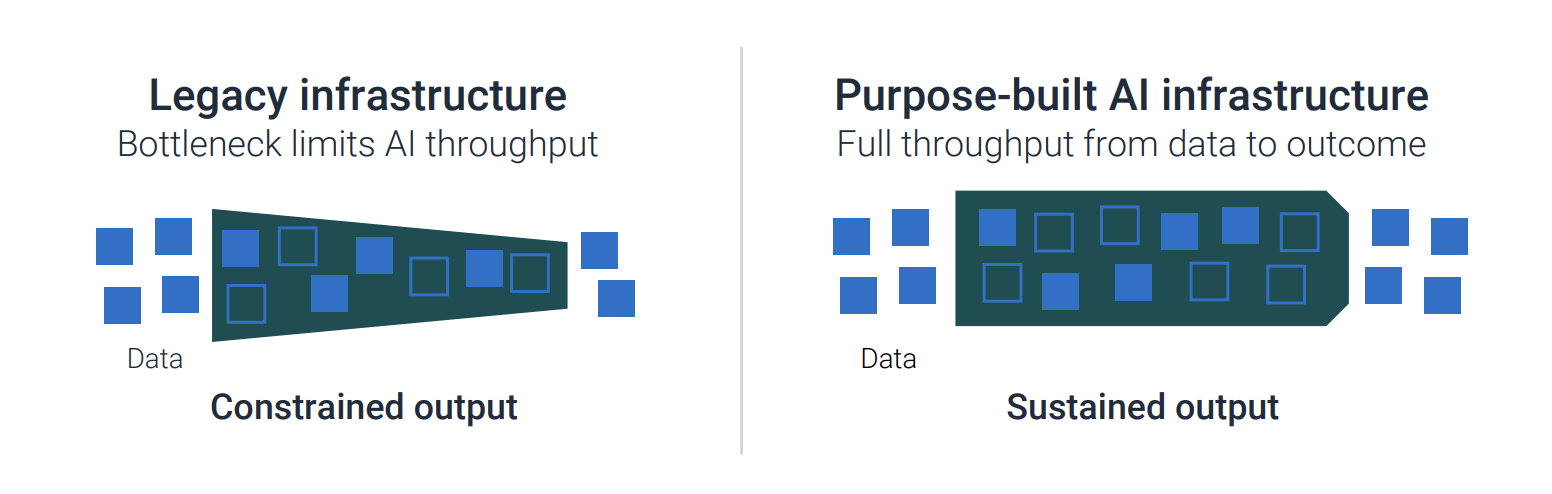
Traditional infrastructure, optimized for general-purpose compute and north-south traffic patterns, introduces multiple friction points when organizations attempt to operationalize AI. Common challenges include GPU underutilization, storage and network bottlenecks, long provisioning cycles and escalating power and cooling demands. These constraints contribute to what many organizations describe as “pilot purgatory,” where AI initiatives fail to transition into production due to infrastructure limitations rather than a lack of model quality or business value. In fact, despite a great deal of AI optimism in the market, nearly two-thirds of enterprises say their organizations have not yet begun scaling AI across the enterprise,2 and 75% are reporting double-digit AI failure rates.
But enterprises are not standing still. IDC estimates that enterprise spending on AI-centric infrastructure is growing at a compound annual rate of 27%, driven primarily by the acquisition of accelerated servers that are purpose-built for AI workloads.
Looking ahead, IDC forecasts that by 2028: 75% of enterprise AI workloads will be deployed on fit-for-purpose hybrid infrastructure to optimize performance, cost and compliance.
This reflects a growing recognition that one-size-fits-all infrastructure models are no longer viable for AI at scale.
As AI becomes embedded in nearly every workload, infrastructure strategy becomes a business strategy. Organizations that invest in right-sized, AI-optimized infrastructure gain the ability to iterate faster, scale more efficiently and align performance with sustainability and cost objectives. Those that rely on legacy architectures risk slower innovation, higher operational costs and reduced return on AI investments.
Key components of AI-ready infrastructure
As with any workload, AI performs only as well as the infrastructure underneath it. Right-sized, AI-ready infrastructure brings modern compute, storage, networking and data pipelines together into a cohesive platform that can support high-performance workloads, move data efficiently and scale reliably from pilot to production, all while reducing power and space requirements via system density.
This section breaks down the core components that make enterprise AI possible and why each one matters for performance, cost-efficiency and long-term operational success.
The engine of AI: Powering businesses of every size
AI workloads are fundamentally compute bound. Training large models, fine-tuning domain‑specific variants and running high-volume inference all require dense, GPU-accelerated systems designed to sustain massive parallelism. Dell PowerEdge servers equipped with NVIDIA GPUs form the backbone of modern AI compute because they deliver the throughput, efficiency and scalability that traditional CPU-centric architectures simply cannot match.
At the heart of this performance are NVIDIA data center GPUs, such as the NVIDIA H200 GPU, which delivers up to 2X higher large language model (LLM) inference performance within the same power envelope compared with prior generations.
This density matters because AI workloads scale non-linearly. Larger GPU pools allow for:
- Faster model convergence through increased parallelism
- Higher batch sizes without memory bottlenecks
- More efficient multinode scaling using NVIDIA NVLink™ and NVSwitch™
- Lower total cost of ownership through consolidation and energy efficiency
Dell engineering around thermal design, power delivery and GPU interconnects means that these systems sustain peak performance under continuous load, which is critical for production AI environments where training jobs may run for days or weeks.
AI-ready compute is not just about raw horsepower. It’s about delivering consistent, scalable and energy-efficient performance that accelerates time to value. Dell PowerEdge servers with NVIDIA GPUs provide the compute density, performance and reliability enterprises need to operationalize AI at scale.
High-performance networking: Sustain throughput at AI scale
AI workloads are only as fast as the data paths that feed them. As models grow and GPU clusters scale from a handful of accelerators to dozens or hundreds, the network becomes a critical performance determinant. Training, fine-tuning and distributed inference all depend on low‑latency, high-bandwidth connectivity to keep GPUs saturated with data and prevent idle cycles that waste both time and energy. In modern AI architectures, networking is no longer just a transport layer; it’s a core enabler of real-time processing, multinode scaling and efficient resource utilization.
Dell PowerSwitch SN-Series switches are engineered specifically for these demands. Built on high‑performance application-specific integrated circuits (ASICs) and supporting up to 800GbE per port, the PowerSwitch SN-Series delivers high throughput, low latency and advanced data center capabilities for fabrics of any size. This keeps data, gradients and model parameters moving quickly and predictably across nodes, which is essential for distributed training frameworks like the NVIDIA Collective Communications Library (NCCL) and for multi-GPU, multiserver clusters built on NVLink and NVSwitch fabrics.
High-performance networking directly impacts:
- Training speed: Faster all-reduce operations and gradient synchronization.
- Scalability: Enabling near-linear performance gains as GPU counts increase.
- GPU utilization: Minimizing idle time caused by data starvation.
- Operational efficiency: Reducing the number of servers needed to achieve target throughput.
AI-ready networking keeps the compute layer operating at full potential. Dell PowerSwitch SN-Series switches provide the bandwidth, latency profile and reliability required to support real‑time AI pipelines and large-scale distributed workloads, making them a foundational component of any enterprise AI infrastructure.
High-performance storage: Keep GPUs fully utilized
AI workloads are fundamentally data-intensive, and storage plays a critical role in keeping GPU‑accelerated systems operating at peak efficiency. Training and fine-tuning large models require sustained, high-throughput access to massive data sets, while inference pipelines depend on fast retrieval of embeddings, features and model artifacts. Without a storage layer designed for AI, even the most powerful GPU clusters sit idle waiting for data, wasting energy, time and infrastructure investment.
AI-ready storage must deliver three things: high bandwidth, low latency and massive parallelism. This keeps data flowing continuously into multi-GPU systems, enabling larger batch sizes, faster checkpointing and more efficient distributed training. Modern architectures rely on a combination of high-performance flash storage, scalable network-attached storage (NAS) systems and object storage to support the full lifecycle of AI data from raw ingestion to feature engineering to long-term archival.
Storage is not just a supporting component; it’s a performance multiplier. By continuously feeding GPUs with data, high-performance storage maximizes utilization, accelerates training and inference and enables organizations to operationalize AI at scale.
In practice, the right storage architecture directly impacts GPU utilization. Systems like Dell PowerScale and Dell PowerStore are engineered to sustain the multi-gigabyte-per-second throughput required for training large models, while Dell ECS provides scalable object storage for data sets, model versions and unstructured data. Together, these platforms help data pipelines keep pace with the demands of NVIDIA data center-class accelerators.
As models grow and data sets expand, scalable storage becomes essential. AI environments must support rapid growth in both capacity and performance without disrupting existing workflows. This means adding nodes seamlessly, increasing throughput linearly and maintaining consistent latency as the system scales.
Scalability: Expand AI capacity without complexity
AI-driven innovation is accelerating faster than ever, enabling new approaches and use cases that rapidly expand workloads - requiring infrastructure to scale just as quickly. As organizations move from experimentation to production, they encounter a wider range of models, larger data sets and more demanding real-time applications.
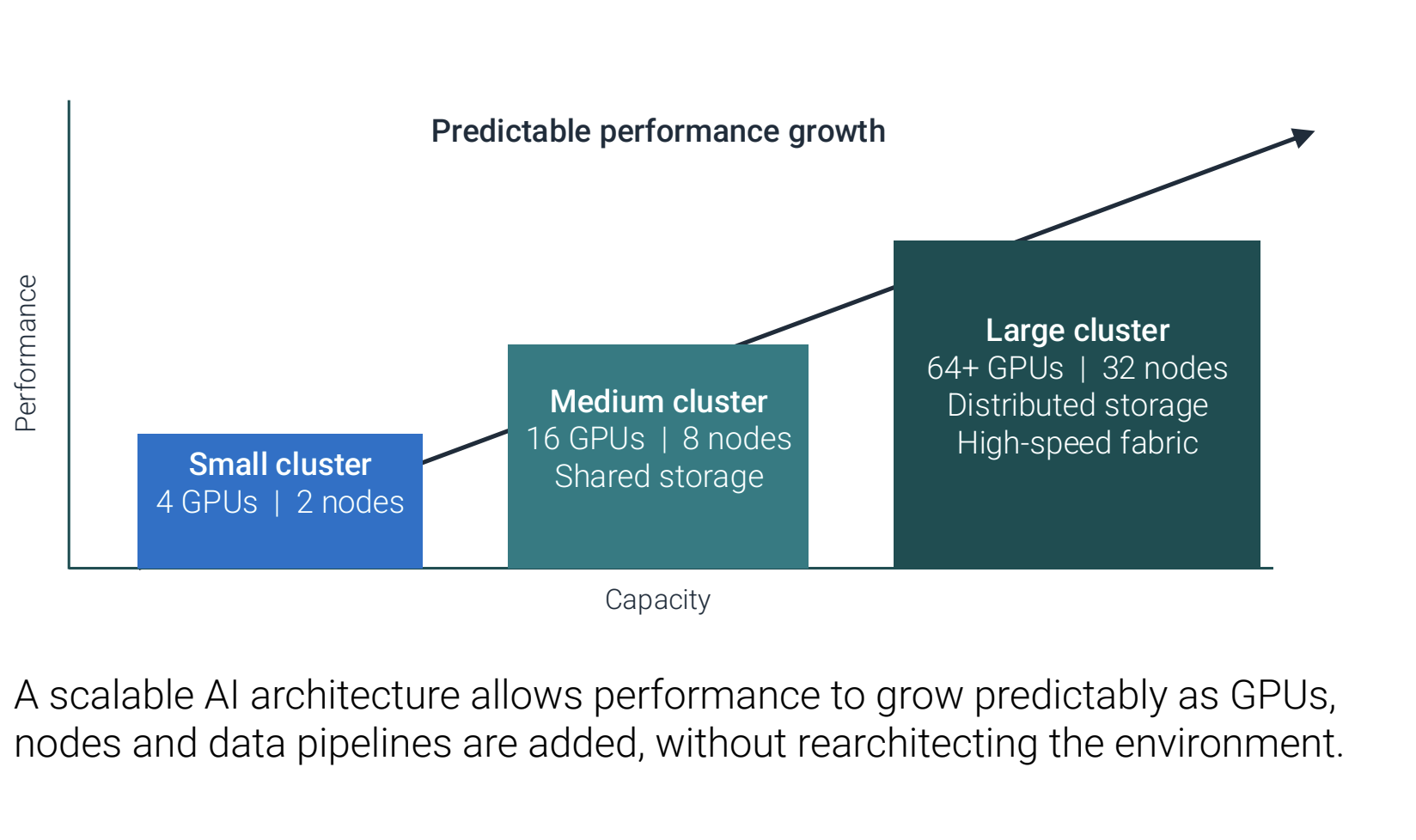
A scalable AI architecture allows performance to grow predictably as GPU counts increase, data pipelines expand and new use cases come online.
This requires systems designed for horizontal and vertical growth, with consistent performance characteristics across nodes and the ability to add capacity without rearchitecting the environment. Scaling AI infrastructure, however, is not just about adding hardware. It also involves addressing operational challenges, such as integrating new systems with legacy environments, managing fragmented data pipelines and ensuring seamless orchestration across hybrid environments.
By simplifying these complexities, organizations can realize the full potential of their AI investments while maintaining efficiency and reliability. These gains are possible because scalable AI infrastructure maintains performance as workloads grow. Multi-GPU and multinode systems can be expanded incrementally, with high-bandwidth fabrics allowing additional GPUs to contribute directly to throughput rather than introducing bottlenecks. Storage and networking scale alongside compute, allowing you to support larger models, higher concurrency and more complex pipelines without sacrificing reliability or efficiency.
In short, scalability is not just about adding more hardware. It’s about making sure that every additional unit of compute, storage or bandwidth translates into measurable performance gains. A well-designed AI infrastructure grows with your organization, supporting new workloads and higher demand while maintaining predictable, enterprise-grade performance.
Energy efficiency: Maximize performance, minimize cost and impact
AI infrastructure needs to deliver raw performance, but it must do so as efficiently as possible. As models grow and GPU density increases, energy consumption becomes one of the highest operational costs in an AI environment. Efficient infrastructure reduces power draw, lowers cooling requirements, minimizes environmental impact and enables you to run more advanced workloads within the same physical and energy footprint.
Modern 8 GPU systems exemplify this shift. Because multi-GPU platforms scale performance faster than power consumption, they deliver significantly higher performance per watt than smaller configurations.
Consolidating workloads onto a single 8 GPU server reduces the number of systems required, cutting total power, cooling and rack space while accelerating time to value.
In short, energy-efficient AI infrastructure is not just about reducing power requirements; it’s about enabling larger models, faster iteration cycles and more sustainable operations. By combining dense multi-GPU systems, advanced cooling and next-generation accelerators, you can achieve higher performance per watt while preparing for the next wave of AI workloads.
Dell engineering reinforces these gains. The Dell PowerEdge XE9680 server with eight NVIDIA H200 GPUs delivers up to 2X more performance in the same rack space compared with the prior generation
The industry is also entering a period of divergence in cooling and form factors. Traditional air-cooled PCle GPU servers remain flexible and cost-effective for inference and mixed workloads, but high-end training increasingly requires purpose-built, liquid-cooled, rack-scale HGX systems to sustain performance within lower power envelopes. Liquid cooling reduces thermal resistance, enabling higher sustained throughput with less energy spent on airflow and environmental conditioning.
Real-world impact
Organizations across industries are leveraging AI-ready infrastructure to achieve transformative results. Right-sized infrastructure directly impacts real-world outcomes.
- In film and media production, James Cameron’s Lightstorm Entertainment creates stunning films that fully rely on digital technology. Dell Technologies infrastructure helps them handle hundreds of millions of real-time files across several sites worldwide.
- In healthcare, radiology workflows powered by AI-optimized compute and networking have shown up to 40% improvements in diagnostic throughput, allowing clinicians to analyze more studies with greater accuracy.
- In the public energy sector, Dell customer NERSC expects a 10X performance increase for complex scientific workflows, offeringreal-time insights.
Act now for strategic advantage
The AI era is no longer emerging. It’s here, and it’s accelerating faster than most organizations can adapt. The infrastructure decisions you and your competitors make today will determine who leads, who follows and who gets left behind. Compute, networking, storage, scalability and energy efficiency are no longer optional considerations; they form the backbone of every successful AI initiative. By aligning infrastructure investments with broader business goals, such as accelerating innovation, improving operational efficiency and enabling real-time decision-making, organizations can ensure that their AI strategies deliver measurable impact and long-term value.
For both large enterprises and mid-market organizations, right-sized AI-ready infrastructure enables teams to train larger models, deploy real-time applications and scale innovation efficiently as needs evolve. Without this approach, organizations face increasing technical debt, performance limitations and growing competitive disadvantages.
For both large enterprises and mid-market organizations, right-sized AI-ready infrastructure enables teams to train larger models, deploy real-time applications and scale innovation efficiently as needs evolve. Without this approach, organizations face increasing technical debt, performance limitations and growing competitive disadvantages.
Building the foundation for AI success
Al is now a permanent and expanding part of enterprise investments, and its success depends on infrastructure that is intentionally designed for AI workloads. Unlocking the full value of AI requires more than adding accelerators to existing environments; it requires right-sized, AI-ready infrastructure that aligns accelerated compute, storage, networking and software to real workload demands across training, inference and deployment.
Dell Technologies and NVIDIA provide right-sized AI Factories to support this approach. Together, they enable you to design scalable, efficient and high-performance AI systems that maximize utilization, simplify operations and support long-term growth. By focusing on right-sizing rather than over-or under-provisioning, you can balance performance, cost and sustainability while building a foundation that evolves with your AI ambitions.
The next step is to translate strategy into execution. By working with Dell Technologies and NVIDIA, you can assess your current environment, identify the right infrastructure configurations for your AI workloads and deploy platforms built to scale, from initial pilots to full production. The right infrastructure doesn't just support AI.
It makes AI practical, repeatable and ready for what comes next.