
.webp "Dell AI Factory with NVIDIA Logo")
- A foundation for actionable answers
- Knowledge is everywhere. Answers are not.
- Why current systems fall short
- Modern knowledge assistants defined
- Democratizing expertise across the enterprise
- Thinking beyond the LLM
- Connecting users with data and systems
- The foundation: Dell AI Factory with NVIDIA
- Dell AI Factory with NVIDIA
- Dell Automation Platform
- Start small, then scale with confidence
- Conclusion: From knowledge silos to answers at scale
A foundation for actionable answers
Knowledge is everywhere. But it's fragmented across systems, tools, experts, and external sources, making actionable answers difficult to process. Knowledge assistants unlock that value. With Dell AI Factory with NVIDIA, and an ever-growing ISV ecosystem, you can rapidly lay the foundation to securely build, deploy, and scale assistants that deliver trusted, cited answers in seconds and at scale.
Knowledge is everywhere. Answers are not.
The cost of searching across fragmented enterprise systems
Enterprise knowledge is distributed across file shares, collaboration tools, enterprise applications, data platforms, and sources outside the enterprise. Each system stores and utilizes their specific information effectively, but none are designed to deliver complete, ready-to-use, cited answers.
- Documents, emails, dashboards, and apps are disconnected
- No unified view across sources
- Users bridge the gaps manually
The cost of searching for answers
Employees search, ask colleagues, and reconcile conflicting information across systems. What should take seconds often takes hours, while subject matter experts (SMEs) are repeatedly pulled into low-value, repetitive questions. As a result, decision cycles slow.
What is an “answer”?
A context-aware response synthesized across systems, grounded in enterprise data, and supported by citations so users can act with confidence.
Why current systems fall short
The answer is in the question
Most enterprise systems were built to store and retrieve information, not deliver answers. As a result, organizations struggle to turn available data into timely, reliable, actionable insights.
Legacy search lists documents, not answers
Traditional enterprise search relies on keywords and indexes, returning lists of documents rather than synthesized responses. It lacks context awareness, struggles with unstructured data, and requires users to interpret results manually.
Traditional knowledge systems are inflexible
Legacy repositories like knowledge bases and portals depend on continuous manual curation. Content becomes outdated quickly, coverage is limited, and systems rarely improve in line with how users actually search and consume information.
- Stale or incomplete content
- Limited scope across systems
- Minimal feedback loops
Shadow AI slows progress
Many organizations now operate multiple GenAI initiatives across business units – without a standardized path from pilot to production. As multi-agent systems grow more sophisticated, coordination becomes harder to manage and performance expectations rise.
Modern knowledge assistants defined
How knowledge assistants deliver answers
Many organizations already use chatbots, but modern knowledge assistants go further – combining retrieval, reasoning, and generation to pull data from multiple systems, synthesize across sources, and deliver grounded, real-time answers with verifiable citations.
Enterprise-grade by design
Enterprise knowledge assistants operate within security, permissions, and governance frameworks that ensure responses are accurate, compliant, and aligned with user roles and organizational policies.
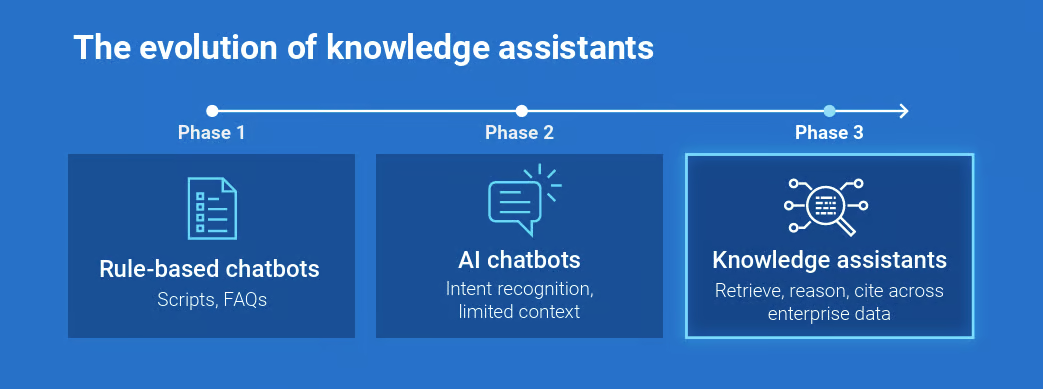
Key differences between chatbots and knowledge assistants
| Chatbots | Knowledge assistants | |
|---|---|---|
| Interaction model | Rule-based | Context-aware |
| Response type | Static responses | Dynamic answers |
| Scope of access | Limited scope | Enterprise-wide access |
Democratizing expertise across the enterprise
Scaling what your experts know
Knowledge assistants expand access to expertise across the organization, reducing reliance on specialists or SMEs. This helps teams get fast, accurate answers without waiting or escalating.
From bottlenecks to broad access
Experts no longer need to answer repetitive questions. Knowledge assistants provide consistent, validated responses, freeing specialists to focus on highervalue work and complex decisions.
Putting knowledge in every workflow
Assistants surface answers directly within existing tools and processes. This enables teams across functions to access relevant knowledge without switching systems or searching across multiple sources.
- Embedded in everyday tools
- Context-aware responses
- Faster task completion
From access to action
Knowledge becomes most valuable when it’s usable. Assistants don’t just expose information – they deliver answers teams can act on immediately.
- Grounded, cited answers in seconds
- Ingest and analyze data from a range of sources
- Reduce dependencies and bottlenecks
- Maintain complete control of your data
- Scale trusted knowledge across your organization
Thinking beyond the LLM
Why models aren't enough
Large language models power knowledge assistants, but they cannot deliver enterprise-ready answers alone. Real-world deployment requires data access, control, and integration beyond the model itself.
LLMs without context fall short
On their own, LLMs lack access to enterprise data, systems, and policies. Without grounding, responses can be incomplete, inconsistent, or misaligned with business context.
- No native enterprise data access
- Limited awareness of context
- Higher risk of incorrect outputs
Answers require more than generation
Delivering usable answers requires retrieving relevant data, applying context, and aligning outputs with permissions and policies – capabilities that extend beyond the model itself.
Enterprise use demands control and visibility
Production deployments require observability, governance, and performance consistency. Organizations need to monitor outputs, enforce guardrails, and ensure responses remain reliable at scale.
LLM flow: User prompt → LLM → Output
Knowledge assistant flow: User prompt → Retrieve → Reason → Govern → Answer
Connecting users with data and systems
From question to answer
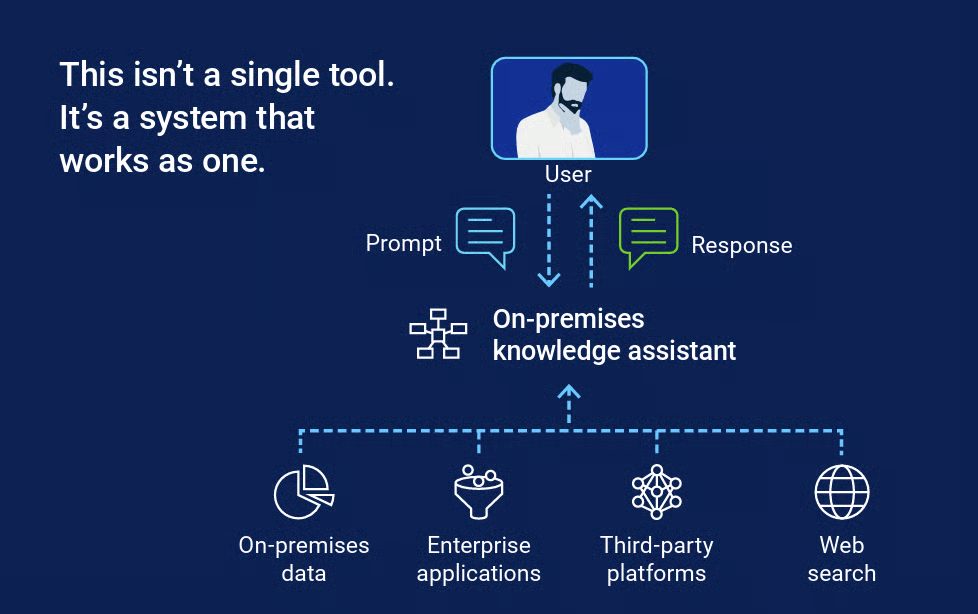
Knowledge assistants work by connecting users to enterprise data through a unified system, transforming questions into grounded answers by retrieving and synthesizing information across multiple sources.
A unified flow from prompt to reponse
Users interact through a single interface, while the assistant retrieves relevant data, reasons across sources, and returns a grounded response with supporting context.
- Single interface for users
- Multi-source retrieval behind the scenes
- Responses grounded in enterprise data
Connecting across enterprise data sources
Knowledge assistants access information across on-premises data, enterprise applications (CRM, ERP, HR, ITSM), third-party platforms, and external data sources, ensuring answers reflect the full scope of enterprise knowledge, not isolated systems.
The foundation: Dell AI Factory with NVIDIA
A system-level architecture for knowledge assistants
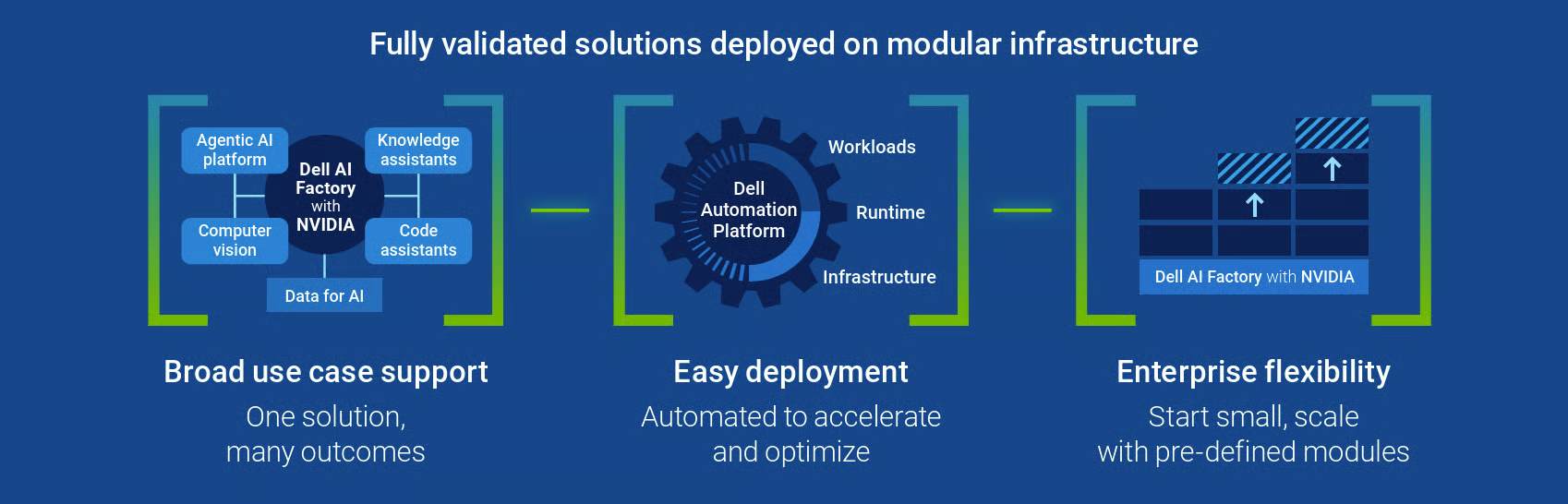
Enterprise knowledge assistants require more than connected components. They depend on a unified foundation that brings infrastructure, data, and AI together – integrating data sources, models, connectors, and controls into a single, coordinated system to deliver trusted answers.
Dell AI Factory with NVIDIA
Built for performance, control, and scale
Dell AI Factory with NVIDIA provides validated, modular infrastructure designed for AI workloads – delivering consistent performance, scalability, and control across knowledge assistant deployments.
- GPU-accelerated compute for inference-heavy workloads
- High-performance storage for embeddings and retrieval pipelines
- Low-latency networking for responsive interactions
- Dell Professional Services for jump-starting your AI journey
Optimized AI stack for enterprise deployment
NVIDIA AI Enterprise provides production-grade AI software, including NIM microservices for optimized inference and NeMo frameworks for building and managing models and retrieval pipelines.
- NIM microservices: Scalable, GPU-optimized inference
- NeMo frameworks: Model development and RAG pipelines
- Run:ai: Orchestration and resource optimization
Data stays secure and close to source
Deploying Dell AI Factory with NVIDIA keeps your knowledge assistants adjacent to enterprise data – reducing movement, supporting compliance, and ensuring sensitive information remains protected while still accessible for retrieval and reasoning.
- On-premises deployment
- Data sovereignty and control
- Reduced data movement
Dell Automation Platform
Accelerated with ecosystem and automation
The Dell Automation Platform provides validated blueprints and integrations from a rapidly growing partner ecosystem. The platform enables faster, repeatable deployment while reducing the complexity of bringing tools, models, and data sources together into a working system.
Delivering this flow requires coordinated tools, integrations, and models. Ecosystem partners provide key capabilities, but bringing them together into a working system adds complexity.
Start small, then scale with confidence
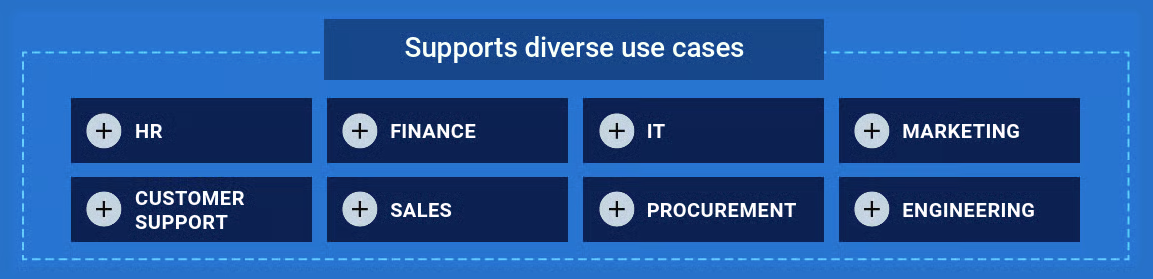
Organizations don’t need to solve everything at once. Knowledge assistants deliver value quickly when applied to focused use cases, then expand using repeatable patterns across teams.
Start with high-impact use cases
Begin where knowledge gaps create friction, from support to HR to operations. Focus on contained domains where data is accessible and outcomes are measurable.
Expand with repeatable patterns
Once validated, extend assistants across functions using shared architectures, connectors, and governance models. This reduces rework and accelerates deployment across additional use cases.
Over time, assistants evolve into a connected system spanning departments. Specialized assistants operate together, delivering consistent, trusted answers across the organization.
- Reuse ingestion and retrieval pipelines
- Apply consistent governance controls
- Standardize integration patterns
Jumpstart your journey with Dell Professional Services
Dell Professional Services guide deployment and scaling. They ensure secure, production-ready solutions.
- Prepare and manage data
- Deploy and test
- Implement a platform
- Operate and scale
Conclusion: From knowledge silos to answers at scale
Organizations no longer need to choose between speed and trust. With the right foundation, teams can turn enterprise knowledge into timely, reliable answers while maintaining governance and control. Knowledge assistants become a scalable capability – delivering faster decisions, reduced dependency on experts, and consistent outcomes – built on Dell AI Factory with NVIDIA.
Key takeaways
- Answers create momentum
- Systems outperform tools
- Scale requires intention