
.webp "Dell AI Factory with NVIDIA Logo")
Authors: Simon Robinson, Principal Analyst Monya Keane, Senior Research Analyst, May 2026
Why data and storage are key to realizing AI’s promise
Introduction – the right data infrastructure holds the key to AI success
AI holds unprecedented promise for transformation, but its potential can only be realized if organizations can harness their data. Unfortunately, that’s where many AI projects stall. Research from Enterprise Strategy Group (now Omdia) shows that data management and/or data quality issues were cited as top challenges tied to AI implementations, behind only cost.
As organizations evolve their AI strategies from experimentation to real-world deployment, IT leaders are realizing that existing data infrastructures were not built for the AI era: 70% of IT decision makers said storage-related challenges are a significant barrier to success.2 The data demands of inference-oriented workloads are enormous, and legacy approaches can become overwhelmed, ultimately derailing organizations’ AI ambitions.
An AI-ready data infrastructure must support multiple (often conflicting) demands tied to capacity/scalability, performance, TCO, ease of use, efficiency, and advanced data functions. Demands change as organizations move data through the AI lifecycle; those on infrastructure during data preparation and training are often wildly different from demands during the inference phase.
AI projects must coexist with already deployed data, systems, and infrastructure, too. Another curveball is the pace at which AI technology is evolving, meaning that flexibility and adaptability are now essential characteristics of an AI-ready data infrastructure. AI workloads’ demanding, fast-evolving, dynamic infrastructure needs call for future-proof storage.
Of course, the demands and priorities of organizations vary; the AI storage needs of a midsize enterprise looking to deploy one workload are different from those of a large GPU cloud provider launching inference at immense scale.
Yet, some suppliers are taking a one-size-fits-all approach to suit a narrow set of customers at a particular moment—not actually catering to the majority.
Dell Technologies understands that the AI revolution is a once-in-a-generation shift directly affecting storage and data architectures. It has, thus, developed a more customer-centric approach that recognizes the diverse, evolutionary nature of the challenge. This approach leverages Dell’s storage expertise to help organizations of all types achieve their AI ambitions now and going forward.
Storage considerations when building enterprise AI factories
Organizations deploying AI at scale are taking an “AI factory” approach to streamline the management of the underlying infrastructure. An AI factory is a modular, full‑stack blueprint that combines compute (GPUs), storage, networking, and software into a repeatable, scalable system for building and running AI workloads efficiently.
Why storage architecture matters when building next-gen AI applications
Since storage-related challenges can undermine organizational AI initiatives, organizations should consider the following:
- Explosive data growth: 87% of IT leaders said AI is driving or will drive substantial data growth. Much of that growth is due to the evolution of generative AI from predominantly text-based data to multi-model data (i.e., capacity-hungry unstructured rich media data). Additionally, the potential to use AI to gain insight from historical data is encouraging organizations to retain data for longer. Organizations, therefore, need cost-effective methods of storing larger, more diverse amounts of data.
- Fast GPUs need fast storage: GPU clusters can overwhelm traditional storage, adding latency to AI workloads by leaving expensive GPUs waiting for data. This is driving buyers to seek higher throughput, lower latency storage.
- Rapid AI market evolution: The landscape is evolving continuously across multiple dimensions. The emphasis has moved from machine learning to generative AI and now to advanced reasoning and agentic AI. Each exerts different pressures on the underlying infrastructure, underscoring the importance of flexibility and agility.
- New technology and ecosystem requirements: Organizations must now onboard new categories of technologies into their IT environments. They include new GPUbased compute, new storage tiers to support KV cache for inference at scale, fast storage networking (e.g., S3 over RDMA), and greater integration between storage management and data management.
- Security and governance controls are a must-have: 79% of IT leaders said AI presents new and significant data security challenges. As AI becomes embedded in the enterprise, organizations must achieve governance and security control over their data estates.
Storage for AI is not "one size fits all"
Although AI workloads place high demands on the infrastructure, how those demands are applied—and how they affect storage—is highly variable. For example:
- Customer type (different needs, different priorities): The AI infrastructure requirements of a midsize or large organization deploying tens or hundreds of GPUs or AI-optimized CPUs are different from those of GPU as a service or cloud service providers deploying thousands of GPUs. The latter will be focused on driving extreme performance from the storage layer to extract maximum efficiency from their expensive GPU investments. Every millisecond of storage latency matters since it can impact customer experience. Conversely, although high performance is still important to midsize and large enterprises, it may play second fiddle to acquisition cost, ease of use, and the ability to ensure data’s security and governance. As AI technology and use cases mature, more organizations will care about satisfying multiple priorities.
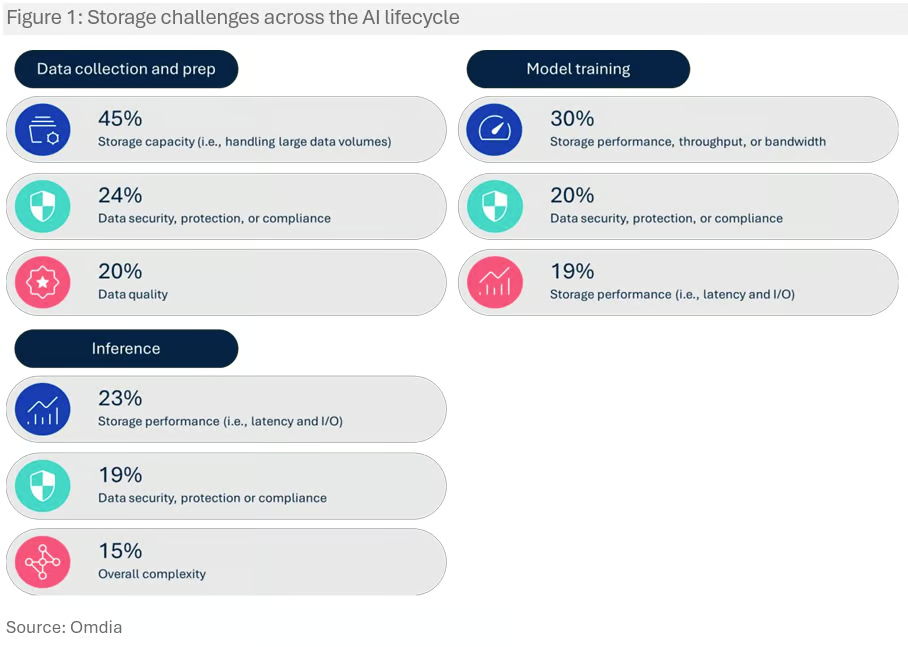
- Stage of AI lifecycle (evolving storage demands): Storage challenges evolve as data moves through the AI lifecycle, and organizations need storage optimized for each stage. As Figure 1 shows, at the data collection and preparation stage, the issue is managing large amounts of capacity. Building a data lake that ensures the right data is available in the right format with appropriate guardrails must be the starting point. For model training, the emphasis shifts to performance (throughput, in particular). It is important for tasks such as checkpointing to minimize GPU idle times. As organizations move to the inference stage, where the real value of AI is realized, emphasis shifts to latency, stemming from the need to rapidly move and access data in response to user or agentic AI prompts.
- Cost and performance optimization: The right storage architecture balances cost and performance—but those choices are increasingly shaped by the AI pipeline itself. Storage selection for AI workloads is primarily driven by the application ecosystem generating data and the tooling used across the pipeline, not the storage type alone. Scale-out file and object (S3-compatible) storage dominates data lake and ingest tiers due to its scalability and low cost, while parallel file systems serve high-performance training and inference stages where ultra-low latency and massive throughput are critical. The two approaches are increasingly complementary. Emerging protocols like S3 over RDMA now allow object storage to meet demanding throughput requirements previously reserved for parallel file systems. Organizations should align storage architecture to their pipeline’s specific access patterns—balancing cost, performance, and the native preferences of their AI frameworks and tooling.
As NAND flash and SSD prices rise quickly, the ability to tier data across fast (but higher cost) flash and lower cost HDDs is critical. Flexibility also means accounting for future changes. If an AI workload is growing faster than expected, organizations need to quickly scale existing infrastructure to meet that increased demand.
Spanning the data and storage divide demands a true platform approach
A final, crucial aspect is the relationship between storage and data. This dynamic has always been important, but AI super-charges it. Agentic AI works at machine speed, not human speed, and it needs near-real-time data for maximum effectiveness. An architectural relationship between the data and storage layers is necessary so that new data can be moved into the storage environment quickly (with the necessary guardrails).
The IT industry is responding to AI challenges in various ways. One of the most popular is through AI “data platforms.” However, not all data platforms are alike; some feature tightly coupled data and storage capabilities that work in some environments but lack the flexibility that businesses require if they want to bring in data management software partners at the data layer.
In contrast, Dell offers an open, flexible approach with its AI Data Platform that promotes choice at both the storage and data layers.
Dell’s storage for AI strategy offers the best of all worlds
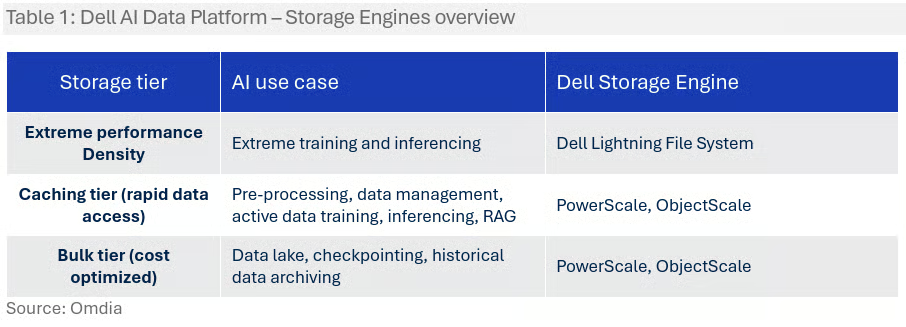
Dell is a longstanding leader in storage optimized for unstructured data with its scale-out NAS (PowerScale) and object storage (ObjectScale) solutions. The company augmented those capabilities with the addition of the Lightning File System solution, designed for the most demanding AI and HPC environments. Dell calls it the world’s fastest parallel file system.
Recognizing the rapid evolution of AI and its impact on the underlying infrastructure and data management stack, Dell has now marshaled these capabilities into a powerful, innovative solution set.
This set of Storage Engines (see Table 1) enables organizations to deploy the capabilities that best meet their requirements across the AI lifecycle. Storage Engines can be paired with data-centric Data Engines, enabling customers to configure and deploy (via Dell Professional Services) an AI Data Platform tailored to their needs.
Introducing Dell Exascale Storage – the most flexible way to run file, object, and parallel file
Dell is taking this flexibility even further with Dell Exascale Storage, billed as the industry’s only 3-in-1 storage capability built for both extreme-scale AI and HPC. Exascale Storage is aimed at large and demanding environments with over 10PiB of data—such as high frequency trading and neocloud service providers. It provides IT teams with the flexibility to deploy Dell’s best-of-breed Storage Engines (file, object, and parallel file system storage software) on the latest Dell PowerEdge servers.
In this way, organizations can deploy hardware built for extreme scale without standing up separate storage appliances for each service or protocol. Instead, organizations can deploy Exascale Storage to run multiple storage personalities on the same high powered hardware, delivering up to 150GBps per rack unit of read performance.
Avoiding the need to commit hardware upfront to a precise storage personality could be a huge win for organizations that are deploying AI training and inference at scale, but are uncertain about the exact nature of future requirements (given the fast-evolving nature of AI workloads). Exascale Storage can also be utilized to span multiple tiers of storage— including capacity/archive storage and primary data storage with ultra-low latency—within a single deployment model. The Exascale Storage architecture enables customers to optimize for performance and efficiency by deploying flash-based SSDs to drive high throughput/low latency and HDD-based object storage for archived data.
Customers also benefit from the highly complementary nature of Exascale Storage when combined with Dell Storage Engines. For example, combining Exascale Storage with Dell PowerScale’s native, automated tiering enables data to flow automatically between tiers, ensuring it is always on the most cost-appropriate media.
In summary, Dell Exascale Storage offers both service providers and enterprises the following benefits:
- The ability to deploy AI training and inference at scale can drive increased hardware utilization and TCO by allowing capacity and performance to be repurposed across tenants, regions, and services, rather than locked into isolated silos.
- The capacity to turn storage into a programmable resource, orchestrated alongside compute and networking.
The importance of infrastructure flexibility to any organization deploying AI at scale cannot be overstated. The AI data stack continues to evolve at a breakneck pace; as AI workloads become increasingly multi-modal, the need for “composability” will be critical as organizations utilize an evolving mix of foundation models, vector databases, KV cache layers, and streaming pipelines.
Given the varied and evolving requirements, IT teams simply cannot rebuild the infrastructure every time there’s a change in the stack. Instead, they require a software-first architecture that enables them to run and shift across an optimal blend of storage personalities under a common operating model. The Dell Exascale Storage approach provides just that, enabling customers to deploy the latest, high performance hardware with best-in-class storage software capabilities that meet their evolving application and data needs across the entire unstructured data landscape (file, object, and native S3 object).
Bringing data management and storage infrastructure together with the Dell AI Data Platform
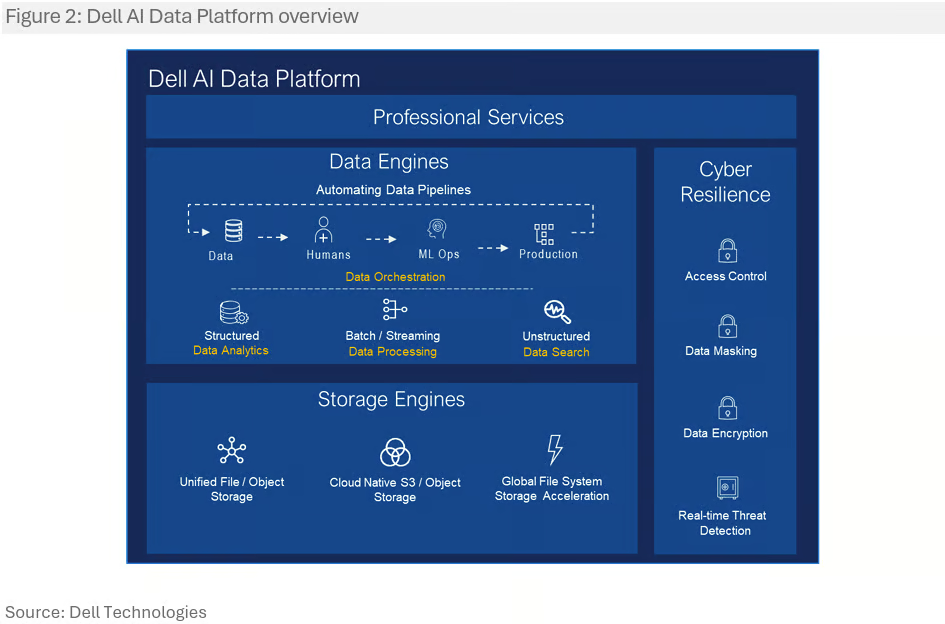
Another aspect of Dell’s approach to storage for AI is the packaging of Storage Engines with other Dell and third-party capabilities as the Dell AI Data Platform. This platform provides a modular, open, secure data foundation designed to unlock the value of fragmented enterprise data for AI workloads.
Data Engines
Dell Data Engines integrate with Dell Storage Engines to deliver advanced, intelligent data management functionality, accelerating AI workflows for data architects working with IT architects. Key elements include the following:
- Data Orchestration Engine. The intelligence layer for enterprise AI operations connects data pipelines, model workflows, and human feedback loops to ensure AI systems continuously improve. Unlike other tools, this engine delivers end-to-end orchestration across ingestion, enrichment, retrieval, and inference workflows, helping organizations move effectively to production-scale AI.
- Data Analytics Engine. This engine accelerates the evolution of raw information to actionable insight. Built to scale, the engine rapidly analyzes complex, diverse data sources spanning relational databases, data lakes, object stores, and NoSQL systems, empowering teams to discover trends and make informed decisions.
- Data Processing Engine. This engine is built to accelerate data preparation and transformation at scale for batch and streaming data. Streamlining ingestion, cleansing, and enrichment, it ensures AI initiatives are powered by high quality information.
- Dell Data Analytics Appliance AE660 (DDAE660). This is a high-performance appliance that simplifies IT operations while delivering the scale and efficiency required to run the Data Engines. Featuring enterprise-ready capabilities (e.g., HA, DR, and robust security) and simplified management, the DDAE660 helps IT teams achieve faster time to production, reduce downtime, and attain significant operational cost savings.
Industry ecosystem support
A final, but critical, aspect of Dell’s comprehensive approach to storage and data for AI is its partnership approach with major AI ecosystem players, such as NVIDIA. Dell’s longstanding and strategic partnership with NVIDIA at the compute level (for AI servers) continues to evolve across multiple dimensions and now extends deep into the data and storage layer.
A good example of this is Dell’s and NVIDIA’s combined work on the Dell Data Orchestration Engine (DDOE). The DDOE provides an end-to-end enterprise data orchestration and AI enablement layer that integrates seamlessly with key NVIDIA elements, including the following:
- NVIDIA Enterprise AI. Provides GPU-accelerated compute for AI training and inference; optimized AI frameworks and libraries (e.g., TensorRT, Triton Inference Server); enterprise support and management; and consistent AI performance across data center, cloud, and edge.
- NVIDIA Blueprints. Provides pre-validated AI reference architectures; reusable workflows for common AI scenarios (e.g., computer vision, healthcare imaging, conversational AI); and faster deployments through standard, best-practice designs.
Combined, all these elements enable organizations to move rapidly from distributed, heterogeneous data to production-grade, GPU-accelerated AI solutions, while maintaining governance, scalability, and operational control across hybrid, multicloud environments.
Working in harmony, Dell ensures data orchestration, governance, and operational integration, while NVIDIA ensures performance, scalability, AI acceleration, repeatability, and faster deployment. Together, the companies enable organizations to move beyond experimentation to build resilient, scalable, and production AI systems across hybrid environments (see Figure 2).
Conclusions
As organizations move to production AI deployments at scale, the importance of an underlying data infrastructure that is “fit for purpose” is apparent. Yet, this is the aspect organizations struggle with the most. With the pace of innovation in AI accelerating, the time for IT leaders to act is now.
They need a storage infrastructure partner that can reduce integration effort, minimize architectural guesswork, and lower infrastructure risk. Such a partner would enable organizations to begin leveraging their data at scale across their AI pipelines and initiatives, both today and in the future.
Dell, an infrastructure supplier that recognized early on the profound impact the AI revolution is having on data environments, is well positioned to be that partner. Building on its industry-leading pedigree as a storage innovator, an evolving portfolio of Storage Engines and Data Engines, its AI Data Platform, and flexible hardware configurations such as Dell Exascale Storage, the company understands the dynamic nature of the AI landscape. It is well placed to provide all organizations, from established enterprises to neoclouds and cloud service providers, with a foundational architecture that not only supports today’s demands but can also help them prepare for what is to come.
When combined with Dell’s AI Factory blueprints and global supply chain reach and resilience, this is a compelling combination that any organization serious about taking its AI ambitions to the next level should evaluate.
For more details about Dell’s Storage for AI solutions, please visit Dell Storage for AI.
Sources: Enterprise Strategy Group (now Omdia) Research Report, Navigating Build-versus-buy Dynamics for Enterprise-ready AI, January 2025; Enterprise Strategy Group (now Omdia) Research Report, Navigating Build-versus-buy Dynamics for Enterprise-ready AI, January 2025.