
.webp "Dell Logo")
- Prepare your organization for the next step of AI
- AI agents as your competitive advantage
- Levels of AI
- Why AI levels matter
- Risks and rewards: The human impact
- Exploring core characteristics
- Why agents are the next stage of AI
- Organizational workflow integration
- Governance and risk mitigation
- Agentic AI use case examples
- Prioritizing agentic AI use cases
- How to build agentic AI
- Crawl, walk, run approach
- Dell and NVIDIA: Your trusted AI innovation partners
- Unlock the full potential of agentic AI
Prepare your organization for the next step of AI
Agentic AI is the evolution beyond generative AI that brings autonomy, adaptability, and goal-oriented intelligence to business operations and the future of work. As organizations navigate an increasingly complex digital landscape, the ability to deploy AI that acts with intent, learns from its environment, and continuously optimizes processes is a game-changer.
Agentic AI has the potential to supercharge every employee and every process, and the impact on workstreams will likely be profound. With the introduction of purpose driven AI agents, the future of work will require employees to leverage and orchestrate a constellation of diverse AI Agents across multiple use cases and workstreams. Agentic AI can accelerate informed decision-making, automate low-risk tasks and processes, and begin to bridge the gap between human expertise and machine intelligence in new and compelling ways.
With the right strategy and planning, organizations can implement agentic AI effectively without introducing unnecessary risk. By partnering with Dell and NVIDIA, organizations can access the right infrastructure, data transformation services, and platforms to harness the benefits of agentic AI.
AI agents as your competitive advantage
What is agentic AI?
Agentic AI gives organizations an opportunity to combine massive quantities of their valuable data, best practices, and procedures with autonomous intelligent systems. Unlike traditional AI, which passively processes inputs to produce fixed outputs, agentic AI functions more like an intelligent collaborator that actively works towards goals within your business context rather than just following instructions.
This collaborative capability allows organizations and their employees to operate at unprecedented levels of efficiency and creativity while ensuring alignment with organizational goals and expectations. By having the power to reason, perceive the environment, learn, and adapt, agents can be given a goal and then independently perform complex tasks and solve problems to reach that goal, potentially without human interaction.
Levels of AI
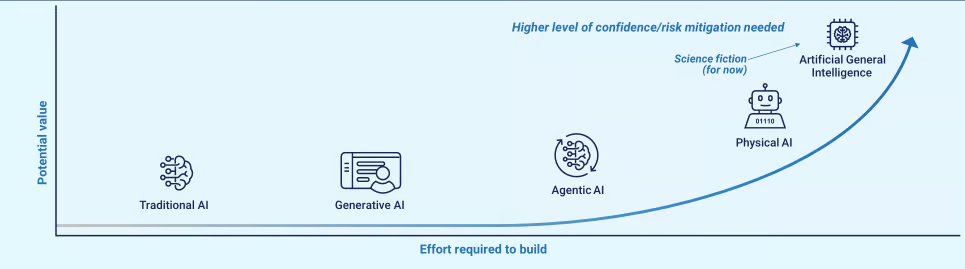
Agentic AI can best be understood by viewing it within the broader continuum of artificial intelligence. As AI has evolved through distinct stages, each of those stages adds new capabilities. This progression can be seen across these categories:
Traditional AI
Rule-based systems that rely on pre-programmed logic and require human intervention for adjustments. Effective for repetitive, structured tasks but lacks flexibility.
Generative AI
Uses deep learning models to create text, images, code, and other content based on existing data and user-driven prompt inputs.
Agentic AI
AI agents can reason, perceive environments, learn, and adapt. When provided with a goal they can solve complex problems with little to no human interaction.
Physical AI
Embodies intelligence in robotic systems that interact with the physical world, such as with robots, sensors, and other equipment.
Artificial General Intelligence (AGI)
Represents the aspirational goal of AI developers, researchers, and science-fiction enthusiasts, i.e. machines with human-like cognitive abilities. AGI remains theoretical.
Why AI levels matter
Business leaders must understand the distinctions between stages of AI to make strategic investments and assess the complexity of different AI implementations or use cases. Agentic AI, in particular, introduces a new level of complexity and sophistication, which will require a deeper alignment with business processes, business logic, and the ability to act autonomously across scenarios.
In addition, as agentic AI solutions are adopted by organizations already invested in traditional and generative AI, it’s imperative to implement robust guardrails, human oversight, and tighter security to ensure safe, reliable outcomes.
Goals, autonomy, and creativity are not just traits of agentic AI, they can be actively defined by organizations. Setting clear goals validates that AI is aligned with business priorities from the start. Defining boundaries for autonomy allows the system to act independently while staying within limits. Guiding how agency is applied via constraints, context, or preferred methods ensures that solutions still support strategic intent.
Risks and rewards: The human impact
Agentic AI is reshaping the workplace, transforming how tasks are completed, decisions are made, and teams collaborate. This shift offers significant rewards, but it also introduces new complexities that must be carefully managed. Organizations need a clear strategy that balances automation with oversight, ensuring systems are calibrated for both performance and accountability.
Advancing to agentic AI is a step toward a more intelligent, adaptive, and resilient enterprise. But getting there means leaders must determine what functions are best suited for autonomy, where human judgment should remain central, and how to ensure transparency and trust in AI driven decisions.
Risks: Automation requires oversight
Agentic AI delivers powerful capabilities, but without proper oversight, it can introduce challenges that impact transparency, accountability, and judgment.
Rewards: AI as a force multiplier
When strategically deployed, agentic AI can become a force multiplier, amplifying employee potential, accelerating decisions, and improving business outcomes using data-driven insights.
Exploring core characteristics
Core traits that define agents
Agentic AI delivers transformative business value by combining autonomy, adaptability, and goal-driven intelligence, enabling IT systems to proactively drive outcomes, optimize processes, and learn in real time. The following core characteristics of agentic AI can help empower organizations to operate with greater speed, precision, and scalability, creating a repeatable, sustainable competitive edge in an AI-driven economy.
These core traits enable agentic AI to provide scalable, intelligent systems capable of driving efficiency, optimizing decision-making, and reducing friction across workstreams. Organizations that leverage these capabilities can achieve greater agility, innovation, and resilience in an increasingly AI-driven economy.
- Operate autonomously to execute tasks without human intervention.
- Interface with systems to take meaningful actions across digital environments.
- Pursue defined objectives without requiring detailed execution instructions.
- Analyze, reason, and act based on contextual understanding and available data.
- Perceive environments through data inputs, sensors, and models to inform interactions.
- Learn and adapt by evolving behavior through ongoing analysis and experience.
Why agents are the next stage of AI
The impacts of autonomous operations
Unlike AI models that require frequent human intervention, agentic AI operates independently by continuously refining its processes based on real-time data and organizational objectives. Below are key capabilities that define how agentic AI enhances business operations.
- Passive monitoring: Agentic AI can scan digital and physical environments to identify relevant data points or anomalies and intelligently react based on defined rules and processes and decision-making
- Active query response: While traditional AI systems often require structured input, agentic AI can dynamically respond to complex, unstructured queries to interpret context and retrieve relevant information.
- Event-driven triggers: Agentic AI can execute predefined actions when specific conditions are met, reducing response times and leading to timely actions in crucial scenarios.
- Scheduled tasks: Agentic AI can optimize efficiency by intelligently managing time-sensitive workflows and adjusting timelines. This helps enhance compliance reporting, predictive maintenance, and inventory restocking.
Organizational workflow integration
For agentic AI to deliver its full potential, it must be seamlessly integrated into existing workflows, data sources, platforms, or infrastructure. Rather than functioning as a standalone system, agentic AI enhances technology ecosystems by augmenting employee capabilities, improving decision-making, and proactively addressing inefficiencies.
When considering how to deploy AI agents, it’s important to determine how specific use cases impact the underlying IT architecture and platforms. For example, an agentic AI system that is purely digital will depend on different infrastructure than agentic AI which requires physical components.
Examples include:
- Information systems
- Business systems: Agentic AI personalizes customer engagement, streamlines workforce planning, and automates supply chain operations by enabling CRM, HR, and ERP systems to adapt and act autonomously.
- IT operations: AI agents can proactively monitor IT systems, identify threats, and automate responses, ultimately helping maintain security, meet SLAs, and reduce downtime.
- Operational systems
- In-store or real-time customer interaction: Monitor and respond to in-store customer interactions in real time using sentiment analysis and computer vision to personalize customer offers.
- Factory, warehouse, logistics: Combine computer vision with IoT devices and agentic AI to manage complex physical operations such as autonomous visual equipment inspection.
Governance and risk mitigation
Maintaining data privacy and compliance is a cornerstone of responsible AI adoption. Organizations must implement governance and multi-layered security measures to safeguard sensitive information while enabling AI systems to operate effectively. Strategies include:
- Controlled access: Restrict AI access to only necessary datasets, ensuring that information remains protected and confidential.
- Encryption: Utilize advanced encryption methods to secure data at rest and in transit, reducing exposure to cyber threats.
- Transparency in AI decision-making: Document how AI models make decisions, providing attribution to stakeholders and regulatory bodies.
- Define and enforce guardrails: Limit scope of functionality, define purpose clearly, and provide a narrow operating window for agents.
- Risk monitoring and measurement: Continuously monitor AI systems for vulnerabilities and performance deviations, using defined metrics to assess risk and inform timely response actions.
By embedding strong governance, security, and privacy measures into agentic AI deployment, organizations can confidently harness AI’s potential while maintaining ethical integrity and regulatory compliance.
Agentic AI use case examples
Agentic AI transforms industries by automating decision-making, optimizing workflows, and driving efficiency. While agentic AI applications may vary across sectors, the following short-list of use cases illustrate AI’s broad impact.
Customer Service
Agentic AI can transform customer service by deploying agents that autonomously resolve inquiries, personalize interactions, and analyze sentiment in real time. Integrated with CRM systems, this reduces customer wait times, improves satisfaction, and handles routine customer support.
Operations and logistics
Agentic AI can optimize the entire supply chain by predicting demand, managing inventory levels, and coordinating logistics with precision. It reacts to real-time conditions—rerouting shipments, adjusting schedules, and learning from every data point to improve efficiency over time.
Cybersecurity
Agentic AI can strengthen cybersecurity by autonomously monitoring IT environments, detecting anomalies, and executing responses based on pre-established security protocols. This proactive approach reduces risk, shortens incident response times, and ensures continuous protection at scale.
Finance
In finance, agentic AI can identify suspicious transactions, analyze complex risk patterns, and prevent fraud in real time. This enhances compliance, reduces manual oversight, and supports more accurate financial decision-making with continuously updated intelligence.
Smart cities and digital twins
Agentic AI can enable smarter urban infrastructure by analyzing real-time sensor data, optimizing traffic flow, and predicting maintenance needs. When integrated into digital twin environments, it can simulate city operations, enabling proactive urban planning and crisis preparedness.
Continuous forecasting and planning
Agentic AI can facilitate dynamic forecasting by constantly refining predictions based on shifting internal and external data. It can auto-adjust plans, detect emerging trends, and support more accurate, agile decision-making across business functions.
Prioritizing agentic AI use cases
Successful implementation requires a structured approach to determine where AI-driven automation delivers the most significant value. Generally, business leaders should evaluate potential AI use case feasibility based on the effort, cost, and complexity of deploying agentic AI. This includes factoring in system integration, data preparation, model training, and ongoing maintenance. Prioritize solutions that fit existing workflows with minimal disruption.
The LEARNS acronym can be used to identify the right types of agentic AI tasks and activities that deliver value. It can help decision-makers understand the business value of AI solutions by viewing use cases through the lens of the following criteria:
- Low risk: Tasks that have minimal negative impact if automated or if AI makes a mistake.
- Emerging: Areas where AI-driven automation still evolves and shows strong potential.
- Arduous: Repetitive, time-consuming processes that benefit from automation.
- Remedial: Error-prone tasks that AI can optimize with enhanced accuracy.
- Not worth it: Functions where AI adds value by enabling employees to perform other, more valuable work.
- Speed: Processes where AI can accomplish the task faster than employees.
By applying this approach, organizations can strategically prioritize which activities are best suited for agentic AI, establishing a balance between automation and human oversight.
How to build agentic AI
Core components
Building a robust agentic AI system requires a combination of foundational AI technologies, scalable infrastructure, and strategic implementation. Below are the key components that enable agentic AI to function effectively:
- Data access: For agentic AI to operate effectively, it must have seamless access to timely, relevant, and context-rich data alongside established business processes and logic. This access enables AI agents to make informed decisions, adapt to changing environments, and continuously optimize performance based on the most current information available.
- Infrastructure: Deploying agentic AI at scale requires a robust, scalable infrastructure and integration with existing tools that support both cloud-based and edge computing environments. Some use cases can rely on the cloud whereas edge computing enables real-time processing at the point of action, reducing latency.
- Large Language Models (LLMs): LLMs are core to agentic AI, providing the ability to process, understand, and generate human-like text. These models enable AI systems to interpret complex queries, synthesize information, and deliver contextual insights tailored to business needs.
Crawl, walk, run approach
Implementing AI and generative AI successfully requires a phased approach to drive alignment with business objectives and risk management. Organizations can adopt a Crawl, Walk, Run methodology to scale AI capabilities gradually.
Crawl
Focus on small-scale traditional AI and generative AI projects focused on low-risk, high-value use cases. Identify areas where AI-driven automation can deliver quick wins to help you validate AI effectiveness before committing to broader deployment.
Walk
Begin piloting small-scale agentic projects, integrating AI driven decision-making into critical workflows, governance frameworks, and models.
Run
Deploy and integrate agentic across your organization as a core component of business processes to address your most critical needs.
Dell and NVIDIA: Your trusted AI innovation partners
The Dell AI Factory with NVIDIA
Agentic AI demands modern IT and scalable infrastructure to support automation at scale. To speed AI adoption, organizations can leverage the Dell AI Factory with NVIDIA, an end-to end framework that incorporates services, AI software, and infrastructure.
The Dell AI Factory with NVIDIA helps accelerate AI adoption with pre-built architectures, high-performance systems, and AI-optimized, integrated software stacks that enable efficient, scalable deployment of agentic AI models.
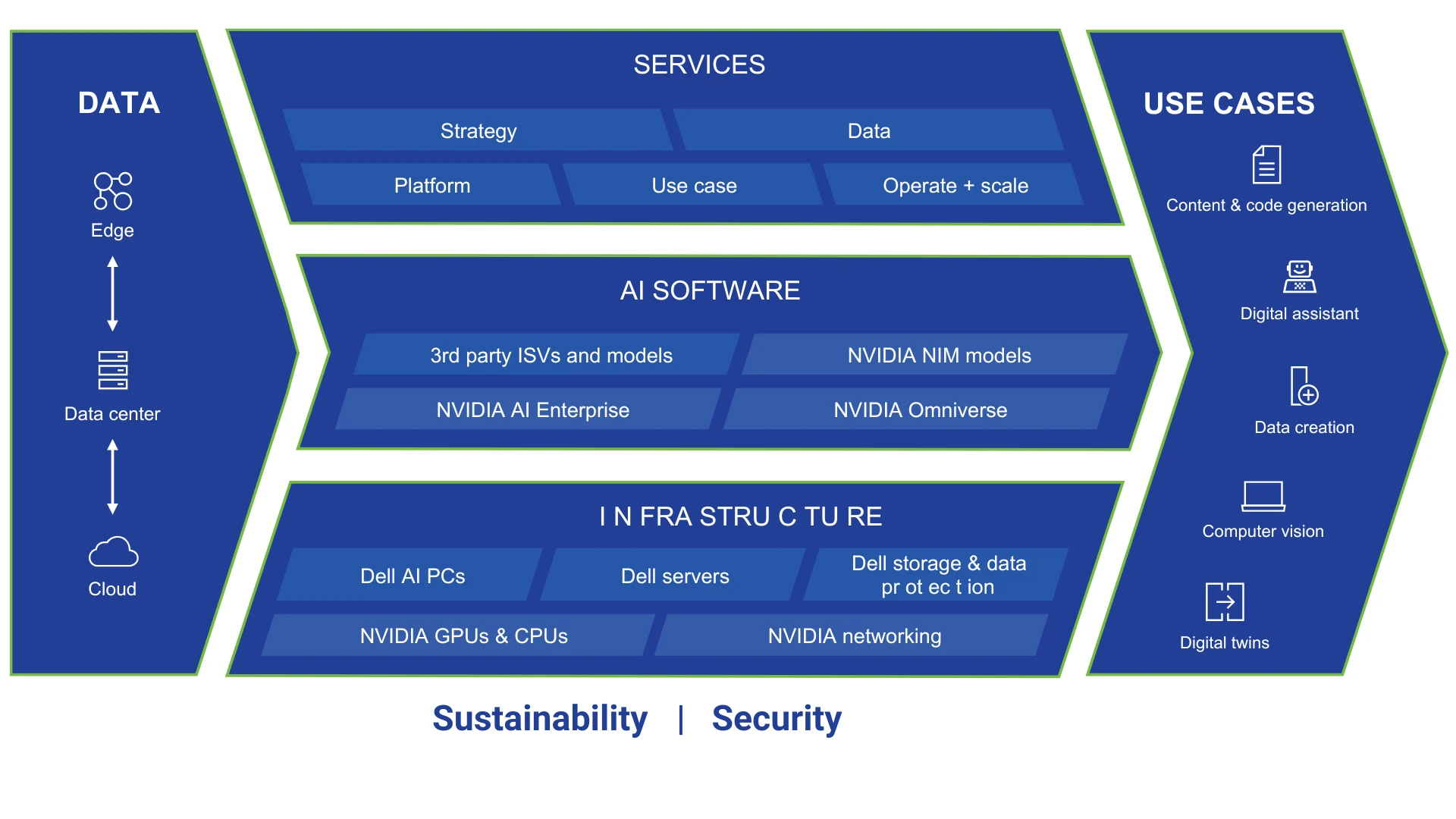
Dell and NVIDIA offer a unique combination of innovation, reliability, and deep industry expertise, including:
- Scalable AI infrastructure: Dell’s AI-ready servers and storage, powered by NVIDIA GPUs, deliver the performance needed to train and deploy agentic AI at scale regardless of whether workloads are on-premises, in the cloud, or at the edge.
- Seamless AI integration: AI deployment requires seamless integration with business processes and operations. Dell and NVIDIA provide pre-validated frameworks, containerized deployments, and automation tools to embed AI into workflows.
- Proven AI expertise: Backed by decades of AI and technology expertise, Dell and NVIDIA offer solutions that accelerate time-to-value, boost performance, and simplify AI implementation.
Unlock the full potential of agentic AI
By partnering with Dell and NVIDIA, you can confidently implement agentic AI, unlock new levels of efficiency, automation, and business intelligence while ensuring AI infrastructure remains secure, scalable, and future-ready.
To optimize your outcomes, explore the fee-waived Dell Accelerator Workshop to develop a tailored AI strategy that aligns with your objectives and gain more insights into the Dell and NVIDIA portfolio of solutions and frameworks.