
.webp "Dell Logo")

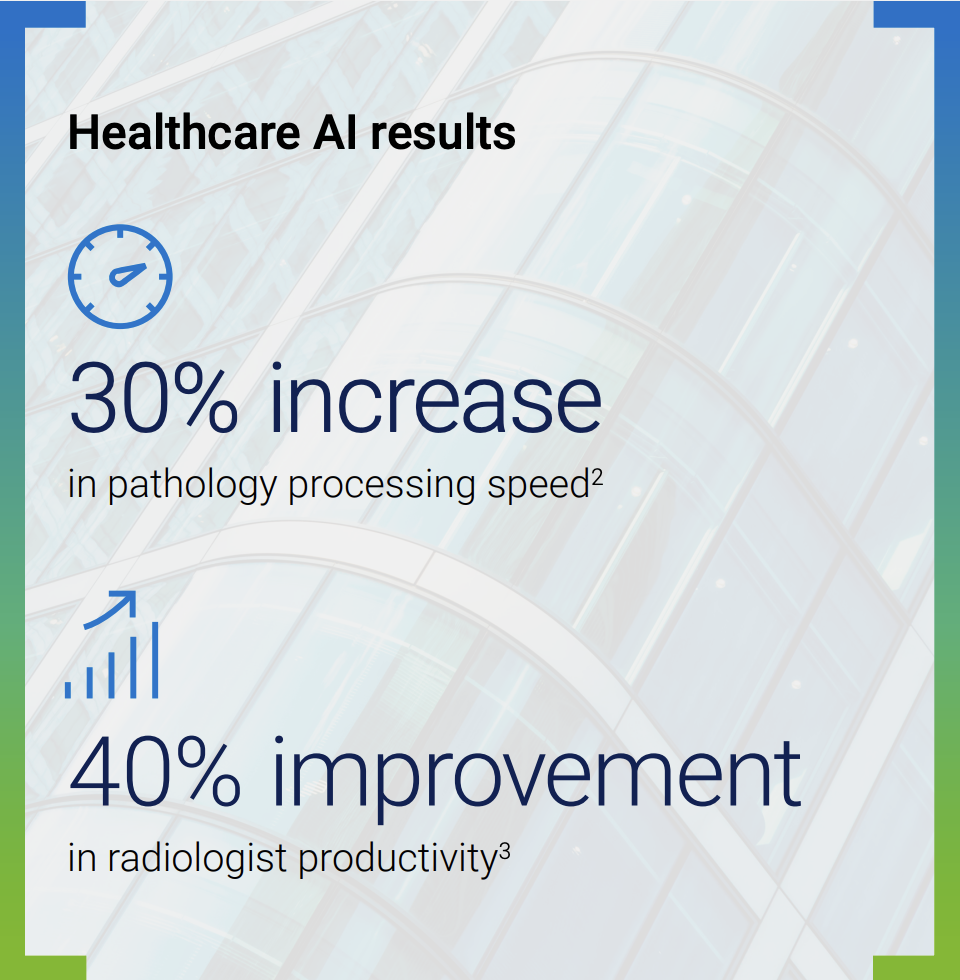
AI is no longer the future of healthcare and life sciences. It’s a present-day success factor. Many organizations already run AI applications in production to accomplish critical business objectives, such as the acceleration of clinical imaging, the improvement of research productivity, the enablement of precision medicine, and the automation of administrative workflows.
For example, data security and management are critical, especially in highly regulated, data-sensitive healthcare and life sciences environments. Concerns about data sovereignty, latency and operational control, combined with variable consumption pricing, are driving a move toward more controlled, on-premises deployments. In fact, 79% of enterprises have already moved AI workloads outside the public cloud
At the same time, workloads are becoming more complex, spanning clinical inference, imaging, large language models, and emerging agent-based systems. So, as AI becomes more widespread in hospitals and labs, priorities are shifting toward greater control over data, performance, cost and governance.
Success under these circumstances requires more than adding capacity. It demands aligning infrastructure with workload and regulatory requirements. Organizations that do this effectively are better positioned to scale AI, accelerate insights and deliver more personalized, efficient care.
One size does not fit all
For healthcare and life sciences organizations, deploying AI on-premises introduces a critical challenge: getting AI stack sizing right. There’s no universal configuration that’s optimized for every workload.
AI workloads ranging from model training and fine-tuning to real-time inference, retrieval-augmented generation (RAG), medical imaging, and edge deployments support use cases like clinical decision support, diagnostic imaging, research acceleration, and AI-driven assistants. However, each places different demands on infrastructure. Factors such as model complexity, latency requirements, and data volumes all influence what’s needed to perform reliably.
Most organizations are running multiple workloads at once, each with distinct performance expectations and cost considerations. That makes sizing a multidimensional decision spanning compute, storage and networking. For example, some workloads can run efficiently on CPUs, while others require GPU acceleration; training pipelines demand high-throughput storage, while inference requires low-latency access; and distributed environments depend on fast, stable connectivity.
Inference drives scale. Unlike periodic training jobs, it runs continuously, often supporting real-time, patient-facing or clinician-facing applications. As usage grows, inefficiencies quickly compound, impacting both performance and cost.
Environments that are undersized for these needs can slow clinical workflows and delay insights, while overbuilt systems add unnecessary costs. Right-sized infrastructure delivers consistent performance, better cost control and the ability to scale AI with confidence in real-world healthcare environments.
Sizing: A practical framework
Sizing depends on five key factors that must be balanced carefully.
#1: Model size
Model size is measured in parameters. Sizes range from small (1B–7B) to frontier-scale (1T+). Larger models require more compute, memory and specialized infrastructure, especially for data-intensive healthcare use cases like imaging or genomics, so choosing the right size for the task is critical.
#2: Precision
Precision also adds to compute and memory requirements. Higher precision, such as FP32 and FP16/BF16, improves accuracy but increases resource demands. Lower precision such as FP8 and Int8 are often ideal for inference and real-time clinical scenarios and reduce compute, memory and costs.
#3: Tokens and context length
Tokens and context length define how much data a model can process at once. Longer contexts increase memory and KV cache requirements, which is especially important for handling patient records, research datasets or complex reasoning tasks.
#4: Latency
Latency impacts how quickly results are delivered. Consistent low latency is essential for clinical and operational applications. Metrics like time to first token (TTFT) and intertoken latency (ITL) indicate model responsiveness. Accelerated infrastructure and AI software should be sized to meet the responsiveness the use case demands.
#5: Input/output sequence length (ISL/OSL)
Input/output sequence length (ISL/OSL) varies by use case. Different patterns such as summarization vs. reasoning affect memory, cache and throughput, so understanding workload behavior upfront helps avoid costly mismatches.
Dell AI Factory with NVIDIA, optimized for healthcare and life sciences workloads
AI workloads in healthcare and life sciences are increasingly hybrid, data-intensive and diverse, spanning clinical systems, research environments and edge locations. Optimization can’t happen in isolation; it requires tight coordination across compute, networking, storage, software and automation.
That’s the foundation of the Dell AI Factory with NVIDIA, a modular, validated, full-stack platform designed to accelerate the shift from pilot to production with an infrastructure approach that operates as a unified system. By integrating every layer of the stack, it helps healthcare and life sciences organizations scale AI more efficiently, simplify operations and deliver stronger outcomes while improving return on investment.
Accelerated compute: The backbone of AI optimization
Servers are the compute platforms for AI performance. They determine GPU density, CPU capability, memory and overall scalability. The goal is to match the platform to the workload, being careful not to overbuild or underpower the environment. The Dell PowerEdge portfolio supports a range of healthcare and life sciences AI needs:
This range of options is important, because AI workloads vary widely. A flexible server portfolio makes it easier to align infrastructure with real clinical, research and operational needs.
- Large-scale training and agentic AI: PowerEdge XE9780 and XE9785 with NVIDIA HGX™ B300 GPUs deliver high performance for complex, data-intensive workloads.
- Training and fine-tuning: PowerEdge XE9780 provides a strong platform for scaling model development.
- GenAI and inference: PowerEdge R770 and R7725 with PCIe NVIDIA GPUs, including NVIDIA RTX PRO™ 6000 or 4500 Blackwell Server Edition, support everyday use cases.
- Inference optimization: PowerEdge XE7745 balances performance, efficiency and latency with NVIDIA RTX PRO™ 6000 Blackwell Server Edition GPU configurations.
- Edge environments: PowerEdge XR-Series systems are built for distributed care settings where space and conditions matter as much as performance.
Networking is essential for AI optimization
Networking enables fast, low-latency data movement across GPUs, servers and racks, directly impacting scale and responsiveness. The Dell PowerSwitch SN6000-Series with NVIDIA Spectrum-6 supports a range of AI demands:
- Large-scale and back-end AI: High performance for dense, data-heavy workloads.
- Massive scale-out: Up to 409.6 Tbps switching capacity, 800 Gb/s per port and ultra-low latency for GPU clusters.
- Efficiency and reliability: Liquid cooling and co-packaged optics improve power use, thermals and uptime.
- Integrated infrastructure: Works with Dell rack-scale solutions to unify networking, power and cooling.
- Open operations: Support for SONiC and Dell Fabric Manager enables automation and lifecycle management.
This flexibility helps align networking with workload needs while scaling AI efficiently.
Storage: The data foundation for AI
AI performance depends on fast, reliable data access as much as compute. Training, inference and retrieval workloads all slow down when data can’t keep pace, making storage a core part of optimization.
The Dell AI Data Platform with NVIDIA provides the data foundation for the Dell AI Factory with NVIDIA, bringing together Dell’s AI-optimized storage and modular data engines with NVIDIA accelerated computing, networking, and NVIDIA AI Enterprise software. Designed for the agentic AI era, it helps enterprises turn distributed, multimodal data into AI-ready data for RAG, search, analytics, agentic workflows, and large-scale data processing—while providing the performance, security, governance, and scalability required for production AI.
Dell offers the following storage engines from the Dell AI Data Platform:
- PowerScale and ObjectScale: Support the full data lifecycle, from ingest to archiving, for most healthcare and life sciences workloads
- Dell Lightning File System: Built for high-performance workloads where maximizing GPU use and reducing training time are critical
The key is simple: match storage performance to workload demand to keep systems efficient and balanced.
Simplify the path to production with Dell Automation Platform
Optimization also depends on how easily you can deploy and manage AI. Dell Automation Platform acts as a unified orchestration layer, helping teams:
- Deploy and manage validated blueprints for consistent outcomes.
- Automate manual tasks to shorten average deployment time by roughly one week.
- Standardize infrastructure across use cases.
- Align compute, storage and network resources to each workload.
This creates a more repeatable operating model, reducing manual effort and accelerating the move from pilot to production.
Software: the control layer that turns infrastructure into an AI platform
Deploy leading open source tools and AI models with confidence, improve productivity and time to value, and run AI workloads at scale with optimized resource utilization.
Software and automation are what make the Dell AI Factory with NVIDIA operate as a unified system rather than a collection of separate components. At a high level, the software layer helps automate deployment, centralize lifecycle management, and keep AI workloads consistent across core, edge and distributed environments.
For healthcare and life sciences, that matters because it reduces operational complexity and helps teams move AI workloads from pilot to production faster, with less manual effort and more repeatability.
NVIDIA AI Enterprise brings together microservices, frameworks and libraries for AI development with advanced GPU orchestration and infrastructure management in a fully supported, production-ready, commercial software suite.
Build for the workload
Organizations seeing real progress take a targeted approach:
- Start with the model. Define size, precision, latency and context needs.
- Run inference on-premises. Improve control, cost and compliance.
- Right-size infrastructure. Match resources to workload demand.
- Design across the stack. Create systems where all layers work together.
- Plan for scale early. Use validated blueprints and reference architecture to move faster
Speeding pilot to production timelines
Moving from proof of concept to production is where many AI efforts stall. What works for a single team doesn’t easily scale across environments, users or use cases. Validated reference architectures help bridge that gap by combining compute, storage, networking and software into tested, repeatable designs that reduce risk and speed deployment.
The Dell AI Factory with NVIDIA brings these elements together in a modular platform, helping healthcare and life sciences teams scale AI with greater consistency and confidence.
Essen University Hospital strategically utilized the Dell AI Factory with NVIDIA on-site to fuel large language models (LLMs)
By balancing AI assistance and clinician expertise, UK Essen can prioritize compassionate, personalized patient care. GenAI allows the organization to deliver outstanding services with great efficiency to a highly diverse patient population, overcome resource constraints and streamline many everyday processes
Take the next step
Every AI environment is different. A tailored approach can reduce complexity, improve efficiency and support scale, especially in healthcare and life sciences. As you define your workload strategy, consider how a modular, validated platform can support your needs.
To move forward:
- Assess your current environment to identify right-sizing opportunities.
- Explore reference architectures for key use cases like LLM inference, RAG and imaging.
- Work with a Dell AI specialist to map a clear path from pilot to production.