


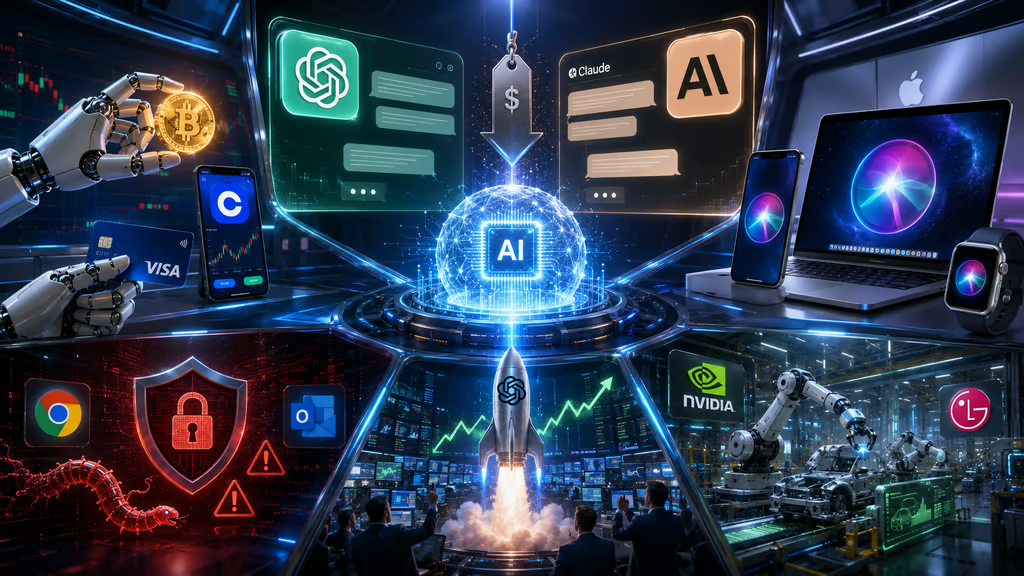
From cutthroat AI price wars and agent-run crypto trades to Apple’s Siri reboot and a flurry of zero-day exploits, this week’s tech news shows the sprint toward smarter, cheaper automation is only getting faster — and far more perilous.
Top news
AI price wars and platform expansion
OpenAI is reportedly considering major cuts to its ChatGPT and API token prices to counter Anthropic’s recent rate reductions. The move underscores intensifying competition as enterprises push for more affordable AI solutions.
Meanwhile, OpenAI is developing a desktop “superapp” that merges ChatGPT, Codex, and the Atlas browser into a unified workspace, aimed at streamlining productivity and deepening enterprise integrations.
AI agents enter the financial system
Coinbase launched “Coinbase for Agents,” a new account type that allows AI assistants such as ChatGPT or Claude to autonomously trade crypto and pay for data. The system leverages Coinbase’s x402 protocol and compliance checks to manage agent-driven transactions.
In parallel, Visa and OpenAI are integrating ChatGPT with Visa’s payment rails, enabling AI agents to make tokenized purchases under user-defined limits. The partnership aims to usher in a new era of “agentic commerce.”
Apple’s AI renaissance
At WWDC26, Apple unveiled a rebuilt Siri powered by its new Apple Intelligence stack, using on-device and private cloud models to perform contextual tasks like drafting emails and managing apps. Developer previews are live, with broader betas expected later this year.
Apple is also combining its own AI models with Nvidia GPUs and Google’s Gemini cloud technology to power new hybrid AI features, balancing privacy with performance. The company’s iOS 27 update brings faster app launches, smarter Safari tab grouping, and expanded AI tools for Photos and Shortcuts.
In a major platform shift, macOS 27 will end support for Intel Macs, marking Apple’s full transition to its own silicon. Rosetta translation support will also end after macOS 27, impacting thousands of legacy apps.
AI ethics and industrial AI
Anthropic issued a stark warning that AI systems like its Claude model could soon design their own successors, calling for a global pause to prevent uncontrolled self-improvement. The company says Claude now writes most of its production code, boosting productivity eightfold.
LG and Nvidia announced a partnership to build “AI factories” integrating robotics, manufacturing, and vehicle systems. The collaboration will leverage Nvidia’s simulation and autonomous platforms to enhance LG’s EXAONE AI model family and industrial automation capabilities.
Insider intel
Researchers at the Initiative for CryptoCurrencies and Contracts (IC3) found that blockchain offers limited benefits in solving AI’s trust and payment challenges. While crypto wallets can automate transactions for AI agents, they do not enhance intelligence or safety—raising concerns about self-replicating, self-funded AI agents operating autonomously.
Security alerts
Major breaches and vulnerabilities
Hackers breached France’s encrypted government messaging app Tchap, exposing data from public chat rooms after exploiting hardcoded credentials. The incident compromised 13.5 GB of sensitive data.
The Ghost-Sender flaw in Microsoft Exchange allows attackers to spoof emails directly to Microsoft 365 inboxes, bypassing SPF, DKIM, and DMARC checks. Admins are urged to disable Direct Send and restrict inbound delivery.
Check Point issued emergency patches for a critical VPN flaw (CVE-2026-50751) that allows attackers to bypass authentication on Remote Access VPNs and Spark firewalls. The vulnerability has been exploited by ransomware groups.
Google patched a Chrome V8 zero-day (CVE-2026-11645) exploited in the wild. The flaw allowed remote code execution, and users are urged to update immediately to version 149.0.7827.102 or later.
AI-driven and cloud threats
Microsoft removed 73 GitHub repositories after the Miasma worm injected credential-stealing code into Azure’s durabletask project. The worm spread through cloud and AI-agent tools, prompting developers to rotate tokens and check for rogue files.
University of Toronto researchers demonstrated an AI-powered worm capable of autonomously exploiting vulnerabilities and hijacking GPUs for computation. Experts urge rapid patching and zero-trust segmentation to defend against similar adaptive threats.
CrowdStrike reported that AI-driven cyberattacks from China and North Korea are on the rise, targeting tech firms for IP theft and cryptocurrency. AI tools are accelerating both the speed and sophistication of these campaigns.
Privacy and platform security
OpenAI expanded its ChatGPT Lockdown Mode to millions of users, disabling live browsing and file downloads to prevent prompt-injection data leaks. The feature is recommended for users handling sensitive information.
A Wired investigation revealed dormant facial recognition code in Meta’s smart glasses app, capable of identifying people via stored faceprints. Although Meta claims the feature is experimental, privacy advocates are raising alarms.
Industry shakeups
Regulatory and market moves
Coupang was fined a record $409 million by South Korean regulators for a 2025 data breach affecting 37 million users and for illegally tracking 11 million others. The company plans to appeal the decision.
Public backlash is slowing AI data center expansion across the US, with states like New York, California, and Illinois imposing moratoriums and utilities proposing surcharges. Companies such as Meta and Switch are facing rising costs and community protests.
IPO and intelligence operations
OpenAI confidentially filed for an IPO with the SEC, reportedly targeting a valuation near $1 trillion. The filing follows Anthropic’s and precedes SpaceX’s expected debut, signaling a new wave of AI-driven market entries.
In a controversial development, the NSA has embedded Anthropic engineers to use its Mythos AI model for offensive cyber operations. The model can identify and exploit zero-day vulnerabilities, raising ethical and geopolitical questions as Anthropic also prepares for its own IPO.
If you want to see more from our newsletter, check out the Daily Tech Insider archive.