


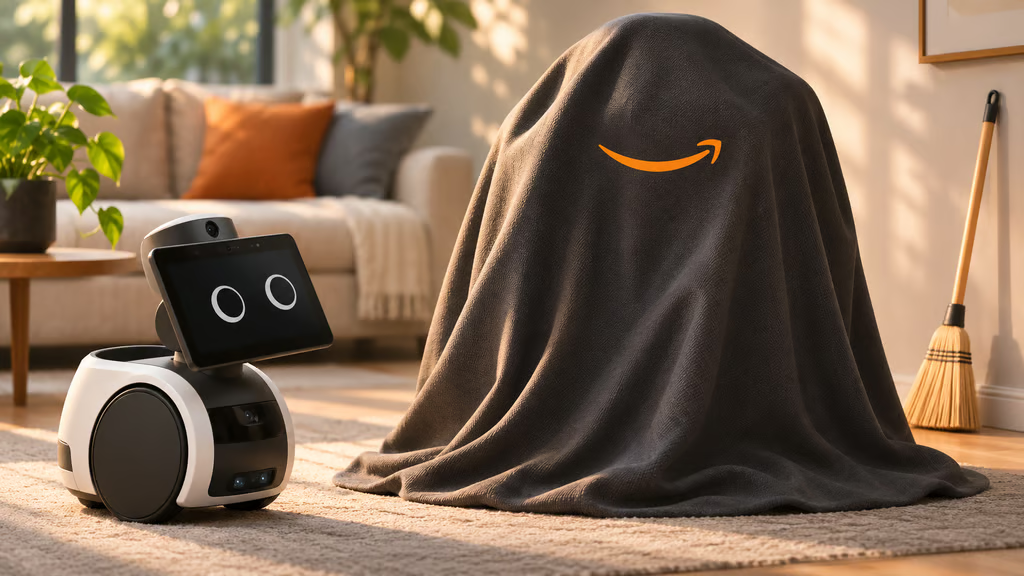
Amazon is taking another run at the home robot, assembling a team to build a device intended to operate around families. This time, the useful part needs to outlast the unboxing.
Amazon hasn’t disclosed the robot’s design, specific capabilities, price, or launch date. A humanoid is one possibility, given its acquisition of Fauna Robotics, but the company hasn’t confirmed that shape or identified Fauna’s Sprout as its next consumer product.
A recent CNBC investigation draws on job listings, LinkedIn profiles, and Amazon’s comments. Listings sought staff for a “new-to-world robot product,” while a since-removed engineering ad described navigation through changing homes and “autonomous operation alongside family members.”
Amazon spokesperson Brad Glasser told CNBC that the company has carried lessons, talent, and experience from Astro into other robotics efforts. Astro gave Amazon experience navigating homes. It also supplied a harder lesson: getting around the house and earning a place in it are different accomplishments. In other words, Amazon learned that an expensive roving security camera is not the killer app consumers were begging for.
Fauna brings a humanoid and a new team
Amazon acquired New York-based Fauna Robotics in March, adding the company to its Personal Robotics Group. Fauna’s March 24 announcement said it would continue selling Sprout Creator Edition robots and supporting existing customers under Amazon ownership.
Sprout is a 3.5-foot, 50-pound humanoid offered as a platform for developers and researchers. Fauna describes a soft exterior, reduced pinch points, and motor controls that yield to outside forces as features intended to reduce risk around people. That gives Amazon relevant hardware and expertise, without establishing what an eventual household product will look like. Right now, at $50,000, Sprout is strictly an R&D play, not something you’ll find on Prime Day.
CNBC also found that Amazon reassigned much of the Astro team to the effort and that some group members previously worked at Lab126, the hardware development unit behind the Kindle, the Echo, and the spectacular belly-flop that was the Fire Phone. MIT roboticist Luca Carlone’s university website says he worked with the Personal Robotics Group while on sabbatical at Amazon.
A Fauna user experience opening covers how robots earn trust, communicate intentions, and fit into home life. A separate support role includes troubleshooting and coordinating repairs, specifically for technical customers such as engineers and researchers. Those are signs of ongoing product development and support work. A job ad, however, still isn’t a preorder page.
Astro found useful jobs, but few customers
Astro arrived in 2021 as a wheeled robot with Alexa, face recognition, and mobile home monitoring. Amazon announced a list price of $1,449.99, with an introductory price of $999.99. CNBC reports that it remained invitation-only and shipped to just a few thousand customers.
A former Astro employee told CNBC that its high price and limited functionality made it a difficult sell. Being an expensive way to check the living room is a tough pitch when customers are imagining a robot cleaning it.
Owners’ experiences were mixed. Emily Lugo Velez told CNBC she still uses Astro to check on pets and appliances remotely, but otherwise described it as a novelty and a “trip hazard.” (Ouch.) Joe Martin, another owner, said he felt he had received his money’s worth over four years.
CNBC also reported complaints in Astro owners’ Facebook groups about diminished customer service and the absence of Alexa+ support. Some owners took those issues as signs that Astro might be discontinued, but Glasser said Amazon continues to support Astro customers.
The distinction matters: Amazon discontinued Astro for Business in July 2024, less than a year after its November 2023 debut. That shutdown concerned the business version, not an announced end to the consumer robot (yet).
Better technology still has to survive a living room
Colin Angle, iRobot’s co-founder and former CEO, told CNBC that robotics tools have improved substantially since Astro’s development. The report points to advances in AI models, sensors, batteries, and actuators, the components that produce physical movement. Angle now leads companion-robot startup Familiar Machines & Magic.
Amazon has considerable experience to draw on: its warehouse robot fleet reached 1 million in June 2025. Even there, execution can be difficult. TechRepublic reported that Amazon shelved its Blue Jay warehouse robot months after its debut, citing Business Insider’s reporting on cost, manufacturing complexity, and implementation challenges. The living room is an ambitious place to seek a more forgiving test environment.
Angle’s assessment offers a reason another attempt could fare differently, rather than proof that the household helper problem is solved. Jeff Burnstein, president of the Association for Advancing Automation, told CNBC that children, pets, stairs, and different home layouts make domestic settings especially challenging, particularly for walking robots.
Amazon acknowledges the problem. Glasser told CNBC that a substantial gap remains between performance in controlled laboratories and everyday places such as living rooms and lobbies, and said Amazon is working with the robotics community to address it.
Astro’s own product documentation illustrates the constraints: it operates indoors on one floor and cannot climb or descend stairs. A new robot would also need to cope with clutter and people moving unpredictably. The dog hasn’t read the floor plan, and let’s be real: your cat is absolutely going to try to push it down the stairs.
Fetching a drink requires more than wheels
Martin told CNBC he would be interested in another robot if it could bring him a drink or dust furniture. Those are an owner’s wishes, not capabilities Amazon has announced for the new device.
There is an important wrinkle in the drinks example. Amazon already describes Astro as able to deliver an item someone puts in its cargo bin. Independently finding and picking up that item would be a different capability. The human currently supplies the arm, which is a fairly significant (and unpaid) accessory.
That limitation wasn’t lost on Astro’s developers. Former Amazon consumer robotics executive Ken Washington told CNBC that executives discussed adding an arm, and that he advocated a bipedal design that leadership (namely, Jeff Bezos) rejected. Those were earlier discussions, not a specification for Amazon’s new effort.
For buyers, the practical test is whether a robot can complete a useful task repeatedly without needing someone to prepare, supervise, or rescue it so often that doing the job themselves becomes easier.
Watch the chores, the price, and the support
Amazon joins a wider push into household robotics, with developers pursuing very different jobs. Angle’s Familiar Machines & Magic is developing companions, while Sunday’s Memo robot targets chores such as laundry and clearing the table. CNBC also points to Tau and Nori as household-robot developers and describes these chore-focused efforts as mostly prototypes or niche devices.
Apple is also working through its own home-robot challenge with a reported $1,000 tabletop device featuring a swiveling robotic arm, whose software development could push a targeted 2027 launch into 2028.
Amazon’s next meaningful milestone would be a demonstrated task set, followed by reliable operation in actual homes. Pricing and availability will matter just as much: Astro showed how small an audience an expensive, invitation-only robot can reach.
Long-term support deserves equal attention, including repair options, software updates, and the availability of essential services over time. Amazon says it still supports Astro owners; buyers of a future robot will need concrete commitments about their own purchase. A household helper becomes a less compelling proposition if maintaining it joins the chore list.
Amazon isn’t the only tech giant trying to figure out the domestic robot market. See why Apple’s rumored $1,000 tabletop assistant is reportedly stuck in software-development purgatory until 2028.