


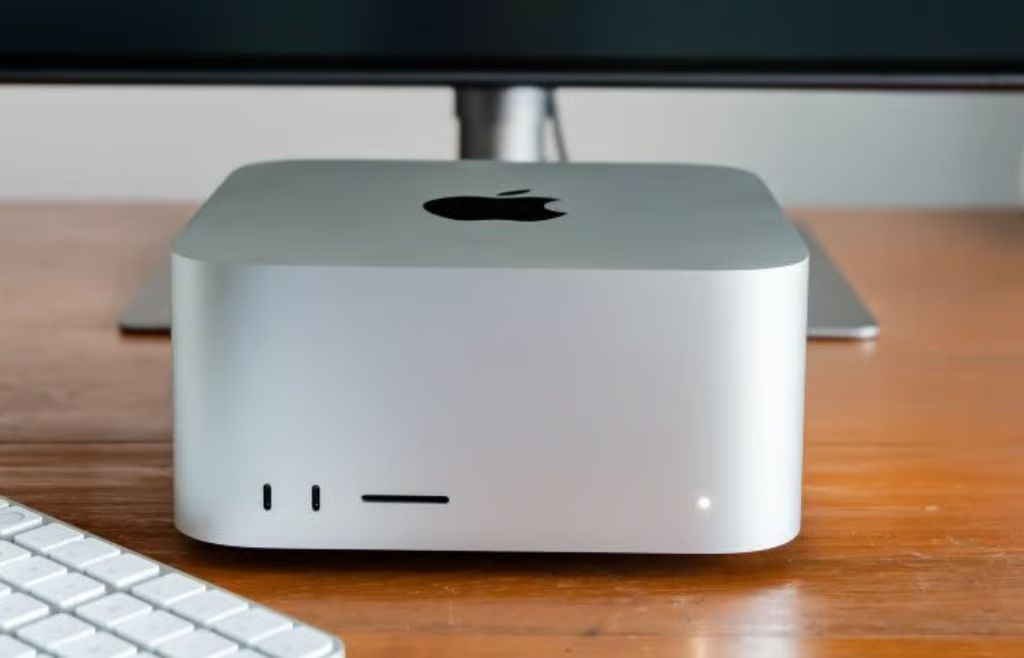
As Apple prepares for its Worldwide Developers Conference (WWDC), speculation continues over whether the company could unveil new Mac Studio and Mac mini models powered by its upcoming M5 chips.
While most expectations point to a software-focused event, mounting supply shortages and unusually strong demand for Apple’s desktop Macs have fueled renewed discussion about when M5-powered versions could arrive.
According to 9to5Mac, many Mac Studio and Mac mini configurations are currently heavily backordered, leading some observers to wonder whether Apple is clearing the runway for refreshed models. Earlier expectations suggested that M5 versions of both machines could launch around midyear, making a WWDC debut possible.
However, recent supply chain challenges have complicated that outlook.
AI boom creates unexpected demand
Apple says the shortages are not simply the result of production issues. During the company’s quarterly earnings call, CEO Tim Cook said demand for the Mac mini and Mac Studio has exceeded internal forecasts as more customers turn to these machines for artificial intelligence workloads.
“Both of these [mini and Studio] are amazing platforms for AI and agentic tools, and the customer recognition of that is happening faster than what we had predicted, and so we saw higher than expected demand,” Cook said.
According to Apple, constraints surrounding advanced chip manufacturing capacity and memory components are limiting the company’s ability to meet demand. Cook said those supply issues are expected to continue for several months.
The trend highlights a growing role for Apple’s desktop computers in AI development. Their combination of Apple Silicon performance, unified memory architecture, and relatively affordable pricing has made them increasingly attractive to developers running AI models locally rather than relying entirely on cloud services.
Why developers are buying Mac minis and Mac Studios
The Mac mini and Mac Studio have become increasingly attractive to developers, researchers, and AI enthusiasts looking to run large language models and other AI tools locally.
Their appeal stems from a combination of relatively affordable pricing, powerful Apple Silicon processors, and a unified memory architecture that efficiently handles AI workloads. The Mac mini, in particular, has become a popular platform for local AI development, helping to drive inventory shortages across multiple markets.
The growing popularity has also led to longer shipping times and reduced availability for several configurations. Some Mac mini models have reportedly been removed from sale, while higher-memory versions of both systems have become difficult to obtain.
That demand surge is one reason some observers believe Apple may be preparing to introduce updated hardware, though supply constraints could just as easily delay new launches.
What Apple’s M5 refresh could bring
Despite uncertainty around launch timing, reports suggest the next-generation Mac Studio and Mac mini will focus on performance improvements rather than design changes.
According to MacRumors, the next Mac Studio is expected to retain its current compact design while gaining new M5 Max and M5 Ultra processors. Faster storage performance and possible configuration changes are also rumored. The publication reports that Apple may now target an Oct. 2026 launch window for the Mac Studio after memory-related supply challenges disrupted earlier expectations.
The Mac mini is also expected to receive M5 and M5 Pro chip options. Reports suggest Apple could increase baseline storage, improve graphics and AI performance, and introduce updated wireless connectivity while keeping the existing chassis introduced with the M4 generation.
Pricing remains unclear, though MacRumors reported that Apple may maintain the current starting price of $1,999 unless component costs force adjustments.
While Apple works through questions about its next-generation desktop Macs, the company is also addressing current software issues with the release of iOS 26.5.1 and macOS 26.5.1 bug-fix updates.