


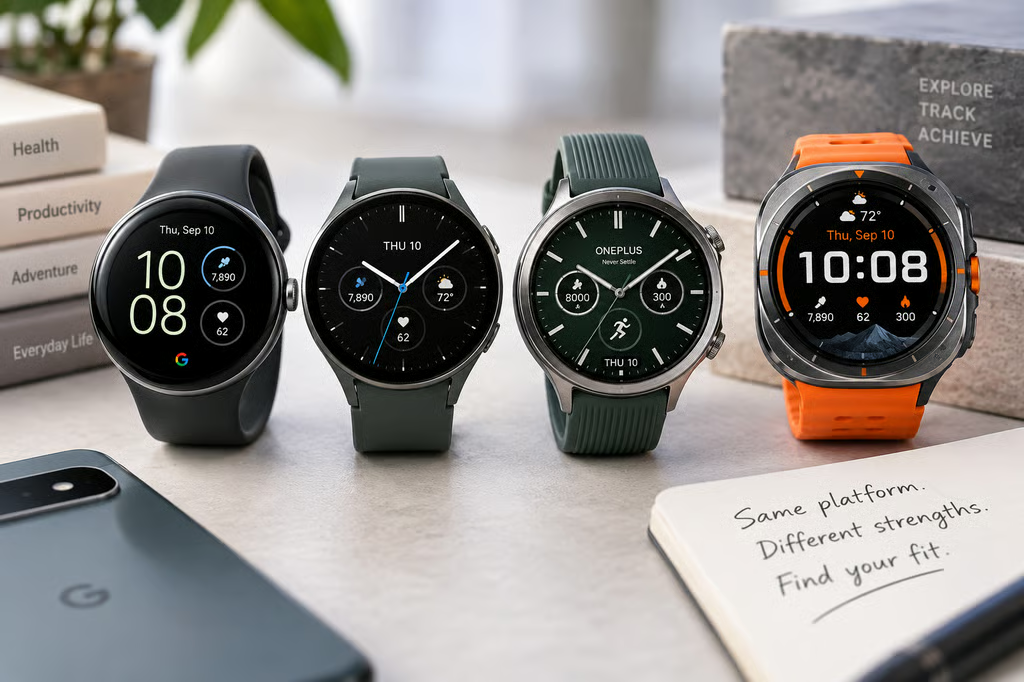
Choosing a Wear OS smartwatch in 2026 means weighing battery life, phone compatibility, software support, health features, and price. Some watches need daily charging, others last several days, and certain AI or health features depend on your phone.
Google Pixel Watch 5 is the best overall pick for its current software, broad Android compatibility, health and fitness features, and competitive battery life. Galaxy Watch9 is especially well suited to Samsung phone users, the 46mm OnePlus Watch 3 leads on battery life, and Galaxy Watch Ultra2 is the premium choice for longer endurance and outdoor use.
| Model | Best for | Starting US price | Battery claim | Software | Main tradeoff |
|---|---|---|---|---|---|
| Google Pixel Watch 5 | Best overall | $399.99 | Up to 30 hours (41mm) or 40 hours (45mm) with always-on display | Wear OS 7 | Some AI and health features have phone or regional restrictions |
| Samsung Galaxy Watch9 | Samsung phone users | $379.99 | Up to 30 hours with always-on display | Wear OS 7 | May require daily charging |
| OnePlus Watch 3 46mm | Battery life | $349.99 | Up to 5 days in Smart Mode | Wear OS 5 | No LTE and older Wear OS |
| Samsung Galaxy Watch Ultra2 | Outdoor and premium use | $699.99 | Up to 60 hours with always-on display | Wear OS 7 | Large and expensive |
Prices were checked Sept. 10, 2026. Manufacturer battery estimates use different settings and test conditions, so figures should not be compared hour for hour.
How we chose the best Wear OS smartwatches
Our ranking focuses on the parts of a smartwatch that have the greatest effect on everyday use. Long battery life matters less if key features don’t work with your phone, and a long feature list cannot make up for uncomfortable hardware or software that is already falling behind.
For each watch, we checked official pricing, battery claims, compatibility, software versions, connectivity, and feature requirements. Where available, we used independent hands-on reviews to assess how those specifications translate into real-world battery life, comfort, GPS performance, heart-rate tracking, and overall usability.
The main criteria were:
- Battery life and charging: Battery life affects sleep tracking, workouts, travel, and how often the watch has to come off your wrist. We compared manufacturer estimates by operating mode, such as always-on display or Smart Mode, and checked them against independent testing where available. Estimates based on different modes were kept separate rather than treated as equivalent.
- Software and support: The Wear OS version affects features, app compatibility, and how quickly a watch may begin to feel dated. Software longevity was also considered because smartwatch support cutoffs can arrive while the hardware itself still works.
- Phone compatibility: We considered minimum Android versions, companion apps, account requirements, LTE availability, and features restricted to particular phone brands. These differences can change the experience considerably even when two watches run the same version of Wear OS.
- Health and fitness: Sensor coverage, sleep and workout tracking, GPS, heart-rate features, subscriptions, regional restrictions, and useful smartwatch health alerts were considered. Where available, we used independent testing to assess real-world tracking consistency rather than relying only on sensor lists.
- Design and everyday use: We considered size, weight, display brightness, durability, controls, and comfort because a smartwatch may be worn through work, exercise, sleep, and everything in between.
- Price and value: We weighed current US pricing against each watch’s features and compromises. More expensive models needed to offer a meaningful advantage in areas such as battery life, materials, durability, connectivity, or specialized fitness features.
No single criterion determines the order. A watch with exceptional battery life, for example, can rank below another model if it runs older software or drops features that matter more to most buyers.
Best Wear OS smartwatches for 2026
Google Pixel Watch 5: Best overall. The Pixel Watch 5 starts at $399.99 and comes in 41mm and 45mm sizes. It runs Wear OS 7, while Google rates battery life at up to 30 hours with the always-on display enabled on the 41mm model and up to 40 hours on the 45mm version.
It works with most phones running Android 12 or later, so you do not need a Pixel phone for the core smartwatch experience. Google also sells LTE versions and includes 64GB of storage, dual-frequency GPS, and a broad set of health and fitness features.
In Android Central’s testing, the watch lasted about two days while tracking sleep and workouts. The review also found its step counts and heart-rate readings tracked more closely to reference devices than the Galaxy Watch9 in its tests.
There are some ecosystem limits. Google’s Proactive Assistance feature requires a Pixel Watch 5 paired with a Pixel 11 or newer phone, and some health features vary by country or region. Anyone buying primarily for a particular AI or health feature should check its requirements first.
Pixel Watch 5 and Galaxy Watch9 start only $20 apart, making battery life, compatibility, and ecosystem features more useful differentiators than price alone when comparing the two watches.
Samsung Galaxy Watch9: Best for Samsung phone users. The Galaxy Watch9 starts at $379.99 for the 40mm Bluetooth model. The 44mm Bluetooth version starts at $409.99, while LTE models start at $429.99.
It runs Wear OS 7 with One UI 9 Watch and includes Gemini, Samsung Health, Vitals, and a display rated at up to 3,000 nits. It works with compatible phones running Android 13 or later, although some features require a Samsung Galaxy phone.
Battery life is its main weakness. Samsung rates the Watch9 for up to 30 hours with the always-on display enabled and up to 40 hours with it off. An Android Central review found that its 44mm test unit barely lasted through a full day even with the always-on display disabled.
If you already use a Galaxy phone, the Watch9 gives you deeper access to Samsung’s health features, provided frequent charging isn’t a dealbreaker.
OnePlus Watch 3 46mm: Best for battery life. The OnePlus Watch 3 has a $349.99 US MSRP. Its dual-engine design pairs Wear OS with a lower-power operating system to reduce battery drain when you don’t need the full smartwatch platform.
OnePlus rates the 46mm version for up to five days in Smart Mode and three days under heavy use. Wareable’s testing produced just under three days with the always-on display enabled, including substantial exercise and GPS use.
Wareable also found that heart-rate tracking improved over the previous generation but still lagged leading rivals during some workouts. That makes battery life, rather than fitness accuracy, the strongest reason to choose the Watch 3.
The watch runs Wear OS 5 rather than Wear OS 7, and there is no LTE model. Size matters too: the smaller 43mm OnePlus Watch 3 is rated for up to 60 hours in Smart Mode, considerably less than the five-day claim for the 46mm version.
Samsung Galaxy Watch Ultra2: Best for outdoor and premium use. The Galaxy Watch Ultra2 costs $699.99 and comes in a single 47mm LTE configuration.
It runs Wear OS 7 and pairs an 800mAh battery with a titanium case, a display rated at up to 5,000 nits, dual-frequency GPS, 10ATM water resistance, and IP69K protection. Samsung rates it for up to 60 hours with the always-on display enabled.
Wareable recorded roughly four days between charges during two test cycles with regular workouts and sleep tracking. LTE and continuous blood-oxygen monitoring were disabled during those tests, an important caveat when comparing that result with Samsung’s own battery estimate.
The review also found strong heart-rate and GPS performance. Combined with the brighter screen, larger battery, LTE, and added durability, that makes the Ultra2 especially well suited to hiking, running, diving, and other outdoor activities.
At $699.99 and 47mm, it costs considerably more and takes up much more space on the wrist than the other watches here.
Which Wear OS smartwatch should you buy?
Pixel Watch 5 is the best choice for most Android users because it offers the most balanced mix of current software, health tracking, compatibility, and battery life.
Galaxy Watch9 is the better fit for Samsung phone users who want tighter Galaxy integration and can live with more frequent charging. OnePlus Watch 3 46mm is the pick for anyone who would rather charge every few days and does not need LTE or the newest Wear OS version.
Galaxy Watch Ultra2 earns its higher price if you want longer battery life, LTE, a brighter display, greater durability, and more outdoor-focused hardware. If those extras are not priorities, Pixel Watch 5 or Galaxy Watch9 offers more value for everyday smartwatch use.
Also read: Oura Ring alternatives offer another way to track sleep, recovery, and health without wearing a full smartwatch.