
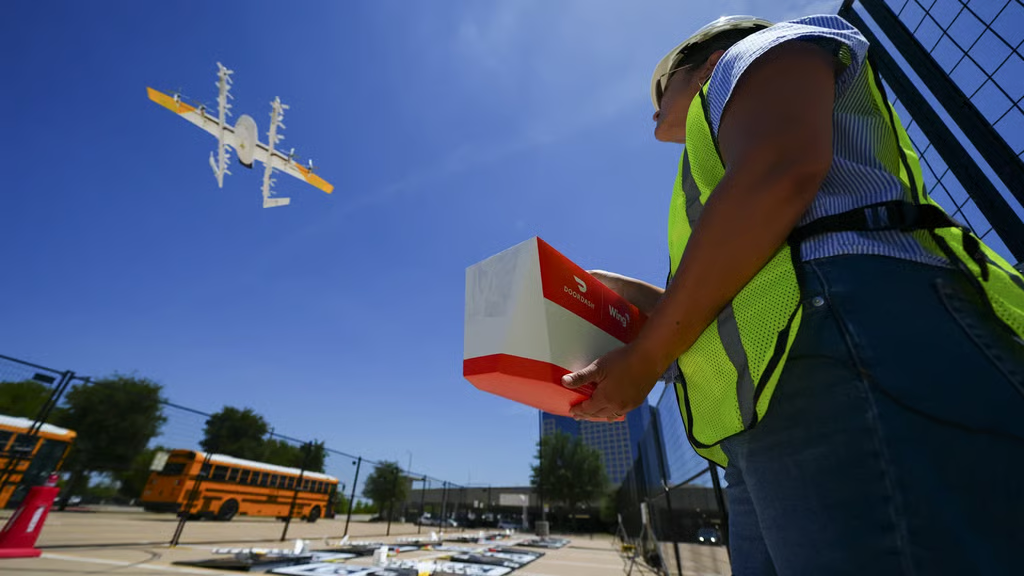


DoorDash is taking its delivery business into the skies after securing FAA approval to operate its own commercial drone service.
The company’s new initiative, DoorDash Air, makes DoorDash the eighth US drone operator to receive Part 135 air-carrier certification, according to Business Insider.
DoorDash plans to develop a custom aircraft and the supporting systems required to manage deliveries from merchant handoff to customer drop-off.
For now, the company will continue working with existing partners such as Wing and Flytrex, meaning the announcement expands DoorDash’s drone strategy rather than replacing its current partnerships, while also giving the company better control.
FAA approval comes with operating limits
The FAA approval clears the way for DoorDash to begin serving customers’ orders by air, with deliveries expected to launch in fall 2026, according to a DoorDash spokesperson cited by Business Insider.
The certification allows DoorDash to operate its own commercial drone-delivery program, DoorDash Air. But it does not give the company unrestricted access to the entire US airspace or mean every customer will be eligible; deliveries will initially be limited to approved service areas and suitable orders.
If and when the company decides to cover more airspace, TechCrunch says it will have to apply for additional approval for the drone’s Beyond Visual Line of Sight technology.
Control sits at the center of DoorDash’s move
For companies that operate in deliveries, ownership of their stack is critical to business success. And while DoorDash still partners with third-party providers for aerial delivery, competitors are already ahead in owning and approving the technology needed to make delivery efficient.
Amazon, for one, already has Beyond Visual Line of Sight technology, per TechCrunch, and in March this year launched a one-hour delivery service as part of an aggressive push for efficiency and speed.
While DoorDash already uses robots, the company is betting on air delivery as the next frontier for competitive relevance.
Doing so will not only enable DoorDash to gain greater logistics control but could also help drive expansion, increase revenue, and improve customer satisfaction.
A push into autonomous technology
DoorDash’s drone approval also follows the company’s efforts in tapping into the spirit of the times: automation.
The company already has a sidewalk robot called Dot, a fully autonomous four-wheeled machine that runs fully on electricity. The company positions the robot as a machine capable of traveling on various road types.
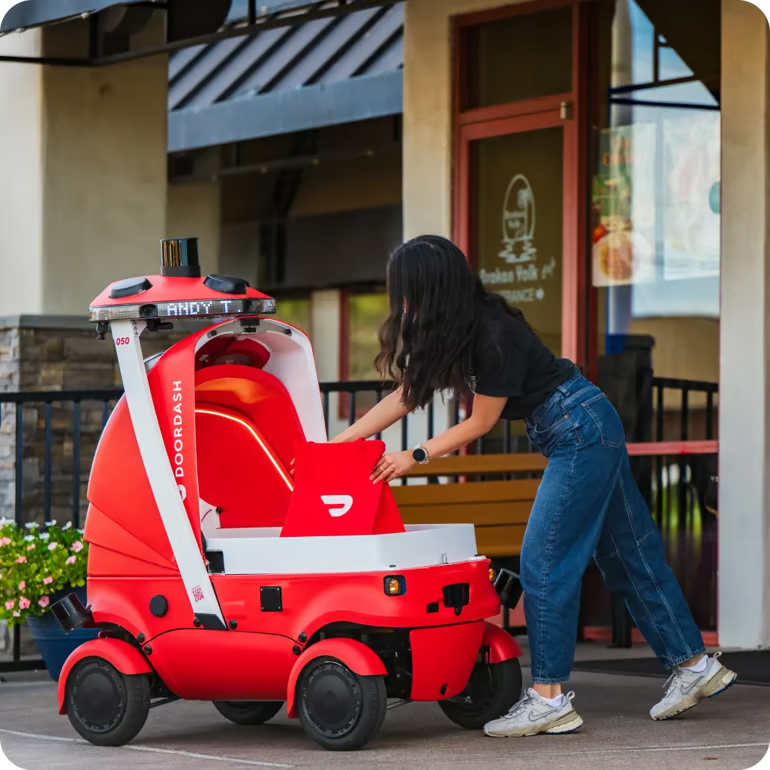
Alongside Dot, the company has also developed an internal autonomous software that, according to TechCrunch, is used by Dot and its human dispatchers, and will also power the soon-to-arrive in-house drones.
Where customers stand to gain
For customers, the clearest benefit is speed: Drone delivery could reduce delays for orders traveling 3 to 5 miles that would otherwise take 25% longer, the spokesperson said.
However, the benefit could initially be limited to eligible locations, lightweight orders, and likely homes with suitable drop-off areas.
Also read: Figure AI’s humanoid robots sorted nearly 50,000 packages during a roughly 40-hour autonomous warehouse demonstration.