


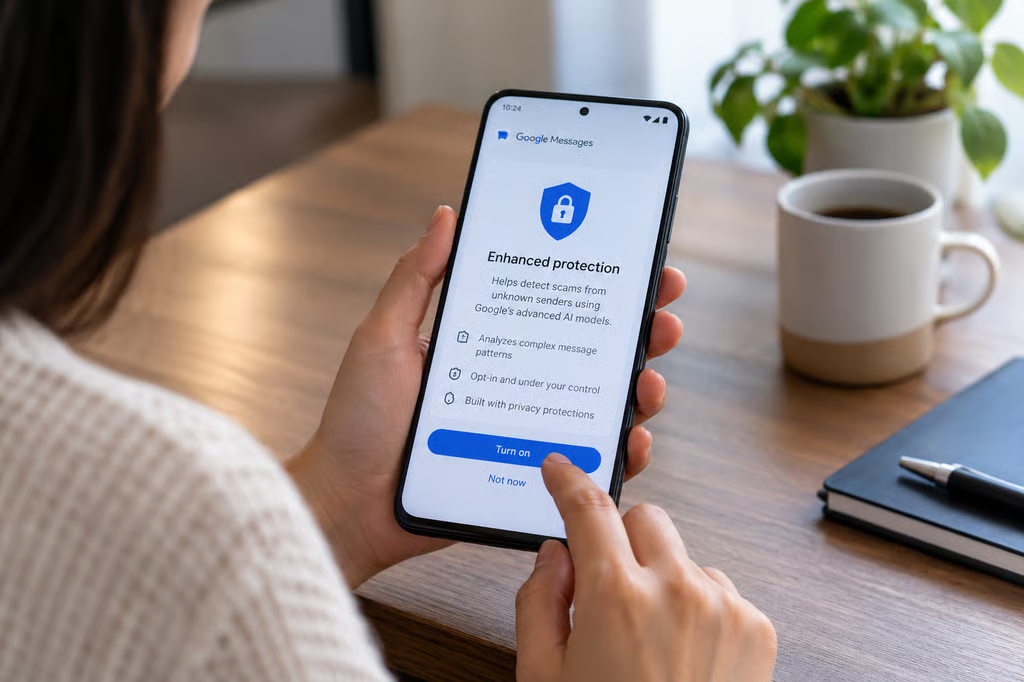
Google Messages is adding an optional Enhanced protection mode that sends conversation context from unknown senders to cloud-based Gemini models when looking for sophisticated scams.
Existing on-device Scam Detection remains in place. The privacy change is the additional cloud analysis: Google says it runs inside Private AI Compute with encrypted data that is inaccessible even to Google, but it has not disclosed exactly which parts of a conversation are sent for analysis.
| Google Messages protection | Where processing happens | What can leave the device? |
|---|---|---|
| Existing on-device Scam Detection | On the phone | Supported detection runs locally |
| Enhanced protection scam analysis | Private AI Compute in Google’s cloud | Google says “message context” is analyzed but does not specify the exact fields |
| Enhanced link checking | Gemini Nano on the phone plus real-time web signals | Link-related information is checked against web signals |
| Reporting a conversation as spam | Google systems | Reported message content and sender information can be sent to Google |
What Enhanced protection sends to Google’s cloud
According to Google’s Oct. 14 announcement, Enhanced protection uses its cloud Gemini models to analyze “complex message context” in conversations with unknown senders. The goal is to catch scams that develop across multiple messages instead of relying on an obviously malicious first text.
Google says the analysis takes place in Private AI Compute, where data is encrypted and processed inside a protected cloud environment. Google’s separate Private AI Compute documentation says remote attestation and encryption connect the device to hardware-secured infrastructure designed so the processed data is inaccessible to Google.
The documentation does not say whether Enhanced protection sends complete messages, selected excerpts, derived signals, sender identifiers, or another representation of the conversation. It also does not specify a retention period for the Messages data processed through the feature.
That distinction is important because Google Messages already has more than one privacy model for spam detection.
Google’s current spam-protection documentation says machine-learning models can identify spam on the device, but it can also ephemerally process the contents of unencrypted messages to detect spam. URLs in messages can also be uploaded to Google to check whether a link is malicious.
RCS conversations between Google Messages users are end-to-end encrypted when RCS is enabled. Google does not explain in its Enhanced protection announcement how the new Private AI Compute analysis interacts with that encryption or whether encrypted and unencrypted conversations are handled differently once a message has reached the recipient’s device.
End-to-end encryption therefore does not answer the new privacy question by itself. It protects message content while it travels between participants, while Enhanced protection adds an optional analysis step after Messages has access to the received conversation.
Google previously emphasized local processing when its Gemini-based scam detection expanded to Samsung Galaxy phones. Enhanced protection changes that model for users who opt in by adding cloud Gemini analysis rather than replacing the on-device layer.
Enhanced protection also adds a separate link-safety feature. Gemini Nano runs locally to evaluate unfamiliar links while incorporating real-time web signals. That is different from sending conversation context to Private AI Compute and should not be treated as the same type of processing.
Which phones get Enhanced protection?
Google says Enhanced protection will roll out over the coming weeks and must be enabled by the user.
Its announcement provides more compatibility detail than the initial description suggests. A footnote attached to the Private AI Compute protection lists:
- Google Pixel 6 and later
- Samsung Galaxy S24 series and later
- Galaxy Z Flip6 and later
- Galaxy Z Fold6 and later
- Other Android AICore devices
The new Gemini Nano link checks have narrower hardware requirements: Pixel 10 and later, Galaxy S26 series, Galaxy Z Flip8 and Z Fold8, and other select devices.
Android AICore itself requires Android 14 or later, although Google says feature availability varies by device and manufacturer.
That staggered compatibility follows Google’s earlier approach to Android scam and theft protections, where some capabilities arrived only on selected phones or Android versions.
Google has not published a country-by-country rollout list for Enhanced protection. It also has not documented an Android Enterprise or MDM policy that lets administrators require or disable this specific setting.
That is separate from Android’s Advanced Protection, which has its own security controls and enterprise support. Administrators should not assume policies for Advanced Protection automatically govern the similarly named Enhanced protection in Google Messages.
What users and IT teams should check before enabling it
For individual users, the first checkpoint should be the consent screen that appears when Enhanced protection becomes available. Google describes the mode as opt-in, so users can continue using the existing scam protections without enabling the new cloud analysis.
Organizations evaluating the feature on managed phones should verify:
- Whether Enhanced protection appears on each supported device and Messages build.
- What the in-app consent screen says about message processing.
- Whether RCS and SMS/MMS conversations behave differently.
- Whether an Android Enterprise or MDM control becomes available.
- Whether Google publishes more specific retention, processing-region, or audit documentation for the Messages implementation of Private AI Compute.
Reporting spam is another separate action. Google’s support documentation says reporting a conversation can send the spammer’s number and recent incoming messages to Google for review and model improvement. Users should not confuse that manual reporting path with automatic Enhanced protection analysis.
The distinction also separates Google’s approach from WhatsApp’s on-device AI scam alerts, which were introduced as local processing rather than cloud conversation analysis.
Enhanced protection gives Google Messages more context for detecting scams that unfold gradually, but opting in also changes where some analysis happens. Google has explained the security architecture protecting that cloud processing, while leaving the exact message fields, retention rules, regional processing details, and enterprise controls undocumented for now.
Also read: Apple is testing a malicious-message warning for iMessage as messaging platforms add more protections against scam content.