


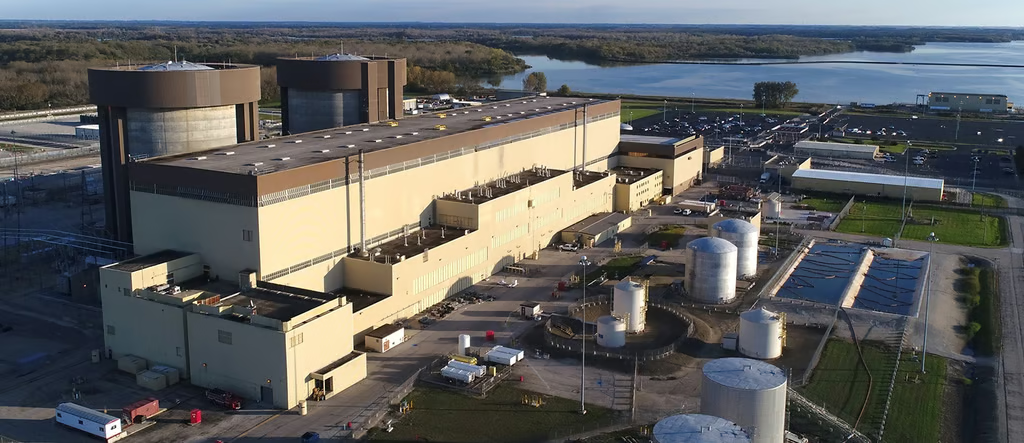
Google is turning to existing nuclear plants to secure more electricity for its expanding infrastructure. The company has signed a 20-year power purchase agreement with Constellation Energy that will support more than $4.3 billion in upgrades to 11 nuclear units across Illinois, Pennsylvania, and New Jersey.
The projects are expected to add 890 megawatts of new generating capacity to the PJM grid, with the first uprate due by 2028. Constellation plans to increase output from existing plants by upgrading turbines, steam generators, digital controls, and other equipment rather than building new reactors.
Under the agreement announced Oct. 6, Google will serve as an anchor customer, giving Constellation long-term revenue certainty for the upgrades. The deal comes as power and cooling constraints reshape AI infrastructure planning across the industry.
Google deal adds 890 MW of nuclear capacity
The upgrades will span six Constellation nuclear sites, and the company says the additional 890 MW will be entirely new capacity for PJM. The regional grid serves parts of 13 states and Washington, D.C.
Google says the full 890 MW should be available before the end of 2032. Its explanation of the nuclear projects says uprates can increase output from plants already connected to the grid rather than requiring construction of new reactors.
The companies also signed a separate 15-year energy supply agreement covering 2,700 MW of Constellation’s existing generation in PJM. That power is separate from the 890 MW of new capacity created through the uprates.
Constellation will also expand its use of Google Cloud and Gemini Enterprise under a five-year technology agreement. Planned uses include interconnection planning, asset monitoring, outage management, generation optimization, and security for operational technology networks.
AI growth puts more pressure on power supply
Google has tied the projects to the growth of its data centers, where increasingly dense AI infrastructure is driving electricity demand higher. U.S. grid data already shows local capacity and connection bottlenecks emerging where data centers can be built faster than new generation and transmission.
The International Energy Agency expects US electricity demand to rise by nearly 2% annually through 2030, with data center expansion accounting for about half of the increase. More AI accelerators and servers are increasing the need for generation and grid infrastructure alongside computing capacity.
The Constellation agreement is part of a wider nuclear strategy at Google. In October 2025, the company signed a separate 25-year agreement with NextEra Energy supporting the planned restart of Iowa’s 615-MW Duane Arnold Energy Center, which is targeted to return to service by the first quarter of 2029, pending regulatory approvals.
That project advanced on Sept. 8, 2026, when the US Department of Energy closed a loan of up to $1.9 billion to help finance the restart. Other AI infrastructure developers are also combining grid connections, generation, and storage as the race to secure data center power intensifies.
Electricity supply is increasingly becoming part of the AI infrastructure buildout itself. Hyperscalers are helping finance new generation rather than relying only on capacity already available on the grid.
Want to learn more AI tips, tricks, and prompting techniques? Let us teach you How to Talk to AI for free! Try our six-minute course at The Neuron Academy, our practical learning platform designed to help professionals use AI more confidently at work.
Learn a few simple ways to write better prompts and get more useful results from AI, or browse our other AI course for free for seven days. eWeek readers get free 7-day access. Check out all the lessons here →