
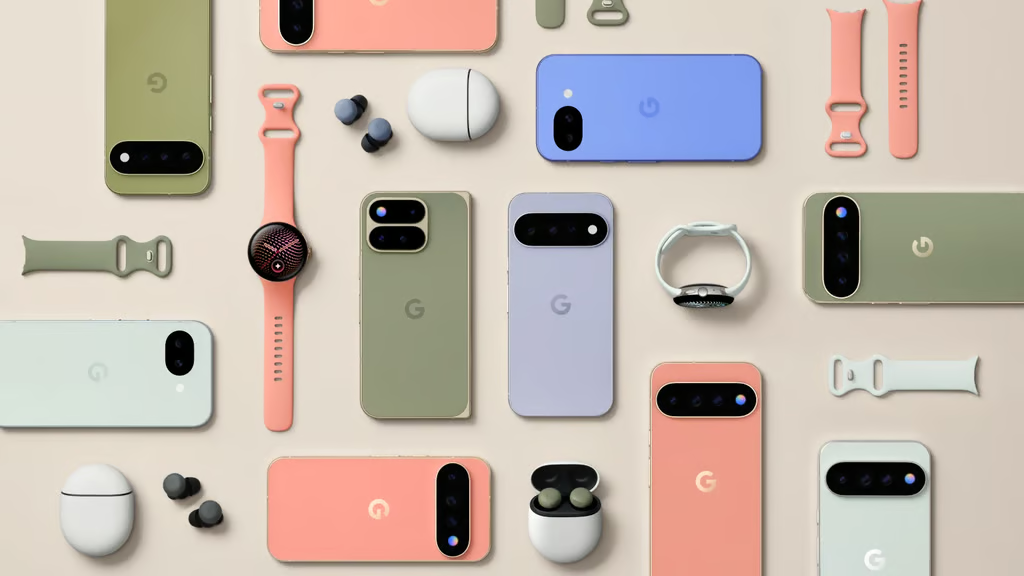


Google’s AI ambitions just got a new flagship.
At its Made by Google event on Aug. 12, Google unveiled the Pixel 11, Pixel 11 Pro, Pixel 11 Pro XL, and Pixel 11 Pro Fold alongside the Pixel Watch 5 and a new Pixel Tag tracker. According to WIRED’s roundup of everything announced at Made by Google 2026, the phones arrive Aug. 20, with prices ranging from $899 for the Pixel 11 to $1,900 for the Pixel 11 Pro Fold.
But hardware was only half the story. Google spent much of the event showing how Gemini can anticipate what users need, work across apps, handle tasks, translate content, and increasingly interact with the world on a user’s behalf.
Here are seven takeaways from Google’s latest Pixel launch and what they could mean for people deciding whether the Pixel 11 is worth an upgrade.
- 1. Gemini is becoming the operating layer of the Pixel
- 2. Tensor G6 is built around AI rather than benchmark bragging rights
- 3. Google is letting AI take a bigger role behind the camera
- 4. Pixel 11 prices are climbing
- 5. The Pixel 11 Pro Fold is better, but rivals are moving faster
- 6. Seven years of support is a game-changer
- 7. The real Pixel 11 question is how much control users want to give AI
1. Gemini is becoming the operating layer of the Pixel
The Pixel 11’s biggest upgrade may not be something users can see.
Google is positioning the new phones around Gemini Intelligence, its umbrella for AI features designed to provide more proactive and personalized assistance across Android. Google previously introduced the concept with Android 17, with newer Pixel and Samsung Galaxy devices among the first targeted for the features.
One example is “proactive assistance.” If someone sends a restaurant suggestion in a message, Gemini can surface relevant information without requiring the user to jump between apps. It can similarly recognize scheduling opportunities and connect with Google Calendar.
Google is also building on Gemini automation introduced earlier this year. TechRepublic previously covered the March 2026 Pixel Drop and its Gemini-powered task automation, which allowed Gemini to work in the background on tasks such as planning a grocery cart, booking a ride, or placing routine purchases.
The direction is notable: Google does not just want Gemini answering questions. It wants the assistant to recognize context, suggest the next action, and increasingly handle parts of that action for the user.
For readers unfamiliar with how deeply Google has already embedded its AI across products, TechRepublic’s Google Gemini cheat sheet covers Gemini’s expansion across Android, Workspace, Chrome, Search, and other Google services.
2. Tensor G6 is built around AI rather than benchmark bragging rights
Behind much of that AI push is Google’s new Tensor G6 processor.
Google says the chip is 20% more power efficient, delivers 25% faster browsing, and loads apps 15% faster than its predecessor. More importantly for Google’s AI strategy, the Tensor G6 includes a tensor processing unit that Google says is 50% more powerful.
Those figures are Google’s performance claims rather than independent benchmark results, but they illustrate what the company is prioritizing with its latest custom silicon.
The extra processing power is being used throughout the phone rather than confined to the Gemini assistant. Tensor G6 supports improvements to photography, translation, and other AI-assisted experiences.
That makes Google’s processor strategy increasingly clear. Tensor does not necessarily have to win a raw-performance arms race with Qualcomm or Apple if Google can use its own silicon to make its AI services noticeably more useful.
3. Google is letting AI take a bigger role behind the camera
Pixel phones have long used computational photography to improve images, but the Pixel 11 lineup pushes software further into the actual act of taking a photo.
One of the more unusual additions is Magic Capture. According to WIRED’s look at the Pixel 11’s new camera features, users can record up to a two-minute video while AI automatically identifies and captures photos during the recording. The idea is to let users stay focused on what is happening rather than continually operating the shutter.
Google is also adding Camera Looks and creator-oriented tools including a built-in teleprompter.
The Pro models get more aggressive upgrades. The Pixel 11 Pro and Pro XL include a 50-megapixel main camera, 48-megapixel ultrawide camera, and 48-megapixel 5X telephoto camera. Pro Zoom can reach up to 120X, with generative AI helping fill in detail in heavily zoomed images.
Google also says its new Instant Night Sight is 4.5 times faster, while the updated image signal processor enables 4K portrait video.
The trade-off is that the line between capturing an image and generating parts of one keeps getting blurrier. That could make Google’s approach especially interesting for professionals who care about when AI enhancement stops being correction and starts becoming creation.
4. Pixel 11 prices are climbing
The AI upgrades come with a less futuristic development: higher prices.
The Pixel 11 starts at $899, while the Pixel 11 Pro starts at $1,100, the Pro XL at $1,300, and the Pixel 11 Pro Fold at $1,900. The standard Pixel 11 and Fold are both $100 more expensive than their predecessors.
Google has at least increased base storage to 256 GB across the lineup, putting the entry-level storage configuration in line with other premium smartphones.
Still, these prices put Google firmly into premium-device territory.
That makes the purchasing question tougher. A Pixel is no longer automatically the relatively inexpensive alternative to an iPhone or Galaxy flagship. Buyers increasingly have to decide whether Google’s AI-first software experience is valuable enough to justify flagship-level pricing.
5. The Pixel 11 Pro Fold is better, but rivals are moving faster
Google’s foldable received several improvements, including a lighter body, thinner design, brighter displays, and a redesigned hinge.
The Pixel 11 Pro Fold weighs 239 grams, roughly 10% less than its predecessor. Google also claims the device is three times more durable than the previous model, though that is a manufacturer claim rather than the result of independent durability testing.
That does not necessarily make it the foldable to beat.
In an early hands-on with the Pixel 11 Pro Fold, Engadget found that Google’s foldable remains relatively heavy and thick compared with Samsung’s latest designs. The Pixel measures 10.1 mm thick when folded and weighs 239 grams.
At $1,900, incremental improvements become harder to overlook.
The Fold nevertheless gains one particularly interesting AI capability: American Sign Language translation. Using its camera, the phone can view someone signing and translate the interaction into text, a feature that could make the Fold’s dual-screen design particularly useful for face-to-face communication.
6. Seven years of support is a game-changer
Flashier AI demonstrations may dominate Google’s marketing, but one quieter feature matters considerably for organizations managing mobile devices: longevity.
Google says the Pixel 11 family will receive seven years of software updates. That long support window could make the Pixel 11 easier to justify for organizations with longer device replacement cycles, particularly when security support and OS compatibility are part of purchasing decisions.
Pixel devices also continue to serve as Google’s first landing zone for major Android releases. As TechRepublic reported when Android 17 rolled out to Pixel devices, organizations using phones from Samsung, Xiaomi, OnePlus, Motorola, and other manufacturers face separate OEM timelines, beta programs, and application-testing considerations.
For IT teams, predictable software support and Google’s control over both Android and Pixel hardware may ultimately matter more than 120X zoom or another AI photography feature.
7. The real Pixel 11 question is how much control users want to give AI
The most important theme from Made by Google was not any individual phone.
Google is assembling an ecosystem in which AI increasingly moves between devices and services on the user’s behalf. That extends beyond the Pixel 11 to Google’s wider hardware lineup.
The new $29 Pixel Tag, for example, connects to Google’s Find Hub network and supports ultra-wideband precision tracking. Users can locate it through compatible Android and Wear OS devices or ask Gemini about its location through Pixel Buds. Google says the tracker will arrive Nov. 11.
The Pixel 11 sits at the center of that increasingly connected system.
For buyers, that means the decision is becoming less about comparing processor speeds or camera megapixels and more about choosing an AI ecosystem. Someone already relying heavily on Gmail, Calendar, Maps, Gemini, Android, and other Google services may see substantially more value in a Pixel 11 than someone who treats their phone primarily as a collection of independent apps.
For business and IT users, there is another layer to consider. Features that proactively interpret conversations, pull information between apps, and automate actions can save time, but they also make permissions, data access, privacy controls, and AI governance more important.
That may be the biggest takeaway from Google’s latest hardware event. The Pixel 11 is not simply asking whether you want a better phone. Google is asking how much of what you do on that phone you are comfortable letting AI understand, anticipate, and eventually do for you.
Related reading: For more on Google’s AI-first smartphone strategy, see how the Pixel 11 puts Gemini and new AI features at the center of the experience.