


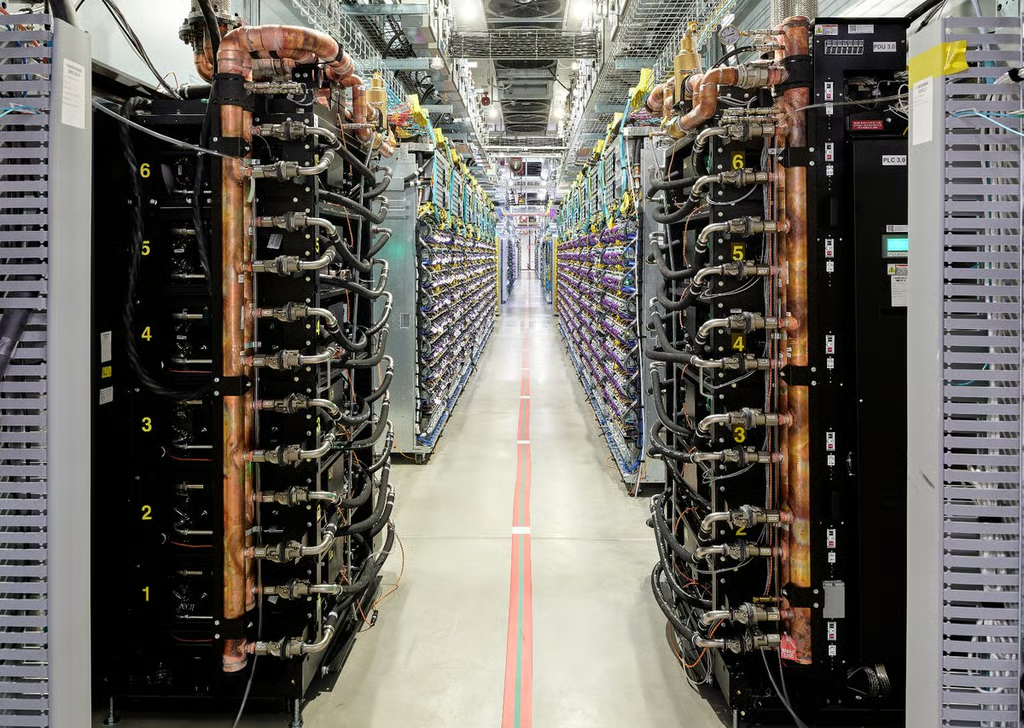
Google’s latest AI infrastructure move runs through SpaceX: a compute agreement worth about $30.4 billion if it reaches its full term. Google has agreed to pay SpaceX $920 million per month from October 2026 through June 2029 for access to about 110,000 Nvidia GPUs, CPUs, memory, and related components, SpaceX disclosed in an SEC filing.
For cloud buyers, the practical question is whether the capacity will improve access to Google Cloud GPU resources. Google has framed the deal as bridge capacity for Gemini Enterprise demand, but it has not said whether the agreement will expand broader Google Cloud infrastructure offerings.
What Google is buying from SpaceX
The agreement is described in the SpaceX SEC filing as a cloud service agreement for compute capacity. It confirms an AI compute purchase, but it does not say that enterprise customers can buy the SpaceX-backed capacity directly.
Capacity ramps through September 2026 at a reduced fee before full monthly payments begin in October. If SpaceX misses the committed GPU amount by Sept. 30, 2026, after a one-month grace period, Google can terminate the agreement or accept fewer GPUs at a reduced fee. After Dec. 31, 2026, either party can terminate with 90 days’ notice.
Google also keeps ownership and intellectual property rights over its content, AI models, and related data.
Key details remain undisclosed, including hardware location, dedicated or shared access, service-level commitments, per-GPU pricing, and how the compute will be split between internal AI work and customer-facing cloud services. Those gaps matter because data location and latency can shape GPU efficiency.
Google told Business Insider the deal is bridge capacity for Gemini Enterprise, its agentic AI platform. As enterprise vendors build more complete AI agent stacks, demand for compute, context, tools, runtime, and governance infrastructure is becoming a larger capacity-planning issue. That does not necessarily mean buyers will see immediate changes in Google Cloud GPU availability.
What cloud buyers should watch
Procurement teams should treat the deal as a signal to monitor, not a reason to change cloud strategy. The key question is whether Google turns the SpaceX capacity into more GPU inventory for cloud customers, keeps it focused on Gemini Enterprise, or uses it mainly for internal AI development.
If Google routes the capacity into commercial cloud services, buyers should watch which regions, GPU-backed products, pricing tiers, and committed-use terms are affected, especially as more enterprises rethink where AI workloads should run.
The broader concern is capacity concentration: large AI buyers are locking up compute outside standard cloud marketplaces, though the filing does not show whether this deal will affect ordinary cloud customers.
The deal also fits SpaceX’s broader AI infrastructure story. Its separate Anthropic agreement reinforces that SpaceX is selling large compute blocks rather than a self-service cloud product.
Until Google says how the capacity will be used, cloud teams should treat the agreement as another sign of AI compute pressure — not a guarantee that GPU access will improve.
Also read: Microsoft’s reported Copilot super app shows how AI platforms are becoming full work environments.