
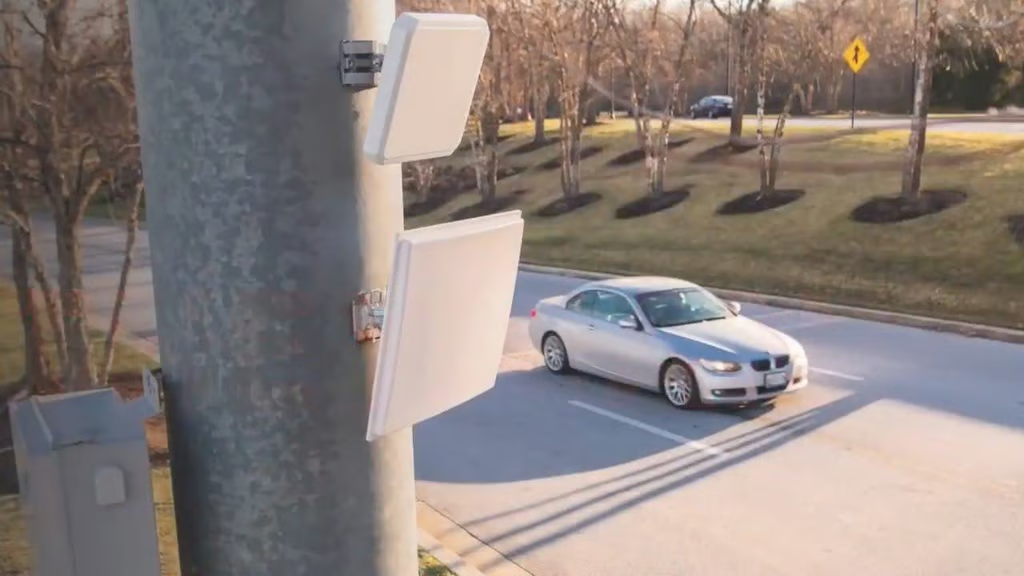


Roadside cameras are no longer just watching cars. Your device is next in line.
Defense contractor Leonardo has begun marketing SignalTrace, its upgraded Automatic License Plate Reader (ALPR) system that adds wireless sensing capabilities, enabling law enforcement to record nearby smart device identifiers alongside vehicle information. The company says aggregated observations will enable investigators to identify crime suspects more effectively.
The approach broadens what roadside surveillance networks can collect without changing how license plate readers operate. The technology brings its own caveats, too, from potential security implications to privacy concerns; it will have to prove that the advantages outweigh these worries.
New features coming with SignalTrace
According to 404 Media, SignalTrace adds a second layer of intelligence to existing license plate reader networks by combining vehicle detections with nearby Bluetooth, Wi-Fi, and Radio Frequency Identification (RFID) broadcasts.
By detecting these wireless signals, SignalTrace can identify a wide range of devices, including smartphones, AirPods, smartwatches, tire-pressure sensors, employee badges, and even pet microchips.
The result is a richer investigative record than conventional ALPR systems provide. For example, rather than simply showing where a vehicle has traveled, the system can indicate that Vehicle ABC123 consistently travels with Bluetooth Device X, RFID Device Y, and Wi-Fi Device Z.
According to Leonardo, this helps investigators identify recurring patterns.
Privacy concerns looming
A technology with the level of capability Leonardo has marketed comes with privacy concerns. Apple Insider says privacy advocates have yet to raise concerns about SignalTrace. That’s likely because the technology is new. However, similar surveillance systems, even without SignalTrace’s expanded capabilities, have been criticized in the past.
Reports that more than 50 law enforcement agencies used automated license plate reader data to track activists across the US also highlight the scrutiny that SignalTrace could face.
Leonardo says SignalTrace does not decrypt or read data stored on the devices it detects. Instead, the system captures wireless signatures, classifies them by device type, associates them with nearby vehicles, and stores the resulting records for investigators.
More connected systems, more opportunities for attackers
Beyond privacy and tracking, SignalTrace may also inherit many of the cybersecurity risks associated with connected surveillance infrastructure.
In 2024, the US Cybersecurity and Infrastructure Security Agency (CISA) warned of multiple vulnerabilities affecting Motorola Solutions’ Vigilant License Plate Reader Manager. Exploiting the flaws could allow attackers to tamper with devices, access sensitive information and credentials, or disrupt system operations.
While the advisory did not involve Leonardo’s previous ALPR system, it illustrates how such systems can be vulnerable and become more attractive targets for cyberattacks.
Whether SignalTrace sees widespread adoption may depend not only on how effectively it helps solve crimes but also on how agencies address the legal, operational, and technical questions that accompany increasingly data-rich surveillance systems.
For now, most people are unlikely to encounter SignalTrace, but that could change if law enforcement agencies adopt the upgrade.
Also read: For another look at how third-party integrations can expose sensitive data, read our coverage of the LastPass breach tied to compromised Klue OAuth tokens that gave attackers access to Salesforce customer information