
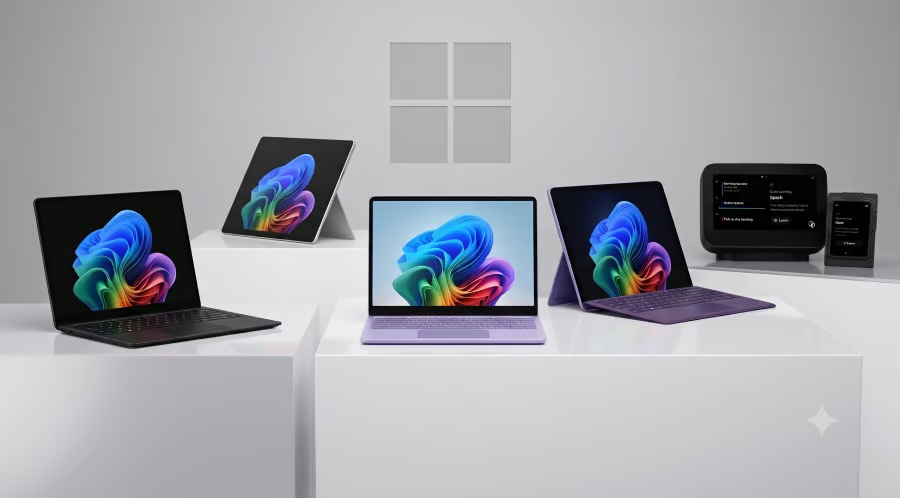


Microsoft’s 2026 hardware releases center on practical Surface upgrades, with Project Solara adding an early look at how work devices might change next.
So far this year, Microsoft’s hardware updates have focused on work devices for different kinds of buyers: people who need stronger business PCs, users who want a lower-cost Surface option, and workplaces watching how AI may change the devices employees use day-to-day.
Some of these releases are available now, while Solara is still a concept, but together they show Microsoft balancing today’s PC needs with early ideas for the future of work.
Note: The pricing and product availability information is accurate at the time of publication.
- Surface Laptop for Business (8th Edition): Best for everyday work
- Surface Pro 12th Edition for Business: Best for flexibility
- 8GB Surface Laptop 13-inch: Best lower-cost laptop option
- 8GB Surface Pro 12-inch: Best lower-cost tablet pick
- Project Solara: Best for future workplace hardware
- What Microsoft’s 2026 hardware lineup says so far
Surface Laptop for Business (8th Edition): Best for everyday work

The Surface Laptop for Business, 13.8- and 15-inch, is the most traditional release in Microsoft’s 2026 Surface lineup. It keeps the familiar laptop design but adds Intel Core Ultra Series 3 processors, Wi-Fi 7, Bluetooth 5.4, and up to 23 hours of battery life for people who need a dependable work laptop.
Microsoft offers the device in 13.8- and 15-inch models, with the 15-inch version getting a sharper display. It also supports up to three 4K external monitors via compatible docks, which helps if you want one laptop that can move between travel, meetings, and a full-desk setup.
Price: Starts at $1,949.99
Surface Pro 12th Edition for Business: Best for flexibility

Surface Pro for Business, 13-inch (12th Edition) is Microsoft’s 2026 Surface release for people who want laptop performance in a tablet-style device. It uses Intel Core Ultra Series 3 processors and retains the built-in kickstand, so users can switch between keyboard work, pen input, touch input, and video calls without carrying a separate tablet.
The 13-inch PixelSense touchscreen supports up to a 120Hz refresh rate, with an optional anti-reflective OLED display. Microsoft also lists optional 5G, all-day battery life, an ultrawide front camera, and a high-resolution rear camera, making this one of the more flexible Surface choices for mobile work.
Price: Starts at $1,949.99
8GB Surface Laptop 13-inch: Best lower-cost laptop option

The 8GB Surface Laptop 13-inch is a 2026 configuration release, not a brand-new Surface Laptop generation. It gives buyers a lower-cost version of Microsoft’s lightest Surface Laptop, with the same 13-inch touchscreen design and Snapdragon X Plus processor, but with 8GB of RAM instead of 16GB.
Microsoft says the 8GB model is meant for everyday tasks like browsing and productivity, while the 16GB version is better for smoother multitasking, more demanding apps, and Copilot+ PC experiences. The 8GB version is a better fit for lighter work, school, and basic productivity than for buyers who need more memory headroom.
Pricing: Starts at $949.99
More Microsoft news
- Inside Microsoft’s Real-Time War Against Cybersecurity Threats
- Project Ire: Microsoft Tests AI That Autonomously Detects Malware
- Microsoft Targets ‘Critical AI Talent’ from Meta to Dominate Next AI Breakthroughs
- Windows 10 Support Ends Soon, Though Extended Security Updates Offers Are Available
8GB Surface Pro 12-inch: Best lower-cost tablet pick

The 8GB Surface Pro 12-inch is the budget-friendlier way to get the Surface Pro form factor in Microsoft’s 2026 lineup. The main reason to choose it over the Surface Laptop is the design. You can use it as a tablet, add the Surface Pro 12-inch Keyboard when you need a laptop-style setup, or pair it with the Slim Pen for writing and drawing.
This model still has the same memory tradeoff as the 8GB Surface Laptop, so it is not the best choice for heavy multitasking or demanding apps. It works better for buyers who want a portable Windows device for reading, notes, browsing, video calls, and light productivity.
Pricing: Starts at $849.99
Project Solara: Best for future workplace hardware

Project Solara is not available to buy yet, but it is Microsoft’s clearest 2026 preview of where workplace hardware could go next. Microsoft describes it as a platform for agent-first devices, with two early concepts: a wearable badge and a desk device.
Badge concept device
The badge concept is a lightweight wearable designed for workers who need quick access to their agents throughout the day. Microsoft says the device includes a touchscreen, fingerprint sensor, privacy switch, volume controls, far-field microphone array, speaker, side-facing camera, Wi-Fi, Bluetooth, GNSS, 5G, and Qualcomm wearable silicon.
The idea is to give workers a small device they can glance at, tap, or use to capture a hallway conversation. With user permission, the built-in camera can also help the agent understand what the worker is seeing.
Desk concept device
The desk concept is designed for people who spend much of their day at a workstation.
Microsoft says it includes a touchscreen, face authentication, privacy lock buttons, microphone mute and volume buttons, dual far-field microphones, a speaker, UWB presence sensor, two USB-C ports, Wi-Fi, Bluetooth, and MediaTek IoT silicon.
The desk device can operate on its own, pair with a Windows PC, or function as a Windows 365 client when connected to an external display. Microsoft says it can also hand off tasks between devices and keep lock state consistent when paired with a PC.
Microsoft has not announced retail pricing for Project Solara devices.
What Microsoft’s 2026 hardware lineup says so far
Microsoft’s 2026 hardware releases are mostly about sharper Surface choices. The business-focused Surface Laptop and Surface Pro models sit at the higher end, while the 8GB Surface Laptop and Surface Pro configurations offer cheaper entry points with clear memory trade-offs.
Project Solara adds the more experimental piece. It is not ready for buyers yet, but it shows Microsoft testing workplace hardware beyond the usual laptop and tablet refresh cycle.