


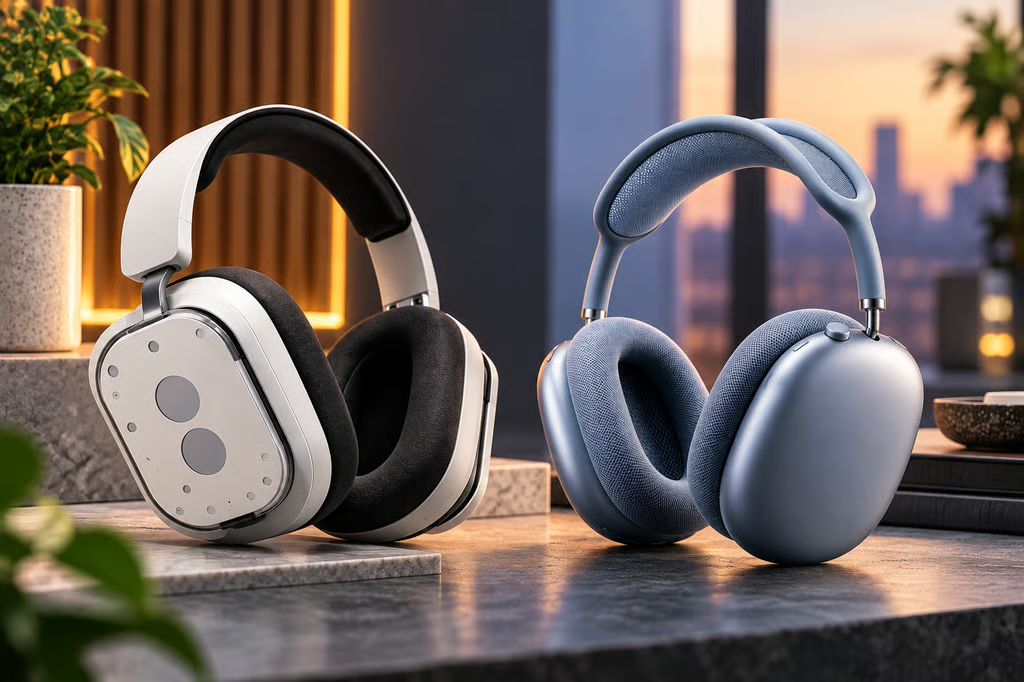
Nothing’s Headphone (1) Pro costs $399, putting it $150 below Apple’s $549 AirPods Max 2. Both are premium over-ear headphones with active noise cancellation, spatial audio, and USB-C listening, but they take very different approaches.
Nothing leans into flexibility with LDAC, Auracast, a 3.5mm jack, 24-bit/192kHz USB-C audio, a full parametric EQ, and much longer claimed battery life. AirPods Max 2 counter with stronger tested noise cancellation and much deeper integration with iPhone, iPad, and Mac.
- Nothing Headphone (1) Pro vs AirPods Max 2 at a glance
- How we compared
- Sound and customization: Nothing gives you more control
- ANC: AirPods Max 2 have the advantage
- Wired audio and connectivity: Nothing is much more flexible
- Battery life: Nothing lasts much longer on paper
- Comfort and build: Nothing is lighter, but fit matters
- Price and value: Nothing saves $150
- Nothing Headphone (1) Pro vs AirPods Max 2: Which should you buy?
Nothing Headphone (1) Pro vs AirPods Max 2 at a glance
| Feature | Nothing Headphone (1) Pro | AirPods Max 2 |
|---|---|---|
| Price | $399 | $549 |
| Weight | 327g | 386.2g |
| Bluetooth | Bluetooth 6.1 | Bluetooth 5.3 |
| Wireless codecs | SBC, AAC, LDAC; LC3 for Auracast | SBC, AAC |
| Wired audio | USB-C, 3.5mm | USB-C |
| USB-C lossless | Up to 24-bit/192kHz | Up to 24-bit/48kHz |
| Battery with ANC | Up to 30 hours | Up to 20 hours |
| Water resistance | IP52 | No IP rating listed |
| Spatial audio | ✔ | ✔ |
| Best for | Android, mixed-device setups, EQ control, wired audio, value | Apple ecosystem, ANC, automatic switching, Apple Intelligence features |
Official US pricing checked Oct. 6, 2026. Retailer prices may differ.
How we compared
We used Nothing and Apple’s current US product information for pricing, connectivity, battery claims, wired-audio support, platform features, and technical specifications.
Independent testing from SoundGuys informed the Headphone (1) Pro’s ANC, fit, sound, and connectivity assessment. SoundGuys also independently tested AirPods Max 2, including battery life and ANC, which lets us compare the two without relying only on manufacturer claims.
We also considered hands-on findings from The Verge and other recent reviews where they add useful context around comfort, Flat EQ, and how Nothing’s ANC compares with established premium headphones. Manufacturer battery claims are kept separate from measured results where an independent test is not yet available.
Sound and customization: Nothing gives you more control
The Nothing Headphone (1) Pro uses three drivers in each ear cup: a 40mm bass driver, a separate precision midrange driver, and an xMEMS treble driver.
The unusual hardware is paired with unusually deep software controls. Nothing X offers a full parametric EQ, Personal Sound, spatial audio with head tracking, and downloadable EQ presets.
There is also a physical Flat EQ switch developed with Metropolis Studios. It bypasses the regular EQ and spatial processing for a more neutral presentation aimed partly at creators and studio use.
SoundGuys found the stock sound generally good, although fit and positioning affected its measurements more than expected. The review noted that a poor seal could change both bass response and noise cancellation.
AirPods Max 2 take a simpler approach. Apple’s H2 chip handles the headphones’ computational audio features, while Apple provides Adaptive EQ and Personalized Spatial Audio rather than a user-facing parametric EQ.
That makes Nothing much better suited to listeners who want to tune the headphones themselves. Apple is the easier choice for buyers who would rather let the system manage most of the processing automatically.
ANC: AirPods Max 2 have the advantage
Nothing has improved ANC significantly, but Apple’s headphones remain stronger.
SoundGuys rated the Headphone (1) Pro’s ANC at 8.7 out of 10 and measured total average attenuation of 87.4% with ANC enabled. The review also found the result could change when glasses, hair, or movement weakened the ear-cup seal.
SoundGuys gave AirPods Max 2 a higher ANC score of 9.0. Its testing found the headphones attenuated about 89.4% of unwanted outside noise by perceived loudness, with particularly noticeable improvements through the midrange compared with the original AirPods Max.
The Verge similarly placed Nothing behind AirPods Max 2, Bose QuietComfort Ultra Gen 2, and the Sony WH-1000XM6 for noise cancellation.
The gap is not enormous, but frequent flyers and commuters who prioritize maximum noise reduction have the stronger case for Apple.
Wired audio and connectivity: Nothing is much more flexible
Nothing supports Bluetooth 6.1 with SBC, AAC, and LDAC for music playback. It can connect to two devices at once and also supports Auracast for receiving or broadcasting compatible Bluetooth LE Audio streams.
The headphones work over both USB-C and a traditional 3.5mm cable. USB-C playback supports lossless audio up to 24-bit/192kHz, while the analog input gives Nothing compatibility with equipment that does not use Bluetooth or USB audio.
AirPods Max 2 use Bluetooth 5.3 with SBC and AAC. USB-C supports wired lossless playback up to 24-bit/48kHz, but there is no 3.5mm input or LDAC support.
Apple’s advantage appears when its headphones are paired with Apple hardware. AirPods Max 2 can move between compatible devices tied to the same Apple Account and gain features such as Adaptive Audio, Conversation Awareness, Siri interactions, Voice Isolation, and Live Translation.
Live Translation requires a compatible Apple Intelligence-enabled iPhone and is available only in supported languages and regions.
For Android users or anyone regularly switching between different platforms, Nothing offers the broader set of conventional audio connections. For an all-Apple setup, AirPods Max 2 provide tighter software integration.
Battery life: Nothing lasts much longer on paper
Nothing rates the Headphone (1) Pro for up to 30 hours with ANC enabled and 68 hours with ANC off when using AAC.
With LDAC, those figures fall slightly to 28 hours with ANC and 53 hours without it.
SoundGuys had not completed its standardized battery test on the Nothing headphones at the time of its latest review, so those figures remain manufacturer estimates.
Apple rates AirPods Max 2 for up to 20 hours with ANC enabled. Unlike Nothing, that claim has already been independently tested.
SoundGuys measured 21 hours and 31 seconds with ANC on and music playing at 75dB SPL, putting Apple’s real-world test close to its advertised number.
Nothing therefore has the clear specification advantage, but a direct measured battery comparison will need to wait until independent testing of the Pro model is complete.
Comfort and build: Nothing is lighter, but fit matters
Nothing’s headphones weigh 327g, almost 60g less than the 386.2g AirPods Max 2.
The Headphone (1) Pro also uses softer dual-layer ear cushions and a wider padded headband than the original Headphone (1). SoundGuys found the headphones comfortable overall, but also encountered fit issues that could weaken the acoustic seal.
AirPods Max 2 remain heavy for wireless headphones, but their mesh headband spreads that weight across the top of the head. SoundGuys rated their comfort highly despite criticizing the overall mass.
Nothing also carries an IP52 rating for dust and limited water exposure. That should not be confused with sweat-proofing or workout-focused protection.
Apple does not list an IP water-resistance rating for AirPods Max 2.
Price and value: Nothing saves $150
Nothing currently sells Headphone (1) Pro for $399 in the US, while Apple lists AirPods Max 2 at $549.
Nothing gives you more connectivity and customization for less money: LDAC, Auracast, a 3.5mm input, higher-resolution USB-C playback, advanced EQ controls, and a considerably higher battery claim.
The $399 price also places Nothing squarely in a crowded premium tier, with several strong over-ear alternatives competing in the same general price range.
Apple’s extra $150 is easier to justify if the headphones will spend most of their time connected to an iPhone, iPad, or Mac. Automatic switching and Apple-only features reduce some of the friction that mixed-platform buyers would not benefit from.
Nothing Headphone (1) Pro vs AirPods Max 2: Which should you buy?
Buy Nothing Headphone (1) Pro if you want:
- To save $150.
- LDAC and Auracast.
- USB-C audio up to 24-bit/192kHz.
- A 3.5mm wired connection.
- A full parametric EQ and Flat EQ mode.
- Longer claimed battery life.
- Better flexibility across Android, Apple, and other devices.
Buy AirPods Max 2 if you want:
- Stronger tested ANC.
- Tight integration with iPhone, iPad, and Mac.
- Automatic device switching in the Apple ecosystem.
- Adaptive Audio and Conversation Awareness.
- Live Translation and other Apple Intelligence features.
- Independently verified battery performance close to Apple’s 20-hour claim.
Nothing Headphone (1) Pro is the better value for most buyers who care about audio flexibility. It costs less, supports more connection options, gives you much deeper control over EQ, and promises substantially longer battery life.
AirPods Max 2 make more sense for people who are already heavily invested in Apple hardware. Their ANC is stronger in current testing, and features such as automatic switching, Adaptive Audio, and Live Translation work together in a way Nothing cannot fully reproduce outside Apple’s ecosystem.
Also read: If you are considering smaller Apple alternatives, the best AirPods Pro 3 alternatives for 2026 compare Sony, Bose, Samsung, CMF, and Sennheiser on ANC, battery life, comfort, and platform support.