


Every major shift in computing has eventually been scaled through open standards. Ethernet won the network, Linux won the data center, and Kubernetes won cloud-native applications, not because they were always the best technology on day one, but because they enabled an entire industry to build in parallel. AI infrastructure is now reaching that same inflection point, and this week’s Open Compute Project (OCP) Global Summit in San Jose made that clear.
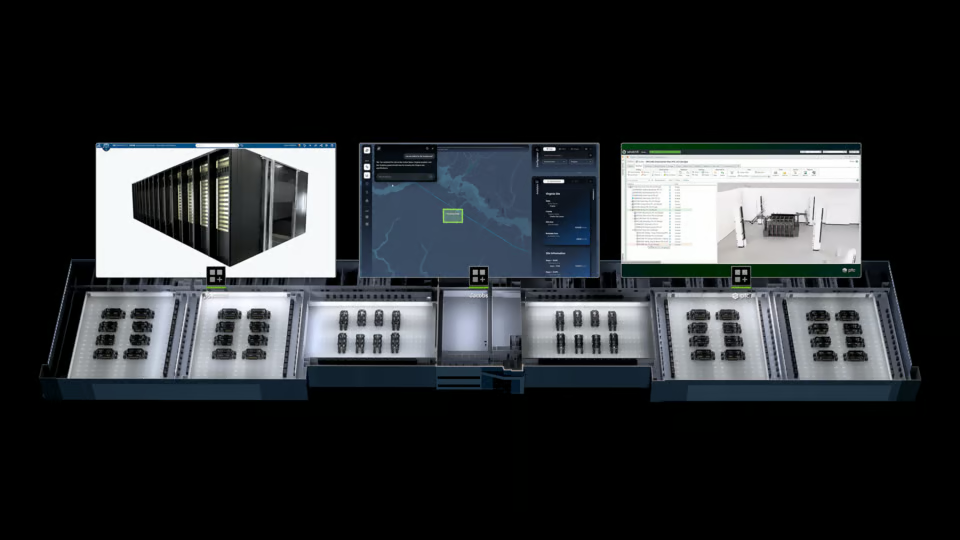
The strongest proof point came from Nvidia, whose announcements at the show focused on contributions to open ecosystems. The company contributed its Vera Rubin rack and compute tray designs to OCP through its MGX architecture, released open-source software for its DSX AI factory platform, co-authored facility and grid standards with the hyperscalers, and teamed with Cisco on a new multi-source optics form factor.
The reason is simple: AI infrastructure has grown so large, so power-hungry, and so physically complex that no single company, whether a vendor or a hyperscaler, can build it alone. Openness has shifted from a philosophical argument to an engineering and supply-chain requirement. When the industry is building facilities measured in gigawatts, the bottlenecks extend beyond GPUs to the infrastructure around them.
What Nvidia actually opened
The headline contribution is the MGX 1.2 specification for Vera Rubin. According to Nvidia’s OCP announcement, it adds rack-scale blind-mate liquid cooling, interoperable rack-scale interconnect infrastructure, a liquid-cooled 5,000A busbar, native 19-inch equipment support, and fanless liquid-cooled compute trays that support racks of up to 250kW.
The facility-level news may matter even more. Nvidia highlighted the Open Data Center Specification v0.7, a blueprint for AI factory power, cooling and physical layout authored with AMD, Google and Meta. Google, Meta, Microsoft and Nvidia also published an OCP Grid Resilience Specification that defines how computational loads should respond to specified utility disturbances, including returning to 90% of pre-fault load within two seconds after voltage returns to the specified normal range. Manufacturers now have a common target to build to without waiting for proprietary specifications from individual customers, which is really the crux of scaling AI today.
Power gear, cooling systems, and switchgear have long lead times. If every hyperscaler and neocloud specifies its own design, suppliers can’t build ahead of demand, and the entire industry moves at the pace of the slowest custom order. Open specs let the supply chain scale in parallel. On the software side, Nvidia released open-source DSX OS components drawn from its DGX Cloud experience, including Config Manager for automating switch configurations and a Cluster Readiness Engine that stress-tests GPU clusters before training begins.
The network is where openness matters most
The network is where AI openness is tested in production. Meta is adopting Nvidia’s Spectrum-6 102.4Tb/s Ethernet switches in a new switch called N-IceCube, which runs Meta’s open-source FBOSS network operating system on the OCP Switch Abstraction Interface. “Extending FBOSS to Spectrum ASICs means we can run that same software stack across our fabrics,” said Omar Baldonado, senior director of data center and AI networking at Meta, in Nvidia’s announcement. That’s the real value of disaggregation: The operator owns the operating model, and the silicon becomes a choice rather than a commitment.
Nvidia and Google also announced that future ConnectX-10 SuperNICs and BlueField DPUs will support Google’s Falcon transport, enabling Nvidia and Google NICs to communicate over a common transport while applications retain standard RDMA interfaces. Nvidia’s planned support for Google’s Falcon transport is a meaningful signal from a company that has long favored its own stack.
Then there’s USFP, the Ultra-Dense Small Form Factor Pluggable, which Nvidia and Cisco are developing together. Cisco says USFP is expected to deliver four times the bandwidth density and 1.3 times the power efficiency of 200Gb/s-per-lane optics, while maintaining the serviceability of today’s pluggables. The two companies are working with TE Connectivity and Amphenol and plan to drive USFP through a community-led multi-source agreement. I like the evolutionary path. AI operators have enough new things to learn without rethinking how they swap a failed optic.
Cisco’s broader OCP news reinforced the theme. Microsoft has moved to production with Cisco Silicon One P200-based systems, and Alibaba has deployed its in-house router, built on the P200 and running SONiC, across its eCORE backbone. “This combination proves the true value of open networking,” said Dennis Cai, head of network infrastructure at Alibaba Cloud, in Cisco’s release.
Open doesn’t mean neutral
Here’s where it’s important to add a dose of realism. Every vendor at OCP is open where openness grows the market and proprietary where it captures value. Nvidia is opening the rack, the power architecture, the facility, and the optics, the layers that speed the deployment of more Nvidia GPUs. The accelerator and the software ecosystem that make it perform remain Nvidia’s. That’s not a criticism; it’s a smart strategy. Cisco is playing a similar game by opening its silicon to SONiC and white-box builders so it can sell to customers who will never buy a full Cisco stack.
For buyers, the practical question isn’t whether a vendor is “open.” It’s which layers are open, who governs the specification, and whether you could realistically swap a component without re-architecting. A standard governed by a multi-vendor community under OCP is very different from a reference design published and controlled by a single company.
Also, most enterprises won’t build 250kW racks or 100,000-GPU fabrics, but they will consume the results. Today’s hyperscaler specs become the colocation designs, neocloud offerings, and on-premises reference architectures that enterprises buy in a few years. Other efforts, including AMD’s Helion open rack design, give buyers additional approaches to evaluate.
Recommendations for IT pros
For IT pros, these announcements offer a reason to ask more specific questions before buying hardware or leasing AI capacity. Start by checking where your stack depends on a single supplier, what alternatives are supported, and who takes responsibility when components from different vendors need to work together.
- Map your openness by layer. Inventory your AI stack, including facility, power, rack, network fabric, network operating system (NOS), network interface card (NIC) transport, orchestration, and models. Identify which layers rely on open standards and which depend on a single vendor. Lock-in at one layer is manageable. Lock-in at every layer is a risk.
- Ask colocation and neocloud providers about OCP alignment. If you’re leasing AI capacity, ask whether their facilities follow the Open Data Center Specification and how they handle grid events.
- Treat the network operating system as a strategic decision. SONiC and FBOSS have proven that the NOS can be decoupled from the hardware. Even if you buy integrated systems today, ensure your automation and telemetry are built around open APIs so you keep your options open later.
- Plan optics for the next transition. Optics account for a significant share of AI networking costs and power consumption. Track USFP and ask vendors about their roadmap to 400G per lane, with a preference for multi-source form factors that keep pricing competitive.
- Validate clusters before you trust them. Tools like the Cluster Readiness Engine reflect a hyperscaler lesson: Testing clusters before training can help identify problems that would otherwise interrupt costly jobs.
The AI industry is learning what the networking industry learned decades ago: Proprietary technology can win a generation, but open standards win the market. Nvidia’s moves at OCP show that even the most integrated vendor understands this. IT pros should use that leverage.